Topic: CDM
Welfare facilities under CDM 2015: what does a construction site need?
Construction workers must have suitable and sufficient welfare facilities available from the start of construction work and throughout the project. Under the Construction (Design and Management) Regulations 2015 (CDM 2015), the minimum welfare requirements include sanitary conveniences, washing facilities, drinking water, changing facilities where needed, and places to rest and eat. The exact provision should reflect the workforce, the work being carried out and the conditions on site.
- Published
- 9 min read
What welfare facilities are required under CDM 2015?
Schedule 2 of CDM 2015 sets the minimum welfare facilities required for construction sites. The main categories are: Read Schedule 2 on legislation.gov.uk: minimum welfare facilities required for construction sites: sanitary conveniences, washing facilities, drinking water, changing rooms and lockers, and facilities for rest (opens in a new tab)
- Sanitary conveniences — suitable and sufficient toilets.
- Washing facilities — including hot and cold, or warm, running water so far as reasonably practicable, soap or another suitable means of cleaning, and towels or another suitable means of drying.
- Drinking water — an adequate supply of wholesome drinking water that is readily accessible.
- Changing rooms and lockers — where workers have to wear special clothing and cannot reasonably be expected to change elsewhere.
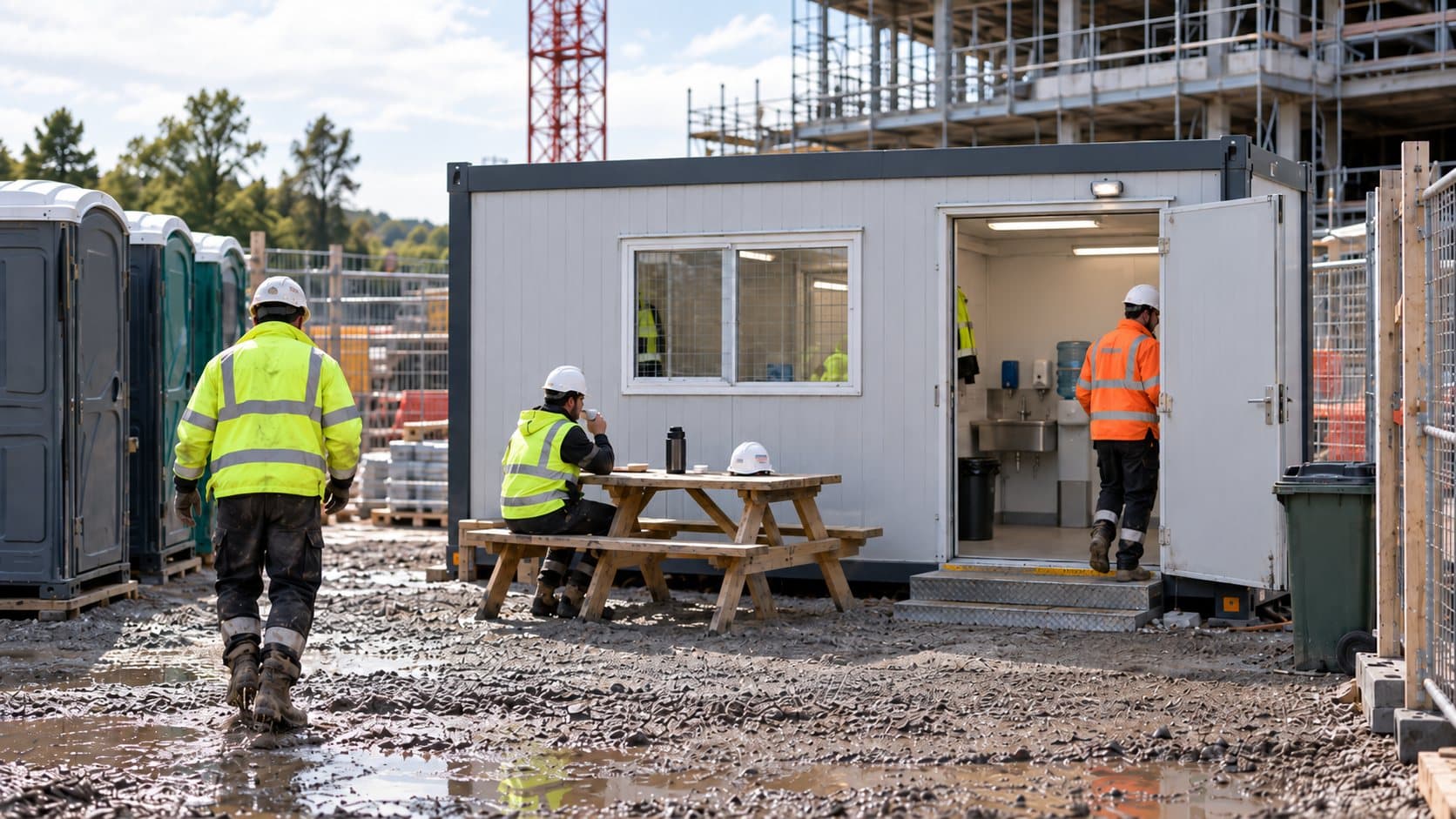
- Rest facilities — suitable rest rooms or rest areas with tables and seating, plus arrangements for preparing and eating meals and boiling water.
Who is responsible for providing welfare facilities?
Responsibility depends on the project structure, but welfare is relevant to several CDM duty holders.
The client’s role
The client must make suitable arrangements for managing the project. Those arrangements are suitable only if they ensure that the facilities required by Schedule 2 are provided for anyone carrying out construction work, and they must be maintained and reviewed throughout the project. The arrangements therefore need to be settled in time for suitable welfare facilities to be available when construction work starts. Read Regulation 4 on legislation.gov.uk: client duties in relation to managing projects: arrangements are suitable only if they ensure the facilities required by Schedule 2 are provided (opens in a new tab)
This does not mean the client has to personally install or operate the facilities. It means the client must make sure the project is organised and resourced so that the required welfare can be provided.
The Principal Contractor’s role
On a project with more than one contractor, the Principal Contractor must ensure that welfare facilities meeting Schedule 2 are provided throughout the construction phase. Read Regulation 13 on legislation.gov.uk: duties of a principal contractor, including ensuring that facilities complying with Schedule 2 are provided throughout the construction phase (opens in a new tab)
The contractor’s role on a single-contractor project
Where there is only one contractor, that contractor must ensure that the Schedule 2 welfare requirements are met for workers under its control. Read Regulation 15 on legislation.gov.uk: duties of contractors, including ensuring that the requirements of Schedule 2 are complied with so far as they affect the contractor or any worker under that contractor’s control (opens in a new tab)
When must welfare facilities be provided?
The facilities should be available when construction work starts. A project should not begin with a plan to ‘sort welfare later’ once the main site set-up is complete. HSE construction welfare guidance: HSE guidance on the standard of welfare facilities expected on construction sites (opens in a new tab)
The provision should also be maintained and adjusted throughout the project. Workforce numbers, work locations and site conditions can change, so facilities that were suitable at mobilisation may become insufficient later.
What does ‘suitable and sufficient’ mean?
CDM does not reduce welfare to a single standard site layout. ‘Suitable and sufficient’ depends on the circumstances. HSE L153 guidance: Managing health and safety in construction: practical interpretation of the CDM 2015 duties, PDF (opens in a new tab)
Factors to consider include:
- The number of workers likely to use the facilities.
- The length and nature of the project.
- Whether work is fixed at one site or moves between locations.
- How far workers have to travel to reach the facilities.
- Whether the work creates heavy contamination, dust, hazardous substances or other hygiene risks.
- Whether additional washing or shower facilities are needed because of the work.
- Whether workers need to change into special clothing.
- Whether facilities are clean, heated, ventilated, lit and maintained appropriately.
- Whether the arrangements remain adequate as workforce numbers or work areas change.
Toilets on construction sites
Suitable and sufficient sanitary conveniences must be provided or made available at readily accessible places. Read Schedule 2 on legislation.gov.uk: minimum welfare facilities required for construction sites: sanitary conveniences, washing facilities, drinking water, changing rooms and lockers, and facilities for rest (opens in a new tab)
They should be adequately ventilated and lit so far as reasonably practicable and kept clean and orderly. Separate rooms should normally be provided for men and women unless each toilet is in a separate lockable room.
For longer-duration or fixed projects, mains-connected flushing toilets are normally the strongest arrangement where they are reasonably practicable. Portable units may be appropriate where fixed facilities are not reasonably practicable, but the overall provision still needs to meet the Schedule 2 standard. HSE CIS59 guidance: Provision of welfare facilities during construction work: fixed, portable and transient-site arrangements, PDF (opens in a new tab)
Washing facilities
Suitable and sufficient washing facilities must be provided at readily accessible places. They should include a supply of clean hot and cold, or warm, water so far as reasonably practicable, together with soap or another suitable means of cleaning and towels or another suitable means of drying. Read Schedule 2 on legislation.gov.uk: minimum welfare facilities required for construction sites: sanitary conveniences, washing facilities, drinking water, changing rooms and lockers, and facilities for rest (opens in a new tab)
Showers may be required where the nature of the work or health reasons make them necessary. Washing arrangements should be appropriate to the risks workers face, including contamination from substances such as cement, lead, dust or biological material.
Drinking water
An adequate supply of wholesome drinking water must be provided or made available at readily accessible and suitable places. Read Schedule 2 on legislation.gov.uk: minimum welfare facilities required for construction sites: sanitary conveniences, washing facilities, drinking water, changing rooms and lockers, and facilities for rest (opens in a new tab)
Where the supply is not obviously drinking water, it should be conspicuously marked by an appropriate sign. Suitable cups or another means of drinking should also be provided where needed.
Changing rooms and lockers
Suitable changing rooms must be provided where workers need to wear special clothing for work and cannot reasonably be expected to change elsewhere. Read Schedule 2 on legislation.gov.uk: minimum welfare facilities required for construction sites: sanitary conveniences, washing facilities, drinking water, changing rooms and lockers, and facilities for rest (opens in a new tab)
Changing facilities should allow workers to change in privacy where necessary, include seating, and provide a way to dry special clothing. Suitable lockers or other secure storage should be available where workers need to keep clothing or personal effects.
Rest and eating facilities
Workers need suitable and sufficient rest rooms or rest areas in readily accessible locations. Read Schedule 2 on legislation.gov.uk: minimum welfare facilities required for construction sites: sanitary conveniences, washing facilities, drinking water, changing rooms and lockers, and facilities for rest (opens in a new tab)
These should have enough tables and seating with backs for the number of people likely to use them at one time. There should be suitable arrangements for preparing and eating meals, a means of boiling water, and an appropriate temperature.
Where necessary, suitable facilities must also be available for a pregnant worker or nursing mother to rest lying down.
Do welfare facilities need to be on the construction site?
Not always. Facilities can be made available rather than physically installed on the site, provided the arrangement is suitable, sufficient and readily accessible. Read Schedule 2 on legislation.gov.uk: minimum welfare facilities required for construction sites: sanitary conveniences, washing facilities, drinking water, changing rooms and lockers, and facilities for rest (opens in a new tab)
For example, on some short-duration or transient works, pre-arranged use of suitable facilities at a nearby base or private premises may be practical. The arrangement should be agreed before work starts and should genuinely meet workers’ needs throughout the job. HSE CIS59 guidance: Provision of welfare facilities during construction work: fixed, portable and transient-site arrangements, PDF (opens in a new tab)
Public toilets alone are generally a weak default where better arrangements can reasonably be provided, because they may not cover washing, rest, eating, changing or availability throughout the working day.
What about short-duration or mobile construction work?
Short duration does not remove the welfare requirement. The solution can be proportionate to the work, but workers still need suitable facilities, and CDM applies to projects of any size. HSE CIS59 guidance: Provision of welfare facilities during construction work: fixed, portable and transient-site arrangements, PDF (opens in a new tab)
For mobile or transient work, the arrangements might include portable welfare units, a suitable welfare vehicle, a pre-arranged base location or agreed access to private facilities. The key question is whether the full needs of the workers are actually met, not whether the project is small.
Do domestic projects need welfare facilities?
Yes. CDM welfare requirements can apply on domestic projects in the same way as on commercial projects.
The domestic-client rules affect how certain client duties are carried out, but they do not remove the need for contractors or Principal Contractors to ensure suitable welfare for people carrying out construction work. Read Regulation 15 on legislation.gov.uk: duties of contractors, including ensuring that the requirements of Schedule 2 are complied with so far as they affect the contractor or any worker under that contractor’s control (opens in a new tab)
Welfare requirements before construction starts
Before mobilisation, check that:
- The expected workforce size has been considered.
- The welfare location is identified and accessible.
- Toilets will be available from day one.
- Hot and cold, or warm, running water is available so far as reasonably practicable.
- Soap and suitable drying facilities are available.
- Wholesome drinking water is available.
- There is somewhere suitable to sit, rest and eat.
- Workers can make hot drinks or boil water.
- Changing and drying facilities are provided where the work requires them.
- Cleaning, servicing and waste arrangements are in place.
- The facilities are included in the construction-phase arrangements and responsibilities are clear.
Construction site welfare checklist
| Welfare area | What to check | Typical evidence |
|---|---|---|
| Toilets | Enough for the workforce; accessible; clean; lit/ventilated; privacy arrangements | Site set-up plan, servicing records, inspection checks |
| Washing | Running warm/hot-cold water where practicable; soap; drying; showers where required | Welfare inspection, servicing records, COSHH/risk information |
| Drinking water | Wholesome supply; accessible; clearly identified where necessary | Site inspection, water supply arrangements |
| Changing/storage | Suitable changing area, privacy, drying and secure storage where required | Welfare layout, inspection records |
| Rest/eating | Tables, backed seating, meal arrangements, boiling water, appropriate temperature | Welfare inspection, site set-up records |
| Ongoing suitability | Facilities remain adequate as headcount, locations and work change | Routine inspections, coordination/action logs |
Who should check welfare during the project?
Welfare should form part of normal construction-phase monitoring rather than being checked only at mobilisation.
On multi-contractor projects, the Principal Contractor should keep the arrangements under review. Contractors should also raise issues affecting their workers rather than assuming the Principal Contractor will identify every problem. Read Regulation 13 on legislation.gov.uk: duties of a principal contractor, including ensuring that facilities complying with Schedule 2 are provided throughout the construction phase (opens in a new tab)
Clients should take reasonable steps to ensure that the Principal Designer and Principal Contractor comply with their duties, so obvious or recurring welfare failures should not be ignored as a purely site-level issue. Read Regulation 4 on legislation.gov.uk: client duties in relation to managing projects: arrangements are suitable only if they ensure the facilities required by Schedule 2 are provided (opens in a new tab)
Common welfare mistakes on construction projects
Providing facilities too late
Welfare needs to be available when construction work begins, not once the site is fully established.
Providing only a portable toilet
A toilet alone does not cover washing, drinking water, rest, eating, changing or drying needs.
No hot or warm running water
Hand sanitiser or bottled water is not a substitute for the washing facilities required by Schedule 2 where running water is reasonably practicable.
Facilities too far from the work
Welfare needs to be readily accessible, including where a project covers a large or changing work area.
Failing to scale provision with the workforce
Facilities that were adequate for a small mobilisation team may become insufficient as the workforce increases.
Poor cleaning and servicing
Facilities must remain usable, hygienic and appropriately maintained throughout the project.
Ignoring welfare on short jobs
Short duration can affect the type of solution used, but it does not remove the requirement.
Treating welfare as the Principal Contractor’s problem only
Clients and individual contractors also have relevant CDM responsibilities depending on the project structure.
How does welfare link to the construction phase plan?
The construction phase plan should set out the health and safety arrangements for the construction phase, including how suitable welfare will be provided and maintained.
The level of detail should be proportionate to the project. The useful question is not whether the plan contains a heading called ‘welfare’, but whether the actual arrangements are clear enough to be implemented and kept effective.
Can poor welfare lead to enforcement action?
Yes. Welfare is a legal requirement under CDM 2015, and HSE can take enforcement action where facilities do not meet the required standard. HSE construction welfare guidance: HSE guidance on the standard of welfare facilities expected on construction sites (opens in a new tab)
Poor welfare can lead to enforcement action. Recent HSE cases and improvement notices have involved failures including no toilet facilities, no hot and cold or warm running water, and inadequate rest facilities. Welfare should therefore be treated as a basic construction-management requirement, not a cosmetic site issue. HSE enforcement case: construction company fined for repeated site failures: HSE prosecution under Regulation 13(4)(c) of CDM 2015, April 2026: no clean hot and cold or warm water in the toilet facilities, and rest facilities without sufficient tables, seating and meal arrangements (opens in a new tab)
Frequently asked questions
What welfare facilities are required on a construction site?
The minimum categories under Schedule 2 are sanitary conveniences, washing facilities, drinking water, changing facilities where required, and rest facilities.
Does every construction site need a toilet?
Suitable and sufficient sanitary conveniences must be provided or made available at readily accessible places.
Does a construction site need hot water?
Washing facilities should include clean hot and cold, or warm, running water so far as reasonably practicable.
Can workers use a nearby cafe or public toilet?
External facilities can sometimes form part of a suitable arrangement, particularly for short or transient work, but they need to be genuinely accessible and collectively meet the required welfare needs. Public toilets alone will rarely address all Schedule 2 requirements.
Who provides welfare on a multi-contractor project?
The Principal Contractor must ensure that suitable welfare facilities meeting Schedule 2 are provided throughout the construction phase, while the client must ensure suitable arrangements are in place before construction begins.
Who provides welfare on a single-contractor project?
The contractor must ensure the Schedule 2 welfare requirements are met.
Do welfare requirements apply to small or domestic projects?
Yes. The scale and form of the facilities can be proportionate, but small size or domestic status does not remove the requirement.
Can hand sanitiser replace washing facilities?
No. Sanitiser may supplement hygiene arrangements, but it does not replace the Schedule 2 requirement for suitable washing facilities.
Need CDM training?
Learn the core requirements, then follow a pathway based on your responsibilities.
Explore CDM training