Topic: Health & Safety
COSHH Assessment: How to Carry One Out
A COSHH assessment looks at work that could expose people to substances hazardous to health: the substances involved or produced, who could be exposed and how, and whether exposure is prevented or adequately controlled. This guide explains how to carry one out, step by step.
- Published
- 14 min read
What is a COSHH assessment?
A COSHH assessment is an employer’s assessment of the risks to health from work that could expose people to substances hazardous to health, and of what needs to be done to protect them. It is required by the Control of Substances Hazardous to Health Regulations 2002 (COSHH), as amended.
The assessment is about the work, not just the substance. It looks at the activity, the substances it involves or produces, who could be exposed and how, and whether that exposure is prevented or adequately controlled. It then records what else needs to happen.
When is a COSHH assessment required?
An employer must not carry out work that is liable to expose employees to a substance hazardous to health unless it has made a suitable and sufficient assessment of the risk and put in place the steps the assessment identifies. The assessment comes before the work. COSHH Regulations 2002, Regulation 6: assessment of the risk to health: a suitable and sufficient assessment before the work, review, and recording of the significant findings where the employer has five or more employees (opens in a new tab)
“Substance hazardous to health” is defined widely. It includes substances and mixtures with health hazards, any substance with a Workplace Exposure Limit, biological agents, dust of any kind above certain concentrations, and any other substance that creates a risk to health because of its properties and the way it is used or present at work. COSHH Regulations 2002, Regulation 2: interpretation: the definition of a substance hazardous to health, including dusts and any other substance that creates a risk to health (opens in a new tab)
- It is not limited to chemicals you buy: dust, fume, vapour, mist and gas produced by the work can be hazardous to health.
- It is not limited to products with hazard pictograms on the label.
- It does not mean a separate form for every product: one assessment can cover the substances used or produced in an activity.
Lead and asbestos are covered by their own regulations, the Control of Lead at Work Regulations 2002 and the Control of Asbestos Regulations 2012, which apply instead of COSHH’s assessment and control duties to the extent they apply.
How to carry out a COSHH assessment
HSE describes the assessment as identifying the hazards, assessing and controlling the risks, giving people information and training, recording the findings and reviewing them. In practice, it helps to work through ten steps. HSE: COSHH risk assessment: HSE’s steps for a COSHH risk assessment: identify the hazards, assess and control the risks, inform and train, record and review (opens in a new tab)
Understand the exposure
- Step 1: Understand the work
The activity, how it is really done, and non-routine work.
- Step 2: Identify the substances
Supplied products and anything the work produces.
- Step 3: Identify who could be exposed
Workers, others nearby and anyone at particular risk.
- Step 4: Work out how exposure happens
Routes, frequency, duration and quantity.
Control it
- Step 5: Prevent or control exposure
Prevention first; PPE only where still needed.
- Step 6: Check adequacy
WELs where they apply, and the evidence.
- Step 7: Consider additional requirements
Monitoring, surveillance, maintenance, training.
Decide and follow through
- Step 8: Record actions and conclude
Is exposure adequately controlled?
- Step 9: Record and communicate
Write it down and tell the people affected.
- Step 10: Review
Regularly, and when things change.
The assessment should be carried out by someone competent to do it, with input from the people who do the work.
Step 1: Understand the work
Start with the activity, task or process, not a list of products. Describe what is done, where, with what equipment, and how the substances are used or produced. Watch the work if you can and talk to the people who do it: the way a job is actually done often differs from the written procedure.
Include non-routine work. Cleaning, maintenance, breakdowns, decanting and spill clean-up can create higher exposures than the normal task, and the assessment must consider them.
Step 2: Identify substances hazardous to health
List every substance hazardous to health involved in the activity. Look at two groups:
- Supplied products: chemicals and products bought in and used in the work, such as adhesives, paints, solvents, cleaning agents, fuels and resins.
- Substances produced by the work: for example wood dust from sanding, silica dust from cutting stone, concrete or tiles, welding fume, solvent vapour, oil mist and exhaust gases.
Product labels and Safety Data Sheets are important sources of hazard information for supplied products. Other sources include EH40 for Workplace Exposure Limits, HSE guidance for the industry or task, and trade association guidance. For substances the work produces there is often no data sheet, so use HSE and industry guidance. Record the health hazards that matter for this work and where the information came from, rather than copying the data sheet.
Remember that the hazard can depend on the form the substance takes in the work. A solid block is not a dust hazard until it is cut.
Step 3: Identify who could be exposed
- Employees carrying out the activity.
- Other employees nearby or working in the same area.
- Contractors, including cleaning and maintenance staff.
- Visitors, members of the public and others who could be affected.
- People who may be at particular risk, such as new or expectant mothers, young people, and people with asthma, skin conditions or existing sensitisation.
Step 4: Work out how exposure happens
For each substance, think about how it could get into or onto the body, and how much exposure there could be.
| Consider | Examples |
|---|---|
| Routes of exposure | Breathing in dust, fume, vapour, mist or gas; skin or eye contact; swallowing; injection through the skin. |
| Frequency and duration | How often the task is done and for how long, for example two hours a day, three days a week. |
| Quantity | How much is used, handled or produced, and how it is applied or generated. |
| Circumstances | Enclosed or open areas, heat, spraying or high-energy processes, and how close people work to the source. |
| Non-routine work | Cleaning, maintenance, breakdowns, spills and other higher-exposure activities. |
| Combined exposure | Whether substances used together, or one after another, add to or interact with each other. |
Step 5: Prevent or adequately control exposure
The legal duty is to prevent exposure or, where that is not reasonably practicable, to adequately control it. Substitution comes first. Work through the measures broadly in this order, and record those that apply: COSHH Regulations 2002, Regulation 7: prevention or control of exposure: prevent exposure or, where that is not reasonably practicable, adequately control it (opens in a new tab)
- Elimination or substitution: remove the substance or process, or use something less hazardous, or a safer form, such as a paste instead of a powder, or ready-cut materials.
- Process design, enclosure and containment: closed systems and processes designed to reduce emission and spread.
- Engineering controls: local exhaust ventilation (LEV), on-tool extraction, water suppression and general ventilation.
- Safe systems of work and organisation: limiting who is exposed and for how long, reducing quantities, and supervision.
- Storage, handling, transport and waste: closed containers, safe storage and disposal.
- Cleaning, housekeeping, hygiene and welfare: cleaning methods that do not raise dust, washing facilities and no eating or drinking in the work area.
- PPE and RPE, where still required: only where adequate control cannot be achieved by other means, and in addition to them.
Step 6: Check WELs and evidence of adequate control
Next, judge whether the measures in place actually achieve adequate control for this activity. Control is only adequate where the principles of good practice are applied, any relevant Workplace Exposure Limit (WEL) is not exceeded, and exposure to carcinogens, mutagens and substances that can cause occupational asthma is reduced as low as is reasonably practicable. COSHH Regulations 2002, Regulation 7: prevention or control of exposure: prevent exposure or, where that is not reasonably practicable, adequately control it (opens in a new tab)
- Not every substance has a WEL. Only around 500 substances have one, listed in HSE’s EH40. The absence of a WEL does not mean a substance is safe: exposure must still be prevented or adequately controlled.
- Where a WEL applies, it must not be exceeded.
- Evidence that control is adequate can come from observing the controls in use, checks on control performance such as an LEV test, exposure monitoring results and specialist advice.
Exposure monitoring is not needed for every assessment. It is used where the assessment shows it is needed to show or maintain adequate control, or to protect health.
Step 7: Consider the additional COSHH requirements
The assessment should also decide whether any of the following are needed for this activity. Apart from information and training, they do not apply to every assessment.
| Requirement | When it applies |
|---|---|
| Exposure monitoring | Where the assessment shows it is needed to maintain adequate control or protect health, for example to show a WEL is not exceeded. Some processes have set monitoring frequencies. |
| Health surveillance | Where it is appropriate: broadly, where an identifiable disease or adverse health effect is linked to the exposure, it can be detected, and it is likely to occur in the conditions of the work. |
| Maintenance, examination and testing of controls | Wherever control measures are used. LEV needs a thorough examination and test at least every 14 months, and more often for certain processes (opens in a new tab). Non-disposable RPE needs examination and, where appropriate, testing at suitable intervals. |
| PPE and RPE arrangements | Where PPE or RPE is still required: selection, face-fit testing for tight-fitting RPE, issue, storage, maintenance and replacement. |
| Accident, incident and emergency arrangements | Where a foreseeable accident, incident or emergency could cause significant exposure, such as a spill or release: procedures, equipment and first-aid. |
| Information, instruction and training | Always, for employees who could be exposed: the hazards, the significant findings of the assessment, the controls and how to use them, and relevant results. |
Step 8: Record further actions and reach a conclusion
Record any further action needed, with an owner and a target date. Then reach a clear conclusion. It should be one of three outcomes:
| Conclusion | What it means |
|---|---|
| Adequately controlled | Exposure is adequately controlled. The work may proceed using the controls recorded. |
| Adequately controlled, with improvements outstanding | Exposure is adequately controlled now and the work may proceed. The outstanding actions are improvements or other actions that do not affect the current adequacy of control. |
| Not adequately controlled | The work must not proceed until the actions needed to prevent or adequately control exposure are complete. |
Avoid a middle ground where work carries on while adequacy is uncertain. If you cannot yet say exposure is adequately controlled, find out — for example through monitoring or specialist advice — before relying on the controls.
Step 9: Record and communicate the findings
Where the employer has five or more employees, the significant findings of the assessment, and the steps taken to prevent or control exposure, must be recorded as soon as practicable. Smaller employers may still find a written record the clearest way to show what was decided and to brief people. COSHH Regulations 2002, Regulation 6: assessment of the risk to health: a suitable and sufficient assessment before the work, review, and recording of the significant findings where the employer has five or more employees (opens in a new tab)
Tell the people affected. Employees who could be exposed must be given suitable information, instruction and training, including the significant findings of the assessment, the controls and how to use them, and what to do in an emergency. Contractors working with or near the substances need to know the risks and controls too.
Step 10: Review the assessment
Review the assessment regularly, and straight away if there is reason to suspect it is no longer valid, if there has been a significant change in the work, or if monitoring results show a review is needed. There is no fixed legal interval, such as once a year: choose one that suits the risk. COSHH Regulations 2002, Regulation 6: assessment of the risk to health: a suitable and sufficient assessment before the work, review, and recording of the significant findings where the employer has five or more employees (opens in a new tab)
- A change to the substances or products used
- A change to the activity, process or equipment
- More use, or longer or more frequent exposure
- Changes to controls, or signs they are not working
- Changes to the people involved
- New information, such as a revised SDS or WEL
- Monitoring or health surveillance results
- An accident, incident, near miss or ill health
COSHH assessment vs Safety Data Sheet
A Safety Data Sheet is a source of information. It is not a COSHH assessment, and copying it into a form is not enough. HSE: Chemical safety data sheets: HSE guidance on safety data sheets, which are not a risk assessment (opens in a new tab)
| Safety Data Sheet | COSHH assessment | |
|---|---|---|
| Written by | The supplier of the product | The employer, or someone competent acting for it |
| About | The product: its hazards, properties and general advice | The work: how the substance is used or produced in your workplace |
| Covers | One supplied product | Every substance hazardous to health in the activity, including any the work produces |
| Answers | What are the hazards, and what precautions are generally advised? | Who could be exposed here, how, and is exposure prevented or adequately controlled? |
COSHH assessment vs general risk assessment
A general risk assessment under the Management of Health and Safety at Work Regulations 1999 covers all the significant risks of a work activity. A COSHH assessment focuses on the risks to health from substances hazardous to health, and on the specific COSHH duties: prevention or adequate control, WELs, maintenance of controls, monitoring, health surveillance and information and training.
They overlap, and neither automatically replaces the other. A task risk assessment or RAMS can reference the relevant COSHH assessment rather than repeating it, and the COSHH assessment does not cover other hazards of the task, such as work at height or manual handling.
Do you need a risk matrix?
No. COSHH does not require a numerical risk matrix or score. The question the law asks is whether exposure is prevented or adequately controlled, and the assessment should answer it with reasons and evidence. If your organisation uses a rating method, it can help prioritise actions, but a low score does not show that exposure is adequately controlled.
Free COSHH Assessment Template
Sources and further guidance
- Control of Substances Hazardous to Health Regulations 2002 (opens in a new tab) (legislation.gov.uk), particularly regulations 6 (opens in a new tab), 7 (opens in a new tab), 9 (opens in a new tab), 10 (opens in a new tab), 11 (opens in a new tab), 12 (opens in a new tab) and 13 (opens in a new tab)
- HSE: Control of Substances Hazardous to Health (COSHH) (opens in a new tab)
- HSE: How to carry out a COSHH risk assessment (opens in a new tab)
- HSE: COSHH frequently asked questions (opens in a new tab)
- HSE: Chemical safety data sheets (opens in a new tab)
- HSE: Workplace exposure limits (opens in a new tab) and EH40/2005 (opens in a new tab)
- HSE: Monitoring exposure (opens in a new tab) and health surveillance (opens in a new tab)
- HSE: Emergencies (opens in a new tab) and training for employees (opens in a new tab)
- HSE: LEV frequently asked questions (opens in a new tab)
- HSE HSG97: A step by step guide to COSHH assessment (opens in a new tab) and L5: COSHH Approved Code of Practice and guidance (opens in a new tab)
- HSE: COSHH essentials (opens in a new tab)
Frequently asked questions
Is there an official COSHH assessment form?
No. The law does not prescribe a form, and HSE says you can use whatever works for you, provided the assessment is suitable and sufficient. A template helps structure the record but does not by itself show compliance.
Is a Safety Data Sheet a COSHH assessment?
No. A Safety Data Sheet is the supplier’s information about a product. It is an important source for the assessment but is not specific to your workplace, and copying it is not enough.
Who should complete a COSHH assessment?
The duty sits with the employer. Someone competent to assess the work should carry it out — a manager, supervisor, health and safety specialist or an adviser acting for the employer — with input from the people who do the work. No external body has to approve it.
Does every chemical need a COSHH assessment?
Not as a separate form for each product. The duty is to assess work that is liable to expose people to substances hazardous to health, and one assessment can cover the substances in an activity. Check the definition carefully: it includes substances the work produces and some without hazard pictograms.
Do process-generated dusts and fumes need assessing?
Yes, where they are hazardous to health. Dust, fume, vapour, mist and gas produced by work, such as silica dust from cutting or welding fume, are covered by COSHH even though no one bought them.
How often should a COSHH assessment be reviewed?
Regularly, and straight away if there is reason to suspect it is no longer valid, if the work changes significantly, or if monitoring results show it is needed. There is no fixed legal interval such as once a year.
Does every substance have a Workplace Exposure Limit?
No. Only around 500 substances have a WEL. Where there is no WEL, exposure must still be prevented or adequately controlled; the absence of a limit does not mean a substance is safe.
Does every COSHH assessment require health surveillance?
No. Health surveillance is needed where it is appropriate: broadly, where an identifiable disease or health effect is linked to the exposure, it can be detected, and it is likely in the conditions of the work.
Does every COSHH assessment require exposure monitoring?
No. Monitoring is needed where the assessment shows it is required to maintain adequate control or protect health, for example to show that a WEL is not exceeded.
Can I use a generic COSHH assessment?
Only as a starting point. Generic or supplier assessments and COSHH essentials sheets can help, but the assessment must reflect the work as it is actually done in your workplace.
Do I need a numerical risk matrix?
No. COSHH does not require one. The assessment should say whether exposure is prevented or adequately controlled, and why.
What records are required if the employer has five or more employees?
The significant findings of the assessment, and the steps taken to prevent or control exposure, recorded as soon as practicable after the assessment.
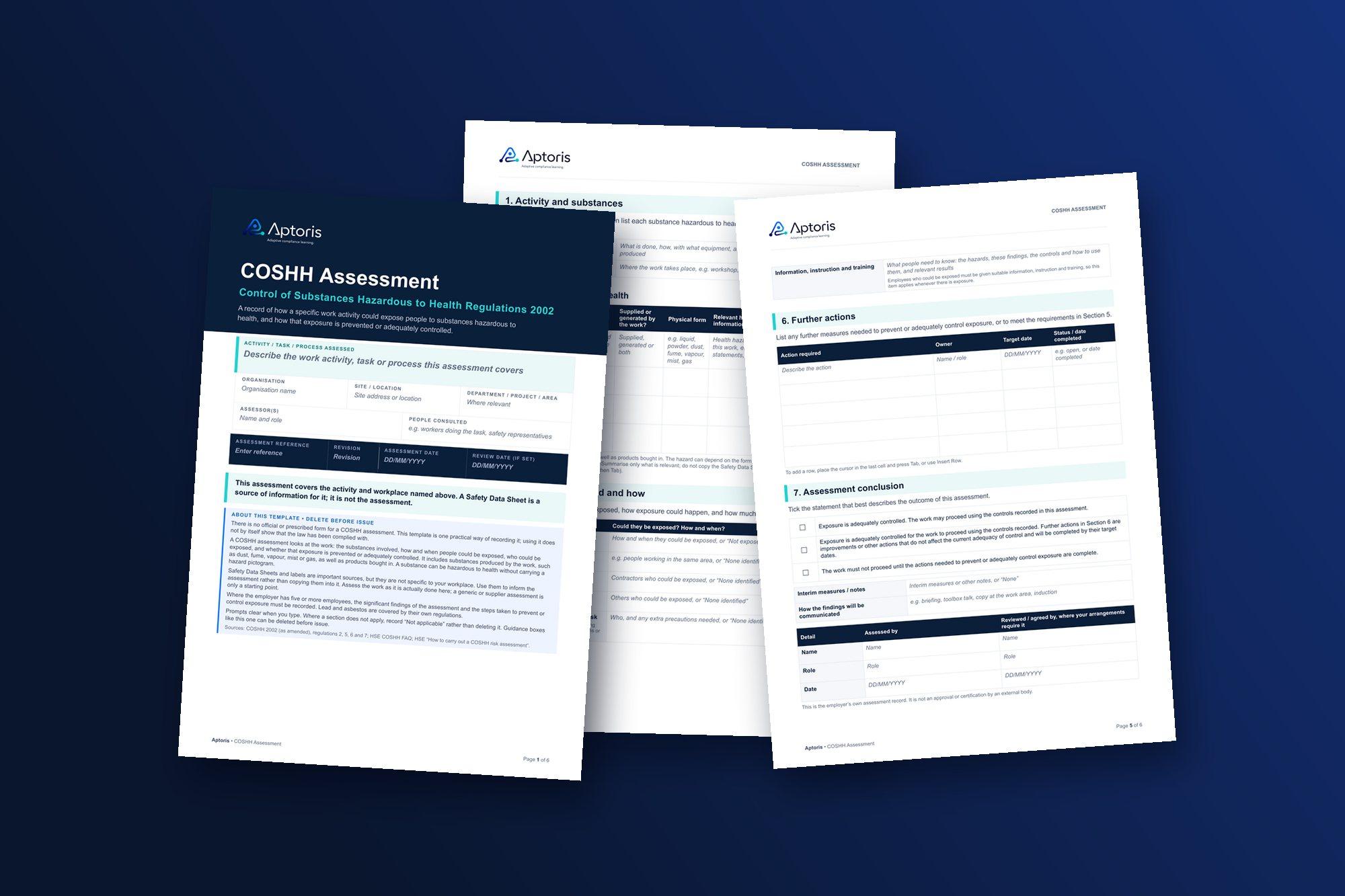
Free COSHH Assessment Template
An editable Word template that follows these steps, from substances and exposure to a clear conclusion and review.
Get the template