Guide
How to carry out a COSHH assessment
A step-by-step guide to assessing exposure, controls, WELs, monitoring, health surveillance and review.

Free Word template
A practical, editable Word template for recording a workplace-specific COSHH assessment — covering hazardous substances, exposure, prevention and control measures, further actions and review.
Editable .docx, 6 pages, No sign-up required
How to carry out a COSHH assessment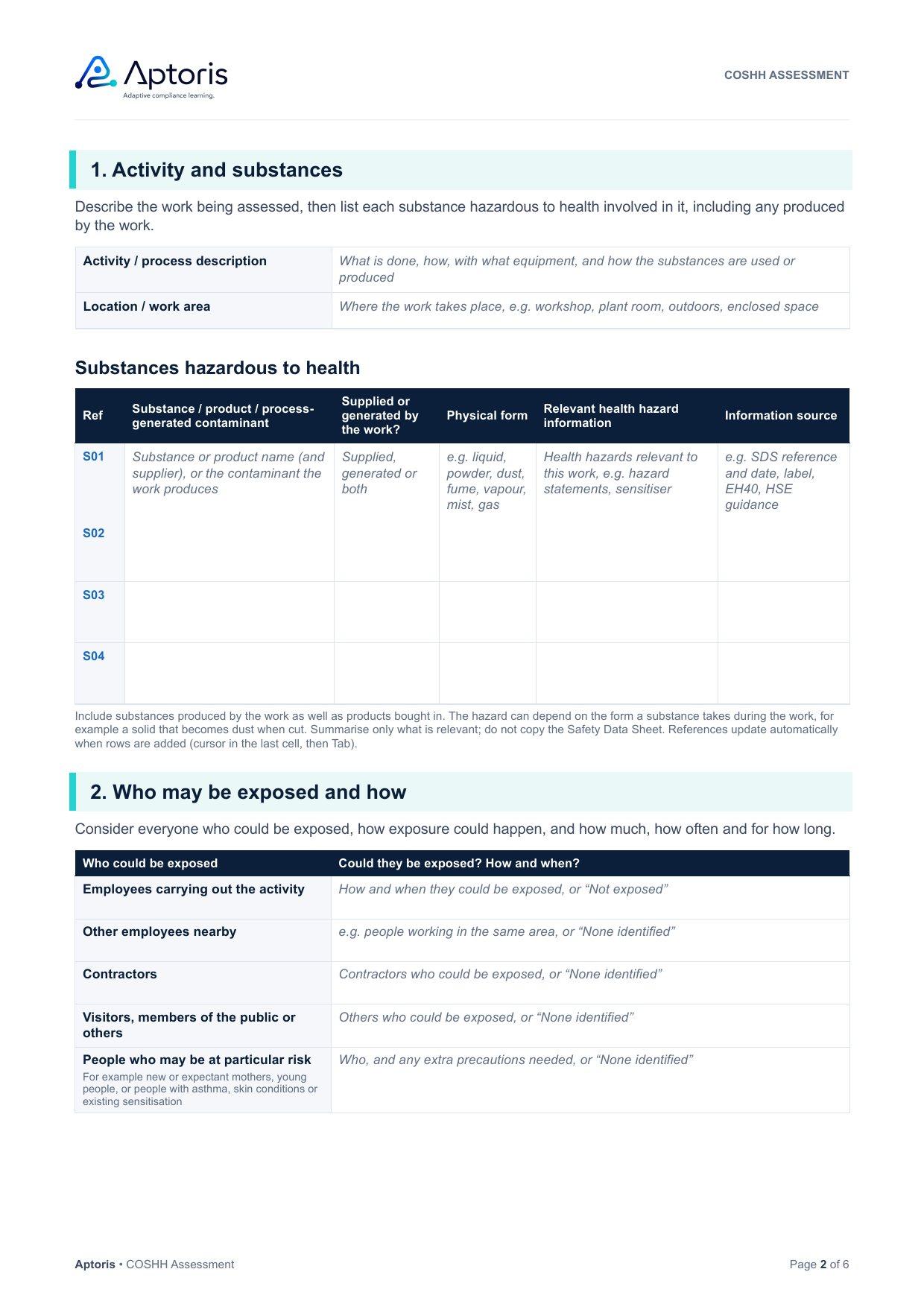
A Safety Data Sheet tells you about a product: its hazards, exposure limits, handling advice and emergency measures. It is written by the supplier and is not specific to your workplace.
A COSHH assessment looks at how the substance is actually used or produced in your work, who could be exposed, and whether that exposure is prevented or adequately controlled. Copying the data sheet into a form is not enough.
HSE: Chemical safety data sheets (opens in a new tab)Use the SDS to inform the assessment
From the activity and its substances to a clear conclusion on whether exposure is adequately controlled.
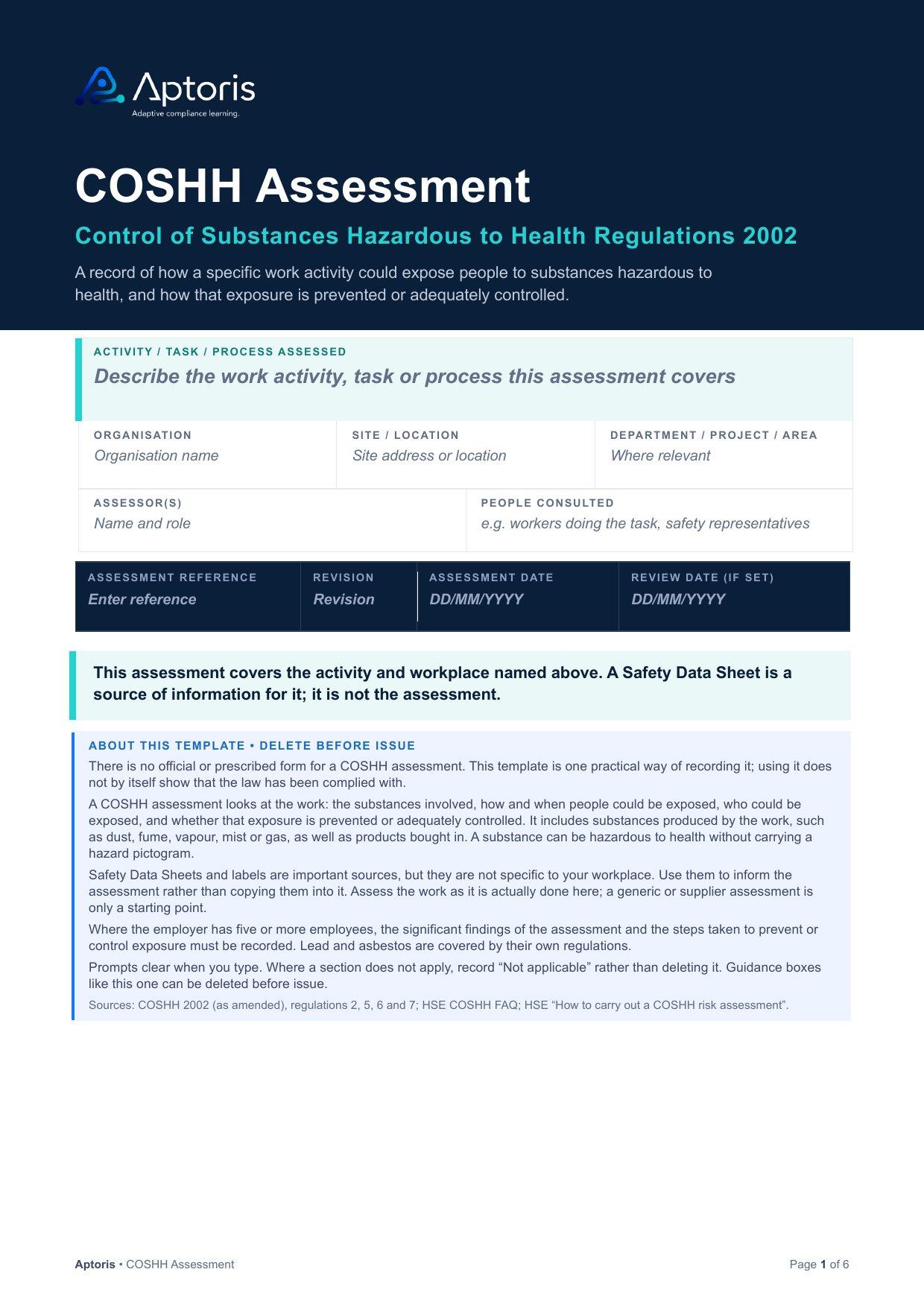
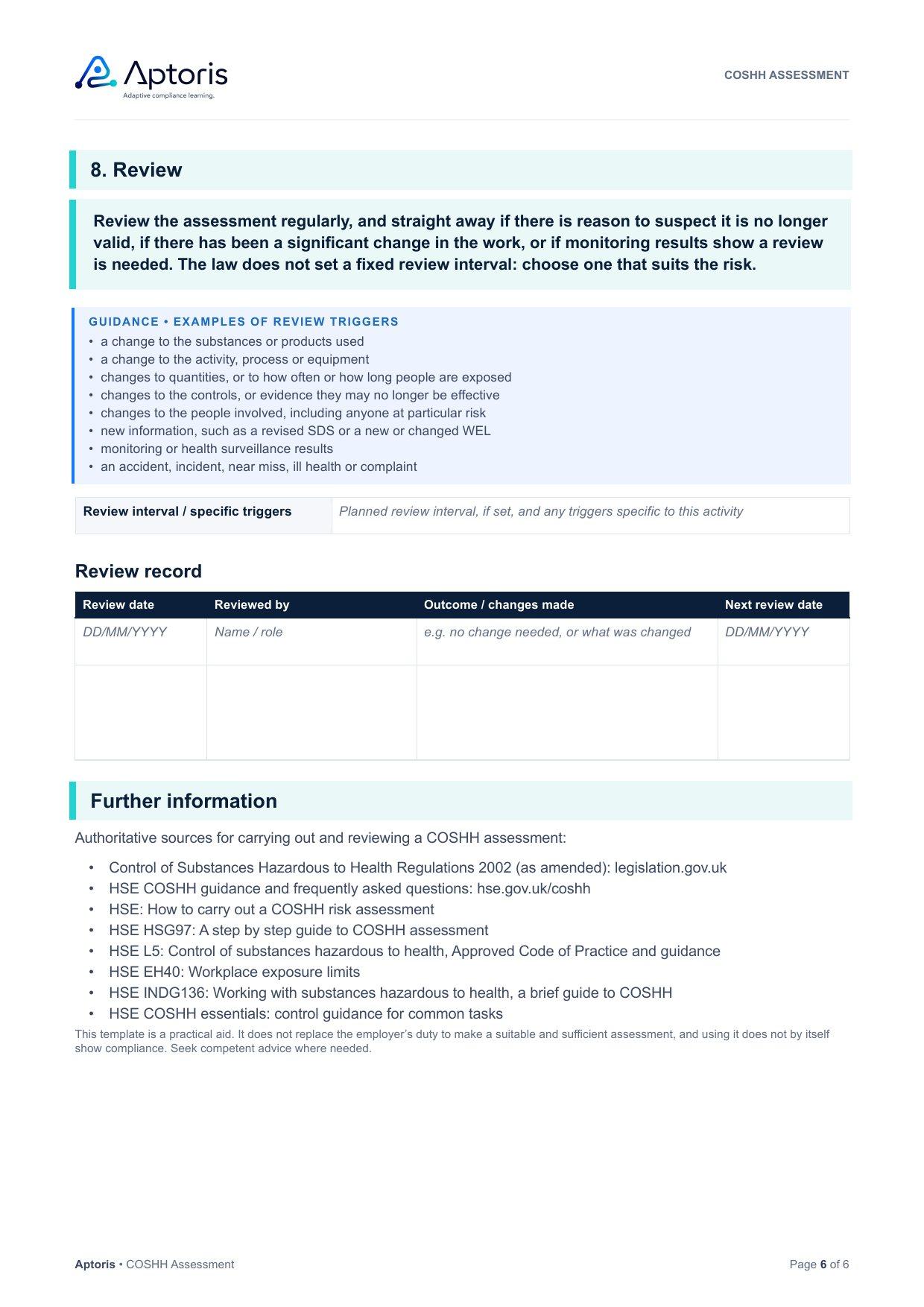
These are real pages from the Word template. Short prompts explain each field and clear when you type. The guidance box on the cover can be deleted before issue.
Section 1 · Activity and substances
Activity and substances
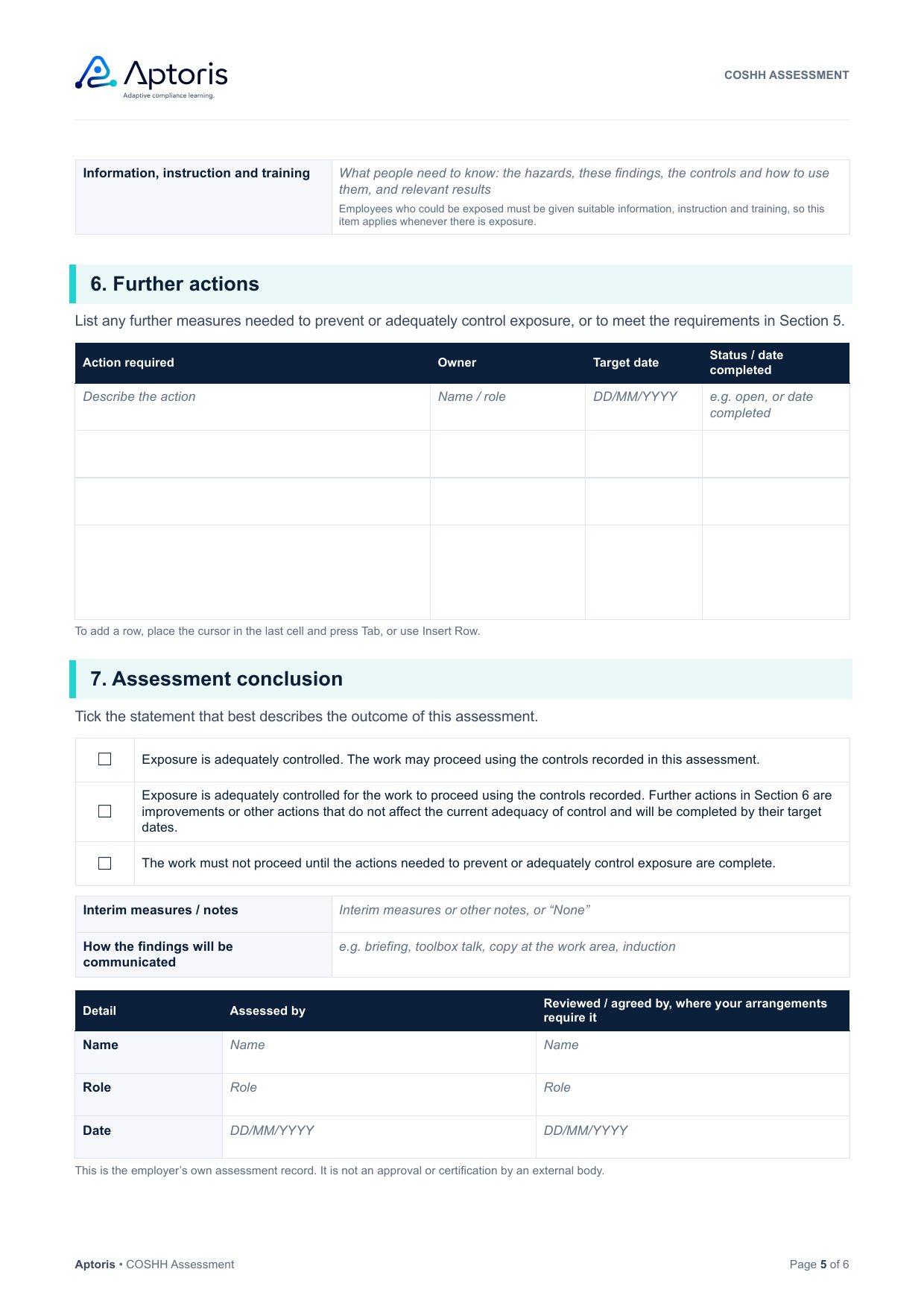
Sections 6 and 7 · Actions and conclusion
Further actions and conclusion
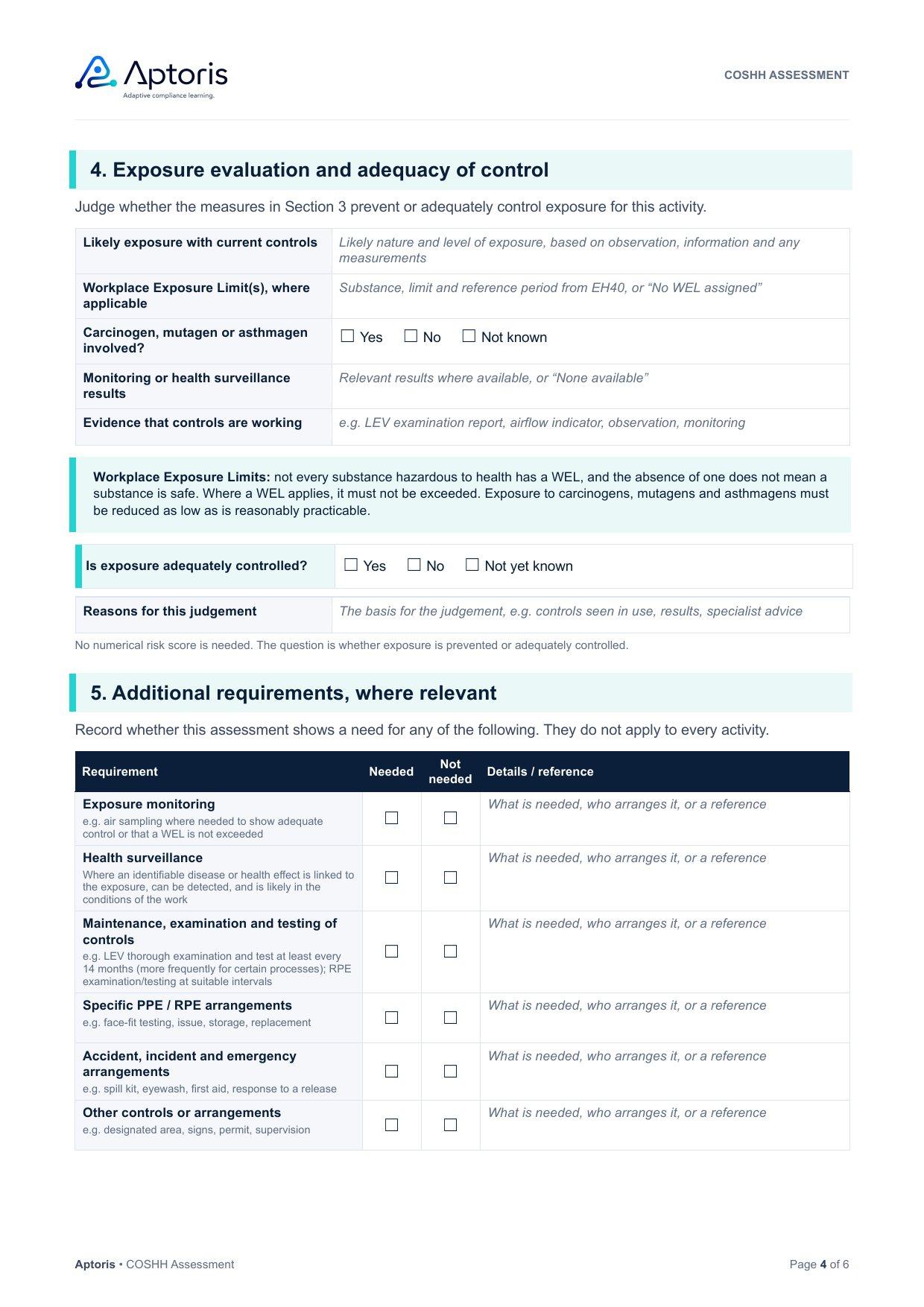
Swipe to see more pages.
Eight numbered sections, after a cover page for the assessment details.
A COSHH assessment is about the work: the substances hazardous to health involved in an activity, who could be exposed and how, and whether that exposure is prevented or adequately controlled.
The activity, and every substance hazardous to health it involves or produces.
Who could be exposed, by which routes, how often, for how long and in what quantities.
What prevents exposure, or controls it, from substitution and engineering controls through to PPE.
Whether exposure is adequately controlled, judged against the evidence and any relevant limit.
The template does not use a numerical risk score. The question it asks is the one the law asks: is exposure prevented or adequately controlled?
Chemicals and products bought in and used in the work, such as adhesives, cleaning agents, paints, solvents and fuels.
Substances the work itself produces, such as dust from cutting or sanding, welding fume, solvent vapour, mists and gases.
A substance can be hazardous to health without carrying a hazard pictogram. Lead and asbestos are covered by their own regulations.
Prompts and tables for the information a workplace-specific assessment needs, kept short enough to complete and use.
The activity or process, where it happens and how the substances are used or produced.
Each substance, its form, the health hazards relevant to this work and where the information came from.
Who could be exposed, the routes, frequency and duration, quantities, non-routine work and combined exposure.
Measures in place, from prevention and substitution to ventilation, safe systems, hygiene and, where still required, PPE.
Likely exposure, any relevant Workplace Exposure Limit, evidence that controls work, and the judgement with reasons.
Monitoring, health surveillance, maintenance of controls, RPE and emergency arrangements, where relevant.
Further actions with owners and dates, a clear conclusion, and how the findings are communicated.
When the assessment will be reviewed, the triggers for this activity, and a record of each review.
Section 7 of the template
The assessment ends with one of three outcomes. Work proceeds only where exposure is adequately controlled.
The three conclusion outcomes
Exposure is adequately controlled. The work may proceed using the controls recorded in the assessment.
Exposure is adequately controlled now and the work may proceed. Outstanding actions are improvements that do not affect the current adequacy of control.
The work must not proceed until the actions needed to prevent or adequately control exposure are complete.
Each outcome is a tick box, followed by space for notes and how the findings will be communicated.
The duty to assess sits with the employer. The assessment can be completed by anyone competent to do it, inside the organisation or advising it.
Record the assessment for work your employees carry out.
Assess activities in your area and track the actions that follow.
Bring knowledge of how the work is really done, and brief the team.
Give assessments across the organisation a consistent structure.
Complete or review assessments on behalf of an employer.
Use the prompts to cover what a workplace-specific assessment needs.
The template has space to record who was consulted. Workers and their representatives often know best how exposure happens in practice. No external consultant has to complete or sign off the assessment.
Set out the work this assessment covers and list each substance involved, including any the work produces.
Record who could be exposed, how, how often and for how long, including non-routine work such as cleaning.
Record the measures in place and decide whether exposure is prevented or adequately controlled.
Record further actions and the conclusion, tell the people affected, and review when things change.
Review the assessment regularly, and straight away if there is reason to suspect it is no longer valid, if there has been a significant change in the work, or if monitoring results show a review is needed. The law does not set a fixed review interval, such as every year: choose one that suits the risk.
Yes. It is free to download, with no sign-up and no email address needed. Select Download free Word template and the file downloads straight away.
A Microsoft Word document (.docx) of 6 A4 pages, with no macros. Each prompt is a Word content control: click it and type to replace it. Tables expand as you add rows, substance references (S01, S02 and so on) update automatically, and tick boxes and date pickers work. Nothing is locked or password-protected.
No. There is no prescribed form; HSE says you can use whatever works for you, as long as the assessment is suitable and sufficient (HSE COSHH FAQ (opens in a new tab)). Where the employer has five or more employees, the significant findings and the steps taken to prevent or control exposure must be recorded.
No. A Safety Data Sheet is an important source of information about a product, but it is not specific to your workplace and does not replace the assessment (HSE (opens in a new tab)). Use it to inform the assessment rather than copying it.
Yes. Section 1 asks whether each substance is supplied, generated by the work or both, and records its physical form, so it covers dust, fume, vapour, mist and gas produced by the work as well as products bought in.
No. COSHH does not require a numerical risk matrix. The template asks whether exposure is prevented or adequately controlled, with the reasons and evidence for that judgement.
Not necessarily. The assessment is of the work: one assessment can cover several substances used or produced in the same activity, which is why the substances table has a row for each. What matters is that it is specific to the activity and workplace. The guide explains when an assessment is needed.
Regularly, and straight away if there is reason to suspect it is no longer valid, if the work changes significantly, or if monitoring results show it is needed. There is no fixed legal interval such as once a year; set one that suits the risk.
The employer is responsible for the assessment. Someone competent to assess the work should complete it — often a manager, supervisor or health and safety specialist, or an adviser acting for the employer — with input from the people who do the work.
Guidance and templates for the work around a COSHH assessment.
A step-by-step guide to assessing exposure, controls, WELs, monitoring, health surveillance and review.
A Word template combining a task risk assessment and method statement, which can reference COSHH assessments.
A Word template for a task-specific, step-by-step safe sequence of work.
Download the editable Word template and complete it for the actual activity, substances and workplace.
Editable .docx, 6 pages, No sign-up required