
Topic: Health & Safety
Method Statements and RAMS explained
Risk assessments identify what could cause harm and the controls needed. Method Statements explain how work will be carried out safely. RAMS commonly bring the two together. This guide explains the difference, what each document should contain and how they are used in construction.
- Published
- 12 min read
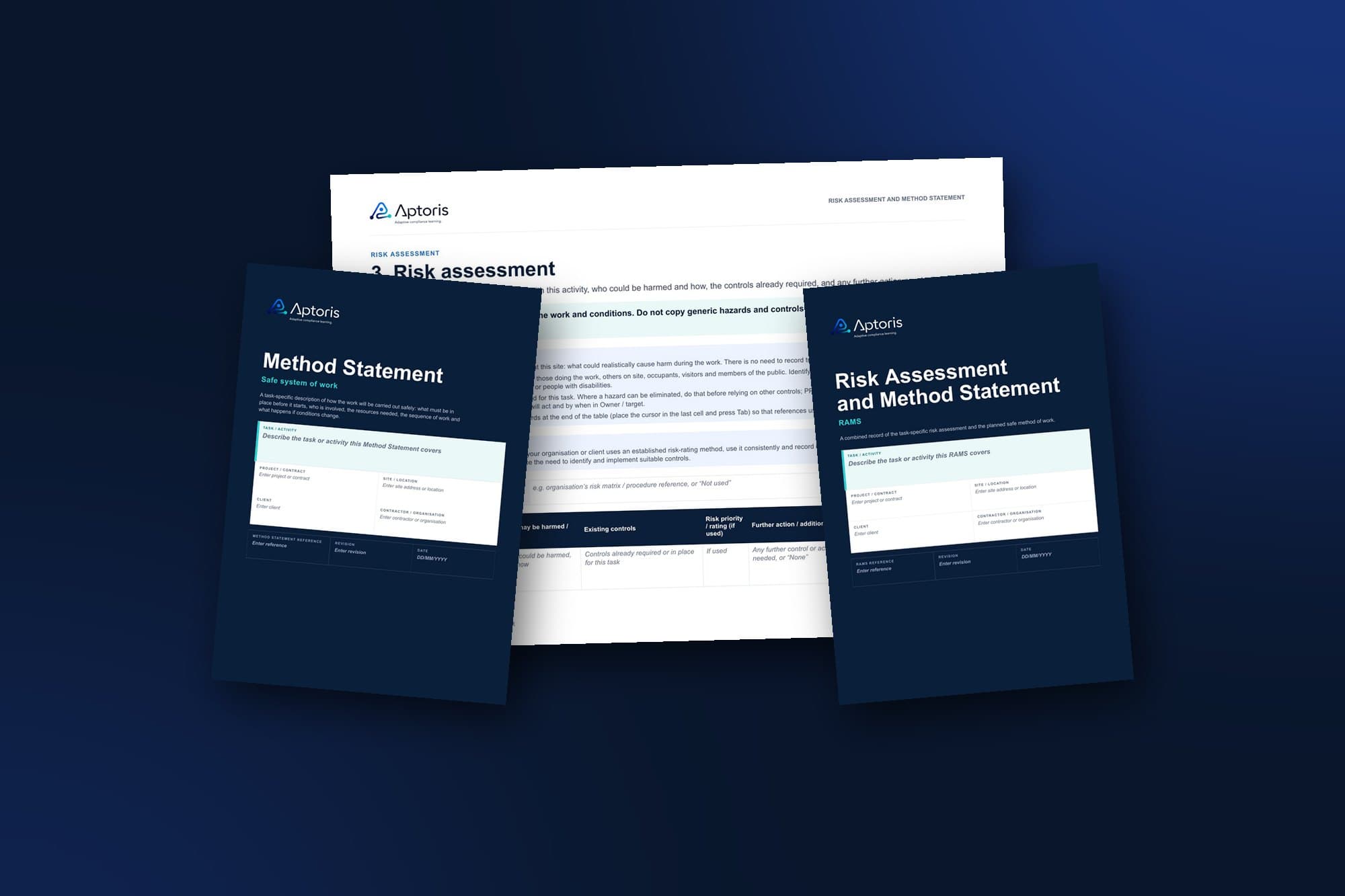
What is the difference between a Risk Assessment, Method Statement and RAMS?
Three documents, three questions
Risk Assessment
Hazards + people affected + controls
What could cause harm, who could be harmed and what controls are needed?
The Risk Assessment identifies the significant hazards associated with the work and the measures needed to eliminate or control the risk.
Method Statement
Sequence + resources + checks
How will the work actually be carried out safely?
The Method Statement describes the planned work in a logical sequence, including the relevant controls, checks, resources and responsibilities.
RAMS
Assessment + safe method, used together
How do the assessment and safe method work together?
RAMS commonly combine the Risk Assessment and Method Statement so the hazards and controls can be linked directly to the way the task will be performed.
The terms are related but not interchangeable. A Method Statement does not replace the risk assessment, and calling a document RAMS does not change what the law requires.
What does RAMS stand for?
RAMS stands for Risk Assessments and Method Statements.
It is a widely used industry term, most often for one combined document or pack covering a particular task. Organisations structure RAMS differently: some issue a single document, others a risk assessment and a method statement as a set. The label itself does not create a separate legal duty.
What is a Method Statement?
A Method Statement describes how a defined activity will be carried out safely, usually as a logical sequence of steps. HSE’s construction guidance describes it as drawing together the hazards of a particular job and the ways they will be controlled, from the conclusions of the risk assessment, and as a way of communicating the safe system of work to the people doing it. HSE HSG150, paras 592–597: Health and safety in construction: method statements are not required by law but are an effective, practical way to draw together the controls from the risk assessment and communicate the safe system of work (opens in a new tab)
Depending on the work, it may set out the resources and competence needed, access arrangements, permits and isolations, the stages of the work with their checks and hold points, emergency arrangements, interfaces with other work and what happens if conditions change. It should be specific to the task and the site.
Are Method Statements required by law?
There is no general legal requirement to produce a document specifically called a Method Statement for every construction activity. HSE’s construction guidance says plainly that method statements are not required by law, but that they have proved an effective and practical management tool. HSE HSG150, paras 592–597: Health and safety in construction: method statements are not required by law but are an effective, practical way to draw together the controls from the risk assessment and communicate the safe system of work (opens in a new tab)
That does not make planning optional. Employers must assess the risks of their work, and on construction projects contractors must plan, manage and monitor the work under their control so that, so far as is reasonably practicable, it is carried out without risks to health and safety. CDM 2015, Regulation 15: duties of contractors: planning, managing and monitoring the construction work under their control, and complying with directions from the principal designer or principal contractor and with the relevant parts of the construction phase plan (opens in a new tab)
For higher-risk, complex, unusual or non-routine work, a Method Statement is often the most practical way to set out the safe system of work and communicate it to the people carrying it out.
Some activities have their own specific legal planning requirements. For example, under LOLER 1998 (opens in a new tab), lifting operations involving lifting equipment must be properly planned by a competent person, appropriately supervised and carried out in a safe manner, while under the Control of Asbestos Regulations 2012 (opens in a new tab) an employer must not undertake work with asbestos without a suitable written plan of work. Those are specific legal requirements, but neither creates a general duty for every construction activity to have a document titled “Method Statement”.
A client, Principal Contractor or organisation may also require Method Statements through the project’s own arrangements. That is a genuine project requirement, but it is different from a general statutory duty to produce a document with that title.
Are RAMS legally required?
UK health and safety law does not prescribe a document specifically called RAMS, and neither does CDM 2015.
What the law does require is a suitable and sufficient assessment of the risks. Regulation 3 of the Management of Health and Safety at Work Regulations 1999 places that duty on employers and relevant self-employed people, and employers with five or more employees must record the significant findings. Our guide to risk assessments and CDM 2015 explains that duty in more detail. Management Regulations, Regulation 3: risk assessment: employers and relevant self-employed people must make a suitable and sufficient assessment of the risks, review it where there is reason to suspect it is no longer valid or there has been a significant change, and employers with five or more employees must record the significant findings (opens in a new tab)
A Method Statement is one practical way of showing how the controls identified by that assessment will be put into practice. Many organisations and projects combine the two as RAMS, and clients or Principal Contractors often ask for RAMS before work starts.
So a project may require RAMS, and that requirement should be met. But it comes from the project or contract arrangements, not from legislation creating a universal ‘RAMS document’ duty. Nor does a Method Statement on its own satisfy the risk assessment duty: the assessment still has to be made.
What should a Method Statement include?
Depending on the work, a useful Method Statement may cover:
- Task and scope
- Project and site details
- People and responsibilities
- Competence or authorisation, where relevant
- Access and work-area arrangements
- Permits and isolations, where relevant
- Workforce
- Plant, tools and equipment
- Materials and substances
- PPE, where relevant
- A logical sequence of work
- Controls and checks at the relevant stages
- Interfaces with other work
- Welfare
- Emergency arrangements
- Stop-work and change arrangements
- Briefing and communication
These are practical headings, not a prescribed list. Keep the document proportionate: enough detail for the people doing and coordinating the work to follow it, and no more.
What should RAMS include?
RAMS contain both sides: the assessment of the task’s risks and the method for carrying it out.
1. Risk assessment side
- Hazard and potential harm
- Who may be harmed and how
- Existing controls
- Further actions
- Action owner and timing
- Organisation-specific rating, where used
2. Method Statement side
- Task and scope
- People and resources
- Pre-start requirements
- Work sequence
- Controls and checks
- Responsibilities
- Interfaces
- Emergencies
- Change and review
- Briefing
The two sides should agree. If the Risk Assessment says a control is necessary, the Method Statement should show how and where that control is actually applied, where it affects the work.
How should the Risk Assessment and Method Statement work together?
The Risk Assessment decides what controls are needed. The Method Statement is where those controls become part of the job. A simple way to connect them:
From hazard to work step
Stage 1: Identify the hazard
What could cause harm during this activity?
Stage 2: Decide the controls
What needs to be eliminated, reduced or controlled?
Stage 3: Plan the method
How will the task actually be carried out?
Stage 4: Apply the control
At what work stage does that control, check or hold point need to happen?
Worked example
Activity
Replacing a unit of rooftop plant near an unprotected roof edge.
Risk assessment
Identifies a potential fall from the unprotected edge, for the installers and anyone escorting them.
Control
Use an agreed access route, and no work within the defined edge zone unless the required protection is in place.
Method Statement
The arrival and set-up steps state the access route and include a check that the protection is in place before anyone enters the edge zone, rather than leaving the control only in the Risk Assessment.
Illustrative example only, not a complete RAMS.
Key takeaway
A control that appears only in the Risk Assessment is easy to miss on the day. Put it in the work step where it applies.
Not every step needs a cross-reference, but where it helps, citing the risk-assessment row (for example RA03) makes it easy to check that the two halves agree.
Do RAMS need a risk matrix?
No particular numerical risk matrix is prescribed by law. HSE’s guidance asks you to decide how likely it is that someone could be harmed and how seriously, without setting a scoring method. HSE risk assessment guidance: HSE’s Managing risks and risk assessment at work: identifying hazards, deciding how likely it is that someone could be harmed and how seriously, and acting to control the risk (opens in a new tab)
Some organisations use a 3×3 or 5×5 matrix, others a qualitative high, medium and low, and client or company procedures may require a particular method. Where one is required, use it consistently.
Scores can help prioritise action and support judgement, but they do not replace it: the aim is to control the hazard, not to move a number into a lower band. A low residual score does not by itself make the work safe. The RAMS template keeps its rating columns optional for this reason, so an established method can be used without one being imposed.
Who prepares Method Statements and RAMS?
No law names a particular person to write RAMS. They should be prepared by someone with sufficient knowledge of the activity, its hazards and controls, and the work arrangements to produce a task-specific document.
In practice that is often the contractor doing the work, through a supervisor, project manager or specialist subcontractor, sometimes with a health and safety adviser. Good RAMS also draw on the people doing the work, relevant specialists, client and site information and, where there is one, the Principal Contractor’s arrangements for the site.
Under CDM 2015, contractors must plan, manage and monitor the construction work under their control. That responsibility stays with the contractor, whoever else reviews the document. CDM 2015, Regulation 15: duties of contractors: planning, managing and monitoring the construction work under their control, and complying with directions from the principal designer or principal contractor and with the relevant parts of the construction phase plan (opens in a new tab)
Does a Principal Contractor have to approve RAMS?
CDM 2015 does not set a universal requirement for the Principal Contractor to approve RAMS.
The Principal Contractor must plan, manage, monitor and coordinate health and safety in the construction phase, including organising cooperation between contractors and coordinating how they implement health and safety requirements. CDM 2015, Regulation 13: duties of a principal contractor: planning, managing, monitoring and coordinating the construction phase, organising cooperation between contractors and coordinating their implementation of health and safety requirements (opens in a new tab)
Contractors must plan, manage and monitor their own work and, where there is more than one contractor, comply with directions from the Principal Designer or Principal Contractor and with the parts of the construction phase plan that apply to them. CDM 2015, Regulation 15: duties of contractors: planning, managing and monitoring the construction work under their control, and complying with directions from the principal designer or principal contractor and with the relevant parts of the construction phase plan (opens in a new tab)
Many projects set up a RAMS review or acceptance process as part of that coordination. Whether formal approval is needed, and who gives it, depends on the project, contract and site arrangements. A review by the Principal Contractor checks that the work fits the wider arrangements; it does not take over ownership of the contractor’s assessment or method.
When should RAMS be reviewed?
The risk assessment must be reviewed where there is reason to suspect it is no longer valid or there has been a significant change in the matters it relates to. Where that change affects how the work is done, the Method Statement should be updated too. Management Regulations, Regulation 3: risk assessment: employers and relevant self-employed people must make a suitable and sufficient assessment of the risks, review it where there is reason to suspect it is no longer valid or there has been a significant change, and employers with five or more employees must record the significant findings (opens in a new tab)
Practical triggers include:
- A change in scope
- A new or different hazard
- Changed site conditions
- New plant, equipment or materials
- Changes in interfaces with other work
- An incident or near miss
- A control that proves ineffective
- New information, such as a survey, drawing or design change
Make it clear what people should do if conditions on the day differ from the planned method: stop, report and wait for the change to be assessed.
Common RAMS problems
Generic hazard libraries
Long lists of hazards and controls copied from previous jobs hide what matters for this one.
The method does not match the Risk Assessment
A control exists in the assessment but never appears in the actual work sequence.
Wrong site or task
Names, equipment, dates or controls from another job are left in the document.
The risk score becomes the objective
Effort goes into moving a score into a lower band rather than improving the controls.
No change process
Workers have no clear instruction on what to do when conditions differ from the planned method.
Briefed but not understood
A signature sheet is not a substitute for meaningful communication, supervision and worker involvement. Task briefings work best when the team can ask questions about the method and its controls.
Are RAMS the same as the Construction Phase Plan?
No. The construction phase plan is a specific CDM 2015 document setting out the health and safety arrangements and site rules for the construction phase as a whole. RAMS deal with particular activities or tasks within it.
Task RAMS may support those arrangements, but they should not be copied into the plan: HSE guidance warns against filling it with generic risk assessments or detailed method statements. See how the plan differs from risk assessments and method statements. HSE L153, Appendix 3: Managing health and safety in construction: the construction phase plan should not include documents that get in the way of a clear understanding, such as generic risk assessments or detailed safety method statements (opens in a new tab)
Do RAMS replace COSHH assessments, lift plans or permits?
No. RAMS can reference other documents where they are relevant to the task, such as:
- COSHH assessments
- Lift plans
- Permits
- Isolation procedures
- Drawings
- Rescue plans
Those documents keep their own purpose and requirements. Reference them at the step where they apply rather than copying them into the RAMS.
Which template do I need?
Method Statement Template
A standalone safe work method
Use when: You already manage the Risk Assessment separately and need a clear standalone safe work method.
Get the Method Statement TemplateEditable .docx · 11 pages · No sign-up required
RAMS Template
Risk Assessment and Method Statement together
Use when: You want the task Risk Assessment and Method Statement combined in one document.
Get the RAMS TemplateEditable .docx · 16 pages · No sign-up required
Frequently asked questions
What does RAMS stand for?
Risk Assessments and Method Statements. It is an industry term, usually for one combined document or pack covering a task.
What is a Method Statement?
A document describing how a defined activity will be carried out safely, usually as a sequence of steps that brings in the controls identified by the risk assessment.
What is the difference between a Risk Assessment and a Method Statement?
The Risk Assessment identifies what could cause harm, who could be harmed and the controls needed. The Method Statement explains how the work will be done safely using those controls.
Are Method Statements required by law?
Not as a general rule: HSE’s construction guidance says method statements are not required by law. The duties to assess risks and plan the work still apply, some activities such as lifting operations and work with asbestos have their own planning requirements, and projects may require Method Statements.
Are RAMS required by law?
No law prescribes a document called RAMS, and CDM 2015 does not either. The law requires a suitable and sufficient risk assessment, recorded where an employer has five or more employees. Clients and Principal Contractors often require RAMS as a project arrangement.
Who should prepare RAMS?
Someone with enough knowledge of the task, its hazards and controls, and the site arrangements to make it task-specific, usually within the contractor doing the work, with input from the people carrying it out.
Does a Principal Contractor need to approve RAMS?
Not as a universal legal requirement. Many projects use a RAMS review or acceptance process as part of the Principal Contractor’s coordination role, but the contractor remains responsible for its own assessment and method.
Do RAMS need to be signed?
Health and safety law does not create a general requirement to sign a document because it is called RAMS. Organisations and projects often use acknowledgement or approval records. What matters is that the people involved understand the significant risks, controls and method; a signature does not replace communication, consultation or supervision.
Do RAMS need a risk matrix?
No particular matrix is prescribed by law. If your organisation or client requires a rating method, use it consistently; scores should support judgement about controls, not replace it.
How often should RAMS be reviewed?
There is no fixed interval. Review them when there is reason to suspect they are no longer valid or something significant changes, such as the scope, hazards, site conditions, equipment, interfaces or the effectiveness of a control, and after an incident or near miss.
Can one RAMS cover several activities?
Yes, for closely related work where the scope is clear, the hazards and controls stay coherent and the method can still be followed. Separate RAMS are often clearer where activities have materially different hazards, methods, teams or site conditions.
Are RAMS the same as a Construction Phase Plan?
No. The construction phase plan sets out the arrangements for the whole construction phase; RAMS cover particular tasks and should not be copied into the plan.
Need CDM training?
Learn the core requirements, then follow a pathway based on your responsibilities.
Explore CDM training