
Topic: CDM
F10 notification: when is a construction project notifiable?
An F10 notification is the notice used to tell the relevant enforcing authority about certain construction projects under the Construction (Design and Management) Regulations 2015 (CDM 2015). Not every construction project needs an F10. Notification is only required when the project meets one of the thresholds in Regulation 6.
- Published
- Updated
- 8 min read
A project is notifiable if the construction work is scheduled to last longer than 30 working days and have more than 20 workers working simultaneously at any point, or if the construction work is scheduled to exceed 500 person-days. Read Regulation 6 on legislation.gov.uk: notice of a construction project, including the notification thresholds (opens in a new tab)
What is an F10 notification?
F10 is the commonly used name for the written notification of a construction project required by Regulation 6 of CDM 2015 when the project meets the statutory notification threshold. Read Regulation 6 on legislation.gov.uk: notice of a construction project, including the notification thresholds (opens in a new tab)
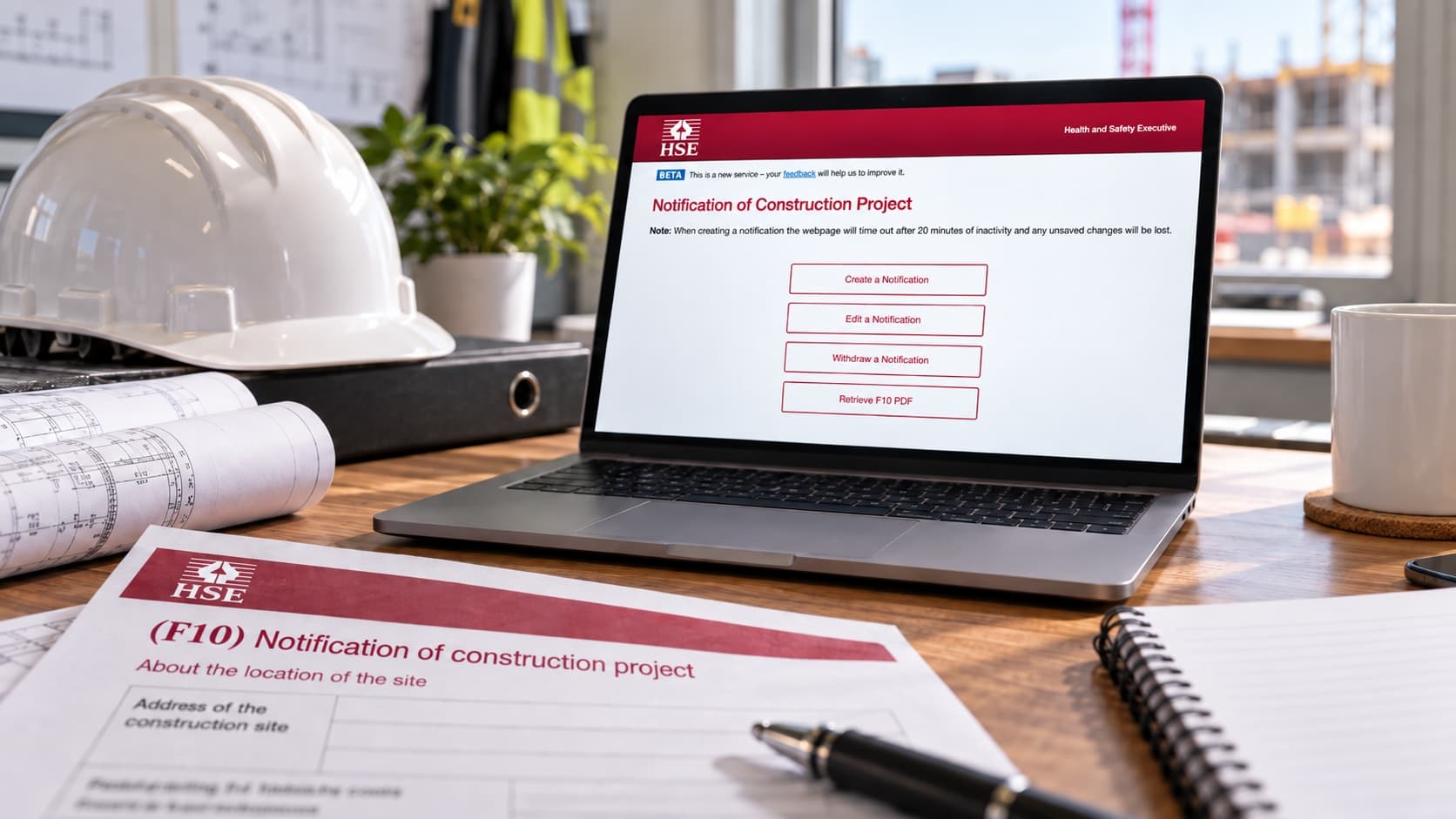
The notice gives the relevant enforcing authority key information about the client, the project, the site and the principal duty holders. HSE provides an online F10 notification service for projects it enforces. HSE F10 notification service: create, edit, withdraw or retrieve an F10 notification online (opens in a new tab)
When is an F10 notification required?
A construction project is notifiable if either of the following conditions is met:
F10 notification thresholds at a glance
Test 1
- More than 30 working days
- andMore than 20 workers at the same time
If both are true, the threshold is met.
or
Test 2
- More than 500 person-days
If true, the threshold is met.
- Exactly 30 working days, 20 simultaneous workers or 500 person-days does not exceed the relevant threshold.
- A working day is any day on which construction work takes place — not a calendar day, and not only Monday to Friday.
- CDM 2015 can still apply even when a project is not notifiable.
If neither threshold is met, the project is not notifiable under Regulation 6. Other CDM duties may still apply in full. Read Regulation 6 on legislation.gov.uk: notice of a construction project, including the notification thresholds (opens in a new tab)
How does the 30-working-day threshold work?
The first threshold has two parts. The construction work must be scheduled to last longer than 30 working days and there must also be more than 20 workers working simultaneously at some point during the project.
Both parts must be satisfied. A project lasting more than 30 working days is not automatically notifiable if the workforce never exceeds 20 workers at the same time.
HSE guidance explains that every day on which construction work is likely to take place counts towards the period, including weekends and bank holidays where work is scheduled. HSE L153 guidance: Managing health and safety in construction, Regulation 6, notification, PDF (opens in a new tab)
What does 500 person-days mean?
A person-day is one person carrying out construction work for one day. The 500 person-day threshold looks at the total amount of construction work across the project.
For example, 10 workers working for 50 days would amount to 500 person-days. The notification threshold is exceeded where the scheduled construction work is expected to exceed 500 person-days. HSE L153 guidance: Managing health and safety in construction, Regulation 6, notification, PDF (opens in a new tab)
Who is responsible for submitting the F10?
For a commercial project, the client has the legal duty to notify the relevant enforcing authority when the project is notifiable. Read Regulation 6 on legislation.gov.uk: notice of a construction project, including the notification thresholds (opens in a new tab)
The client may ask another person, such as the Principal Designer or another project adviser, to complete and submit the notification on their behalf, but that does not remove the client’s underlying duty to ensure notification is made. HSE L153 guidance: Managing health and safety in construction, Regulation 6, notification, PDF (opens in a new tab)
What about domestic clients?
Domestic-client duties are transferred under Regulation 7, including notification where the project is notifiable. The duty is carried out by the contractor where there is only one contractor, the Principal Contractor where there is more than one, or the Principal Designer where there is a written agreement that the Principal Designer will fulfil the client duties. Read Regulation 7 on legislation.gov.uk: application to domestic clients, including the transfer of client duties (opens in a new tab)
When must the F10 be submitted?
The notification must be given in writing as soon as practicable before the construction phase begins. Read Regulation 6 on legislation.gov.uk: notice of a construction project, including the notification thresholds (opens in a new tab)
If a project is not expected to be notifiable at the outset but later changes so that it meets one of the thresholds, HSE guidance says it should be notified as soon as possible. HSE L153 guidance: Managing health and safety in construction, Regulation 6, notification, PDF (opens in a new tab)
There is no paper F10 form to fill in. The F10 is submitted through HSE’s official online notification service, which HSE says has replaced paper forms, email and post. The same service is used to edit or withdraw an existing notification. HSE F10 guidance: how to notify through the online service, including that paper, email and post are not accepted (opens in a new tab)
Most projects are notified to HSE. Where the Office of Rail and Road is the enforcing authority for the construction work, or the work is on a nuclear site, an authorised defence site or a new nuclear build site, Regulation 6 requires the notice to go to the Office of Rail and Road or the Office for Nuclear Regulation instead. Read Regulation 6 on legislation.gov.uk: notice of a construction project, including the notification thresholds (opens in a new tab)
What information does an F10 notification include?
The notice must contain the 15 particulars specified in Schedule 1 of CDM 2015: Read Schedule 1 on legislation.gov.uk: particulars to be included in a notice of a construction project (opens in a new tab)
- The date the notice is forwarded.
- The address of the construction site or a precise description of its location.
- The name of the local authority where the construction site is located.
- A brief description of the project and the construction work it entails.
- The client’s contact details: name, address, telephone number and (if available) email address.
- The Principal Designer’s contact details: name, address, telephone number and (if available) email address.
- The Principal Contractor’s contact details: name, address, telephone number and (if available) email address.
- The planned date for the start of the construction phase.
- The time allocated by the client under Regulation 4(1) for the construction work.
- The planned duration of the construction phase.
- The estimated maximum number of people at work on the construction site.
- The planned number of contractors on the construction site.
- The name and address of any contractor already appointed.
- The name and address of any designer already appointed.
- A declaration signed by or on behalf of the client that the client is aware of the client duties under CDM 2015.
Have these ready before you start. HSE’s online form can only be saved once the required fields are complete and the declaration has been made. HSE F10 guidance: how to notify through the online service, including that paper, email and post are not accepted (opens in a new tab)
Does the F10 need to be displayed on site?
Yes. Regulation 6 requires the notice to be clearly displayed in the construction site office in a comprehensible form where it can be read by any worker engaged in the construction work. Read Regulation 6 on legislation.gov.uk: notice of a construction project, including the notification thresholds (opens in a new tab)
Where project information changes and the notice needs updating, the displayed information should reflect the current notification.
Does the F10 need to be updated?
Yes, where necessary. Regulation 6 requires the notice to be periodically updated if needed. HSE’s online service allows an existing notification to be edited using the notification details. HSE F10 notification service: create, edit, withdraw or retrieve an F10 notification online (opens in a new tab)
Changes might include key appointments, programme information or other Schedule 1 particulars that materially change after the original notification.
Is an F10 required for every CDM project?
No. This is one of the most common CDM misconceptions.
CDM 2015 applies to construction projects much more broadly than the F10 notification requirement. A project can be fully subject to CDM duties but remain below both Regulation 6 notification thresholds. The Does CDM Apply? checker works through that separate question.
Does a non-notifiable project still need a construction phase plan?
Yes. A construction phase plan is required for every construction project under CDM 2015, regardless of whether an F10 notification is required.
Notification status also does not determine whether the client must make Principal Designer and Principal Contractor appointments. Those appointments are required where there is, or it is reasonably foreseeable that there will be, more than one contractor.
Does F10 notification prove CDM compliance?
No. Submitting an F10 is only one specific duty for a notifiable project. It does not demonstrate that the wider CDM duties have been discharged.
A notifiable project still needs appropriate client arrangements, competent and capable duty holders, pre-construction information, required appointments, construction-phase planning and ongoing coordination.
Quick F10 notification test
Ask the following questions:
- Is the project a construction project under CDM 2015?
- Is the construction work scheduled to last longer than 30 working days?
- Will more than 20 workers be working simultaneously at any point?
- Or is the project scheduled to exceed 500 person-days?
- If the answer to either complete notification threshold is yes, has the relevant client duty holder arranged the notification before the construction phase begins?
- Is the notification displayed on site and kept updated where necessary?
Common F10 notification mistakes
Assuming every CDM project needs an F10
Only projects meeting one of the Regulation 6 thresholds are notifiable.
Using “more than 30 days” on its own
The 30-working-day route also requires more than 20 workers working simultaneously at some point.
Confusing 500 person-days with 500 calendar days
Person-days are the total worker-days of construction work across the project.
Treating notification as the trigger for all other CDM duties
Most CDM duties apply independently of F10 status.
Failing to notify after the project scope changes
A project that later crosses the threshold should be notified as soon as possible.
Submitting the notice and forgetting about it
The notice must be displayed and updated where necessary.
Frequently asked questions
What is an F10 notification?
It is the written notification required under Regulation 6 of CDM 2015 for a construction project that meets the statutory notification threshold.
When is an F10 notification required?
When construction work is scheduled to last longer than 30 working days and have more than 20 workers working simultaneously at any point, or when it is scheduled to exceed 500 person-days.
Who is responsible for the F10 notification?
For a commercial project, the client has the legal duty to notify. The client can ask someone else to submit it on their behalf. Domestic-client duties transfer under Regulation 7.
Does every project lasting more than 30 days need an F10?
No. The first threshold also requires more than 20 workers working simultaneously at some point.
Does exactly 500 person-days require an F10?
No. The work must exceed 500 person-days, so exactly 500 does not meet that test; 501 does. The same applies to exactly 30 working days and exactly 20 simultaneous workers. The F10 Notification Calculator shows how your figures compare with each threshold.
What counts as a working day for an F10?
Regulation 2 defines a working day as any day on which construction work takes place. Count the days construction work is scheduled, including weekends or bank holidays where work is planned, rather than the calendar duration.
When should an F10 be submitted?
In writing, as soon as is practicable before the construction phase begins. A project that only becomes notifiable later should be notified as soon as possible once it crosses a threshold.
Where do I submit an F10?
Through HSE’s official online F10 service (opens in a new tab). There is no paper F10 form; the same service is used to edit or withdraw a notification. Where the Office of Rail and Road or the Office for Nuclear Regulation is the relevant authority, the notice goes to them instead.
Does every CDM project need an F10?
No. CDM applies to many projects that do not meet the notification thresholds.
Can an F10 be updated after submission?
Yes. The notification should be updated where necessary, and HSE provides a way to edit an existing notification.
Do I still need a construction phase plan if the project is not notifiable?
Yes. The construction phase plan requirement applies to every construction project under CDM 2015.
Need CDM training?
Learn the core requirements, then follow a pathway based on your responsibilities.
Explore CDM training