Guide
How to appoint a Principal Contractor
When a Principal Contractor must be appointed, what the client should check and how to make the written appointment.

Free CDM 2015 template
Download a free, editable one-page Word template for recording a written Principal Contractor appointment under CDM 2015.
Editable .docx, 1 page, No sign-up required
Read the Principal Contractor appointment guide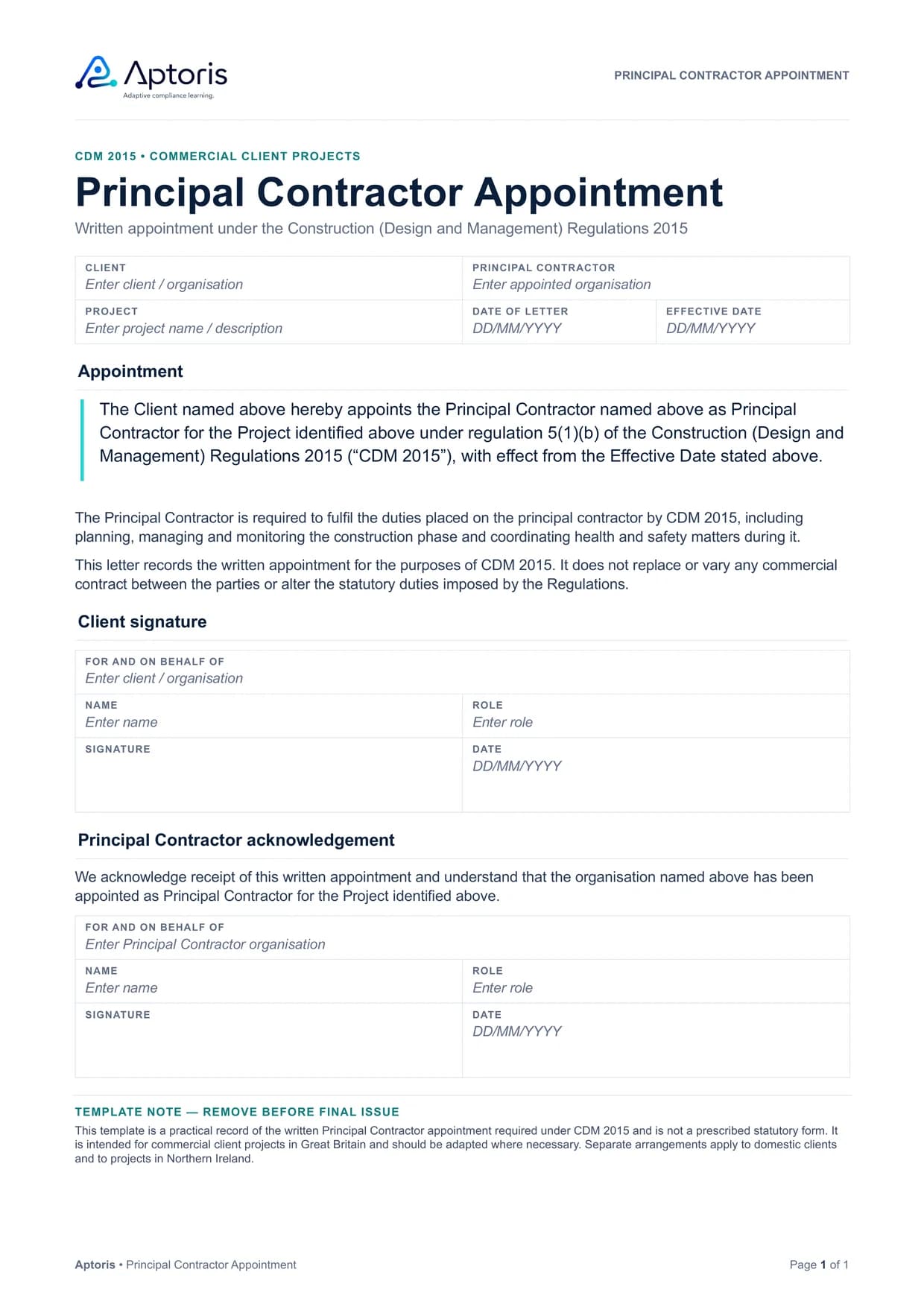
A simple written record identifying the client, Principal Contractor, project and effective date, with client signature and Principal Contractor acknowledgement.
This is the whole template: one A4 page, shown exactly as Word renders it. Every grey prompt is a Word content control, ready to replace.
Where Regulation 5 applies, the client must appoint the Principal Contractor in writing. CDM 2015 does not prescribe a standard appointment form.
The template is designed to make the appointment clear (who is appointed, for which project and from when) without turning the letter into a project-management document.
Detailed scope, programme, interfaces and management arrangements can be dealt with elsewhere in the project documentation where appropriate.
Commercial clients making a Principal Contractor appointment under CDM 2015 in Great Britain.
Add the client, Principal Contractor, project and relevant dates.
Make sure the letter clearly reflects the organisation being appointed and the project concerned.
The client signs the written appointment. The Principal Contractor acknowledgement provides a useful record of receipt.
Yes. It is free to download, with no sign-up and no email address needed. Select Download the free Word template and the file downloads straight away.
Yes. It is an editable Word document (.docx) with no macros. Each prompt sits in a Word content control: click it and type to replace it. Other software that opens .docx files should work, although formatting may vary.
Where more than one contractor is, or is reasonably foreseeable to be, working on the project at any time, the client must appoint a Principal Contractor as soon as practicable and before the construction phase begins. See when a Principal Contractor must be appointed.
Yes. Regulation 5 requires the client to make the appointment in writing. This letter is one simple way to do that.
CDM 2015 does not prescribe the content. A clear letter identifies the client, the organisation appointed, the project and the effective date, and states that the organisation is appointed as Principal Contractor under CDM 2015. See what the letter should cover.
CDM 2015 requires the client to make the appointment in writing; it does not require the Principal Contractor to sign. The template’s acknowledgement section is an optional record of receipt.
Yes. The appointment can sit within a building contract or another written document, provided the Principal Contractor role, the organisation appointed and the effective date are clear. See appointments in the main contract.
No. The letter records the appointment. The Principal Contractor still needs to draw up the construction phase plan before the construction site is set up. Our Construction Phase Plan template can help.
It is designed for commercial clients. Different arrangements apply to domestic clients under Regulation 7, so check the domestic client arrangements before using it.
No. Aptoris is independent, and this template is not produced, approved or endorsed by HSE. CDM 2015 does not prescribe an appointment form. For authoritative requirements, refer to CDM 2015 and HSE’s guidance, L153 (opens in a new tab).
Guidance and templates for the wider appointment and the construction phase.
When a Principal Contractor must be appointed, what the client should check and how to make the written appointment.
What the Principal Contractor must do to plan, manage, monitor and coordinate the construction phase.
The client’s duties under CDM 2015, including appointing the Principal Designer and Principal Contractor.
An editable Word template for the plan the Principal Contractor draws up before the construction site is set up.
An editable Word template for the project information the client provides to designers and contractors.
How the two roles differ, when both are needed and how they work together.
Editable .docx, 1 page, No sign-up required