Guide
Construction site inductions
What a site induction should cover under CDM 2015, who must provide it and how site-specific it should be.

Free Word checklist
A practical, editable Word checklist for preparing, delivering and recording a site-specific construction induction.
Editable .docx, 6 pages, No sign-up required
Read the Site Induction guide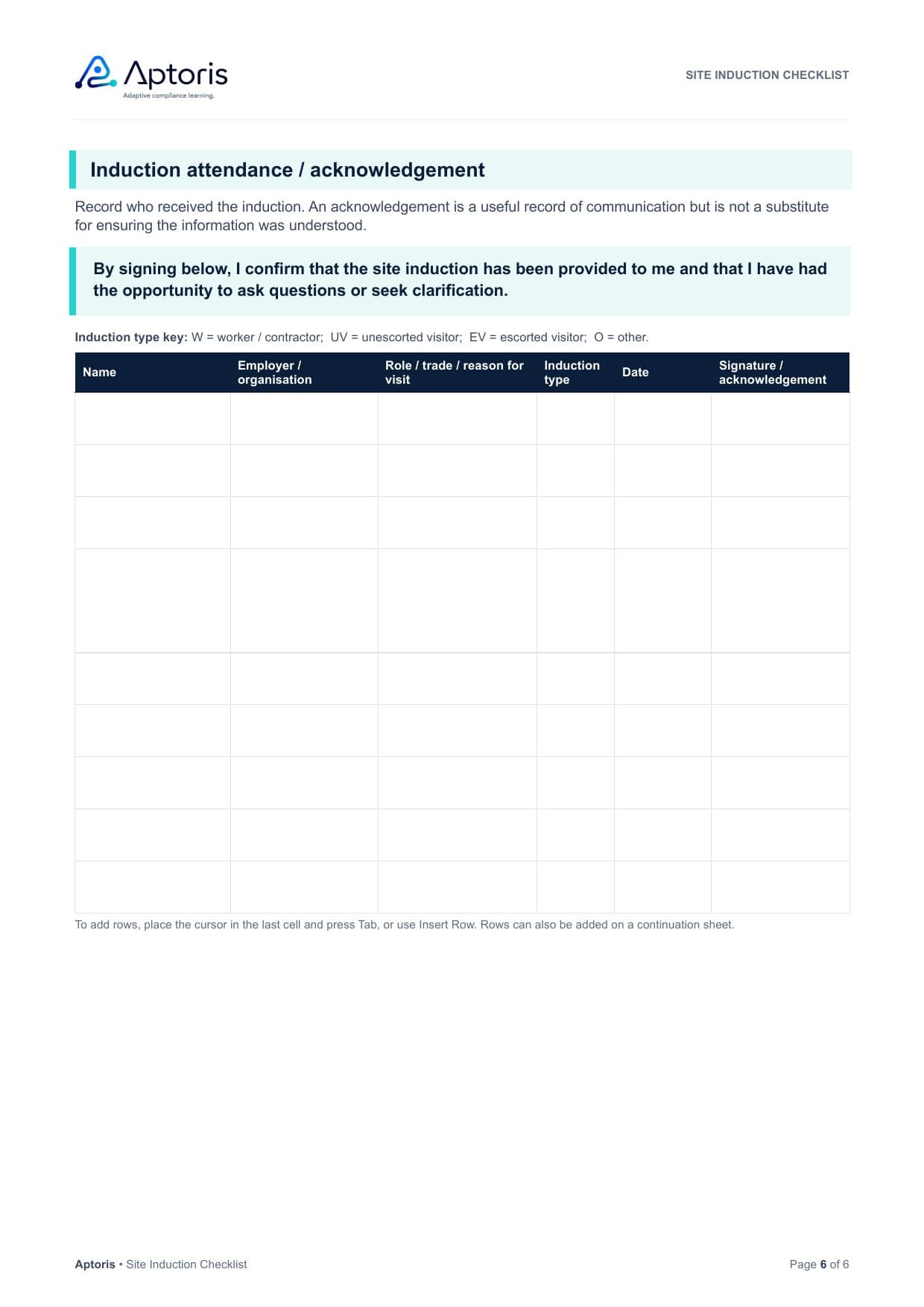
An escorted visitor may only need the principal hazards, relevant controls and emergency arrangements for the visit, while an unescorted visitor may need more detailed site information.
The checklist includes induction types for workers / contractors, unescorted visitors, escorted visitors and other users so the record can be adapted without creating a separate form.
Induction types in the checklist
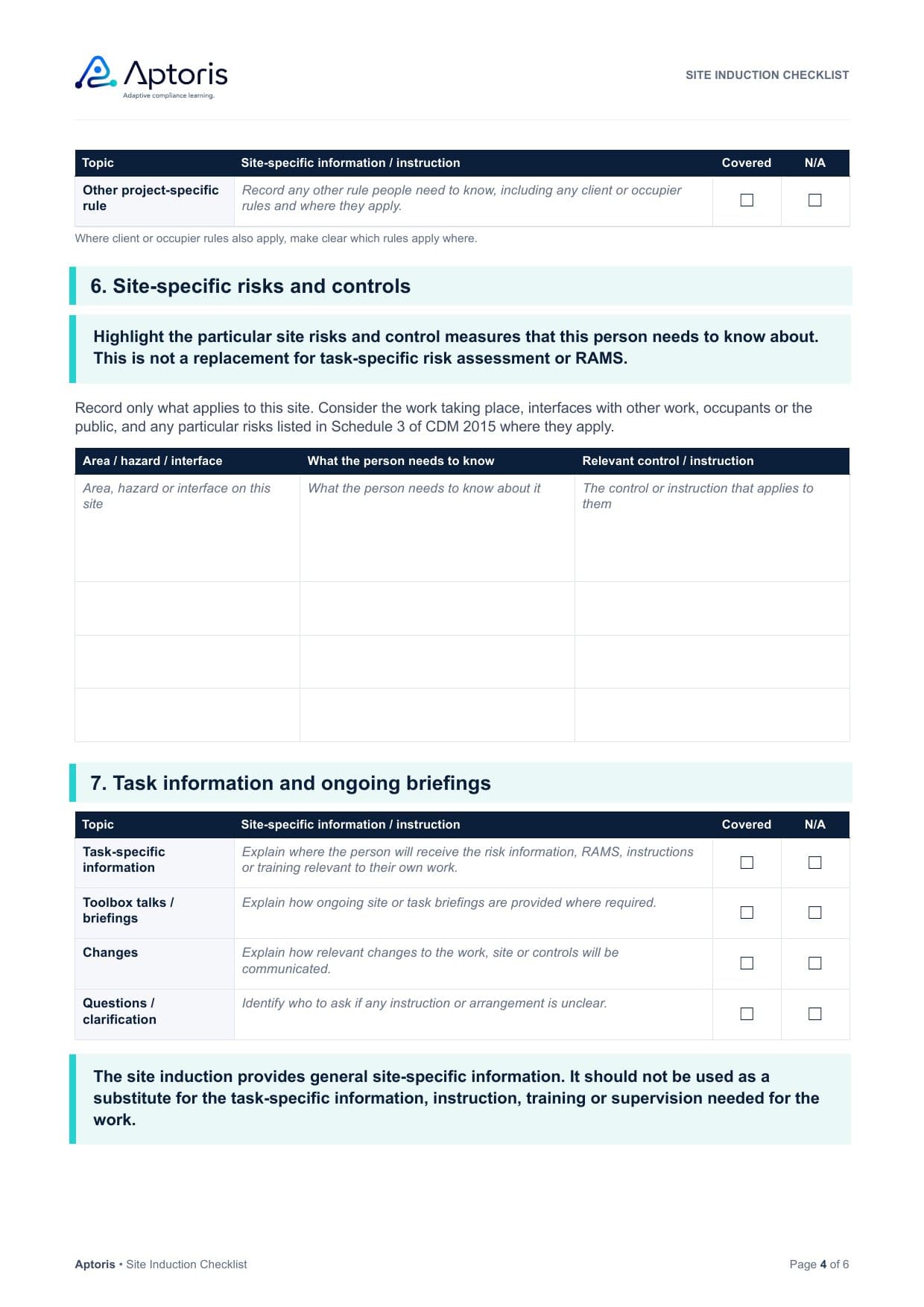
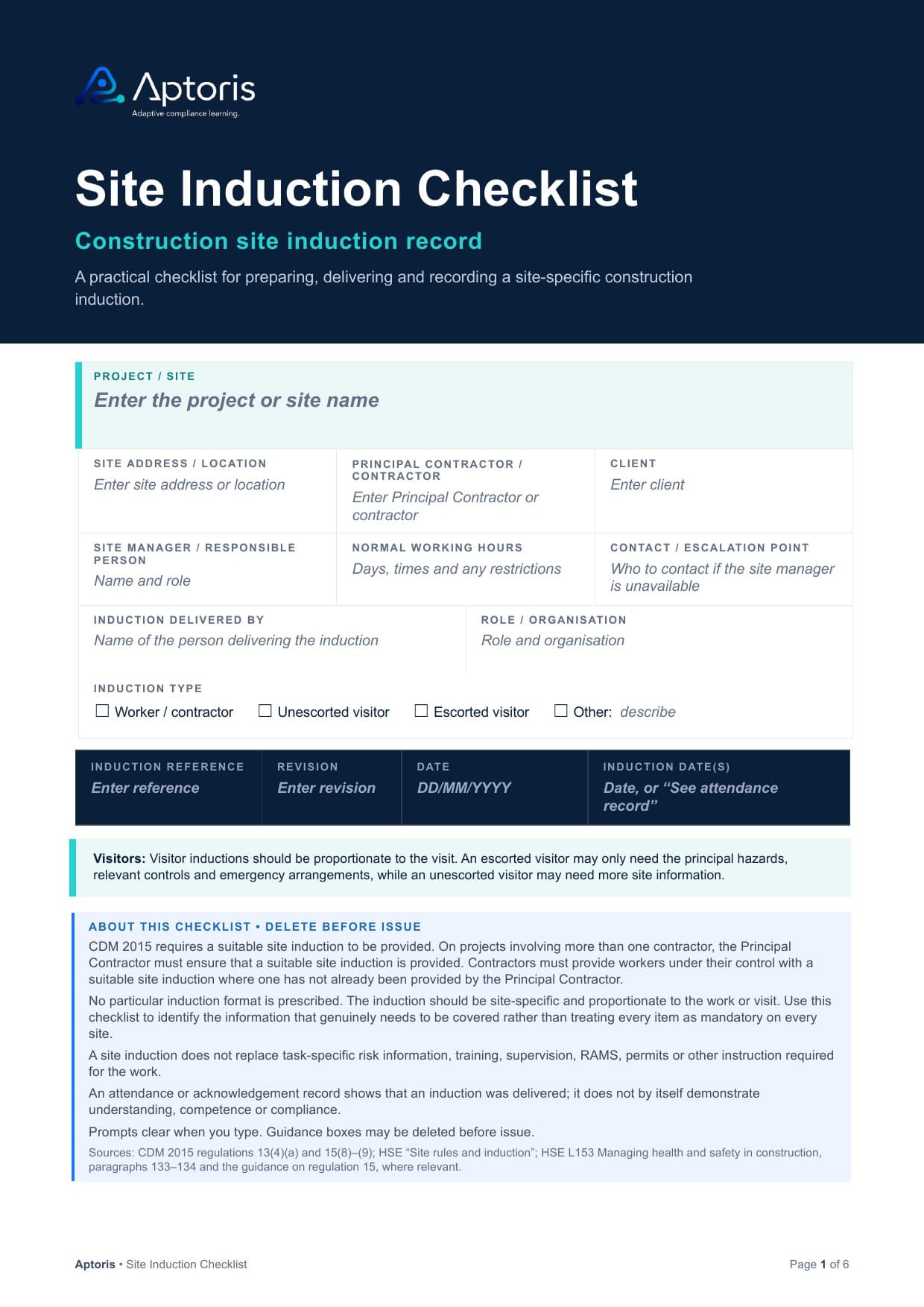
Six pages: induction details, eight checklist sections, a final review and the attendance record.
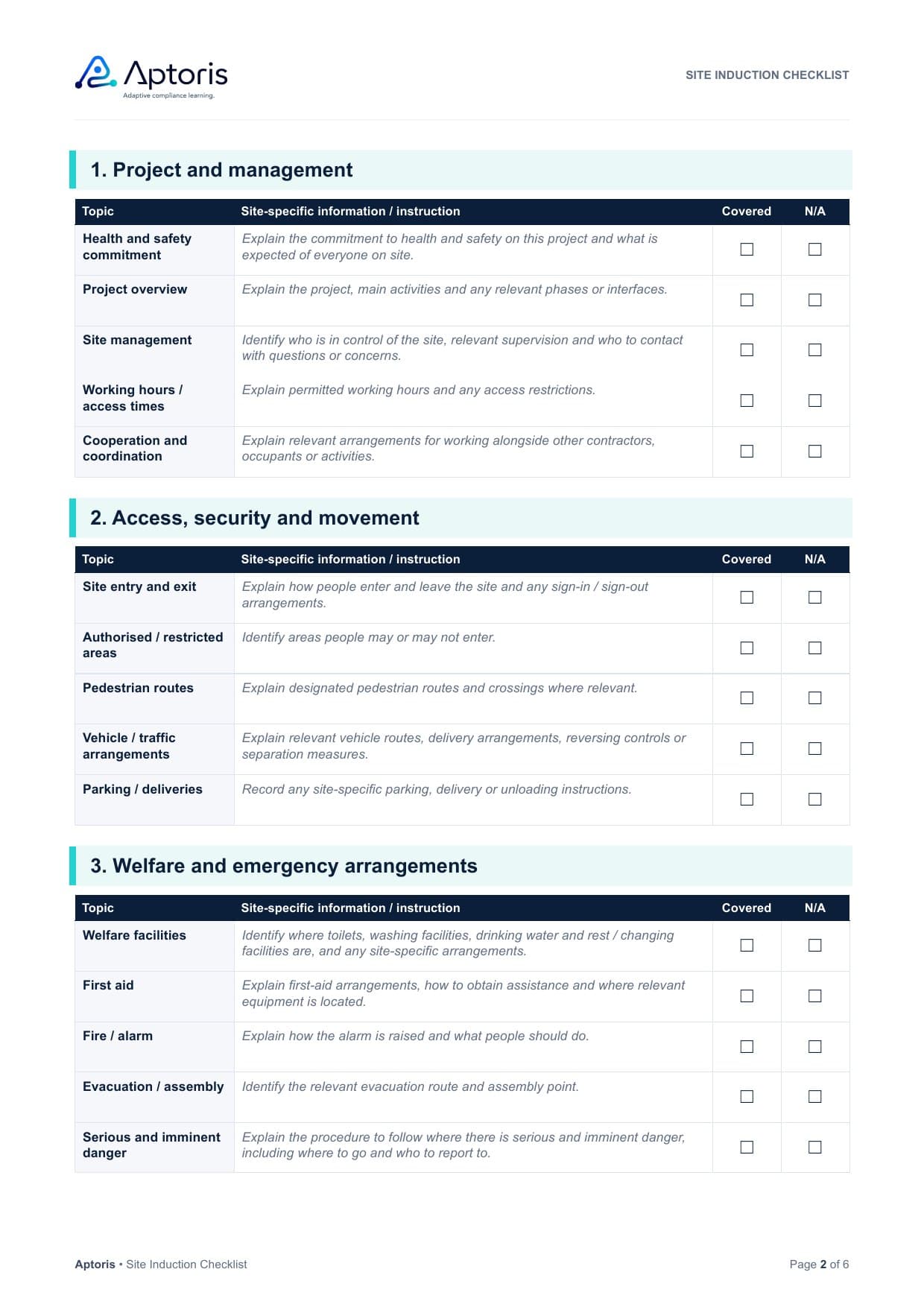
These are real pages from the Word checklist. Each topic has space for the site’s own information and tick boxes for Covered and N/A, so the induction can be adapted to the site and the person. The blue About box can be deleted before issue.
Section 6 · Site-specific risks
Site risks and briefings
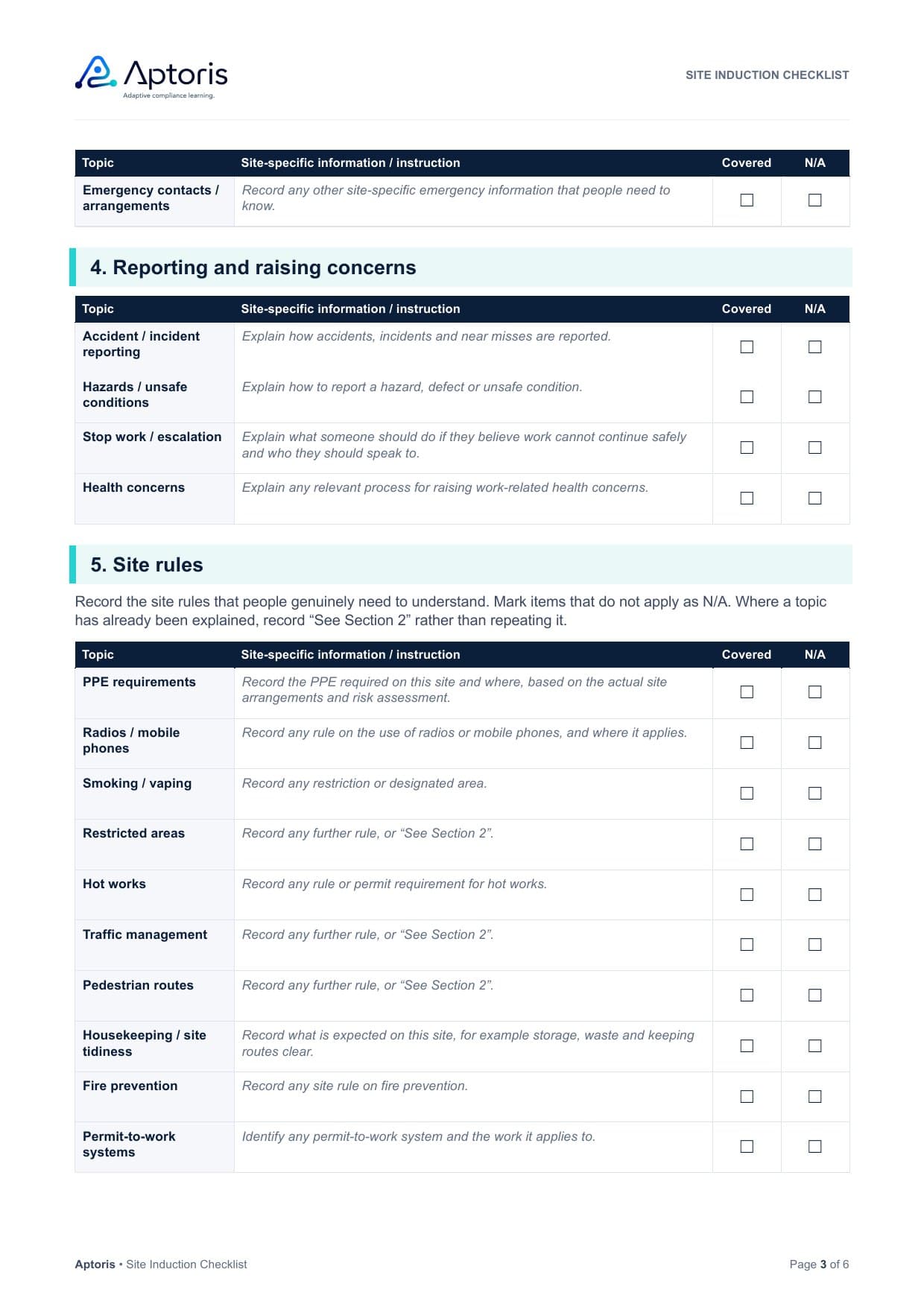
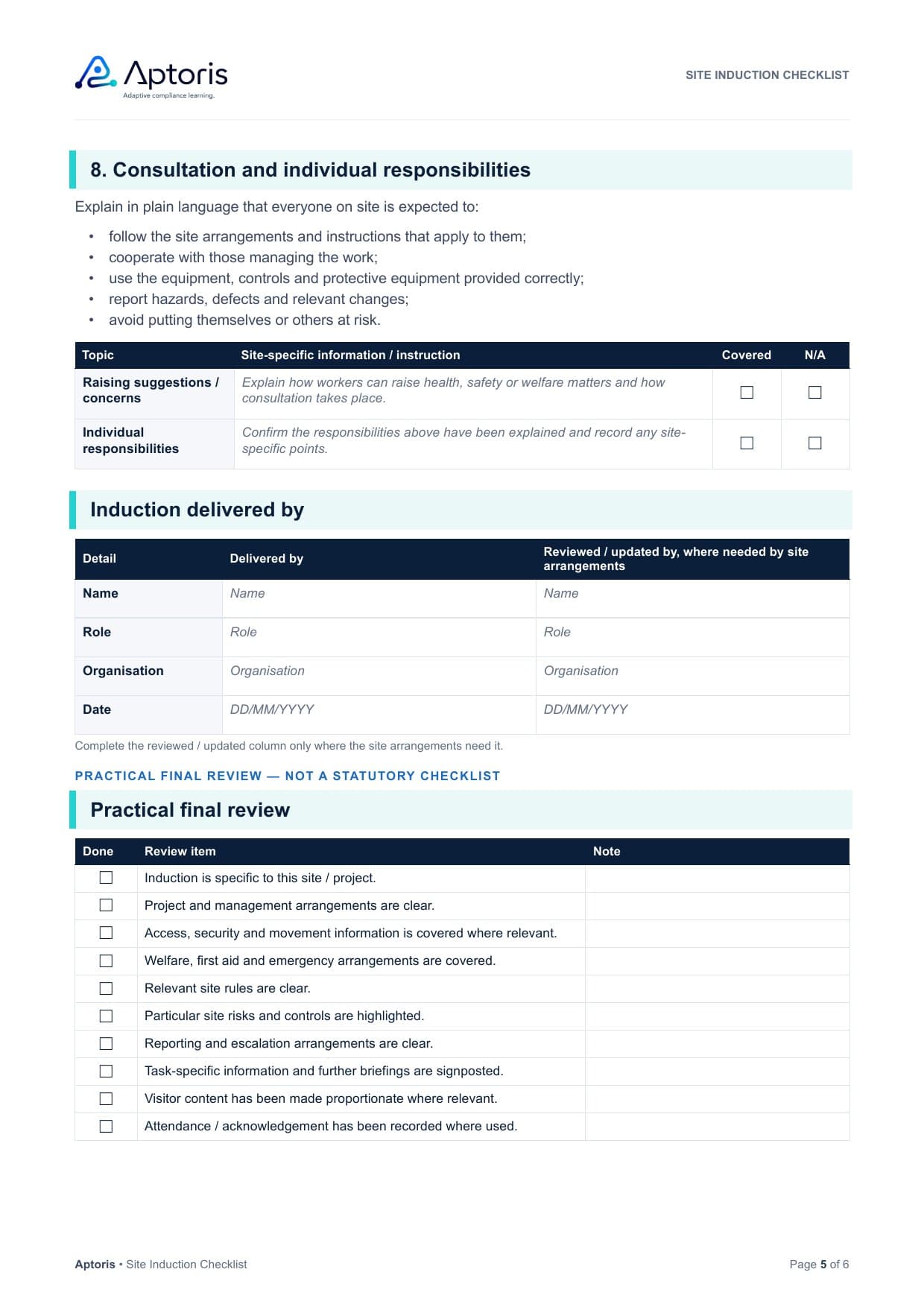
Swipe to see more pages.
Attendance / acknowledgement
Attendance / acknowledgement
Eight numbered sections, then a record of who delivered the induction, a practical final review and the attendance record.
A useful induction should focus on the particular arrangements, risks and controls people need to know about on that project. The checklist deliberately avoids a pre-filled hazard library or generic PPE list.
The checklist is designed to be adapted rather than forcing every topic onto every site or every visitor.
Each topic has its own Covered and N/A tick boxes, and site rules already explained elsewhere in the checklist can simply be cross-referenced.
Depending on the project and person being inducted, a suitable site induction may need to cover:
Practical guidance, not a statutory list: cover what is relevant to the site and the person. The Site Induction guide explains each area in more detail.
Covers the general site-specific arrangements, principal risks, rules and emergency information people need to know.
Covers the hazards, controls, method, training, permits or supervision needed for the person’s actual work.
A site induction should not be used as a substitute for task-specific risk information, RAMS, training or supervision.
Final page of the checklist
The attendance and acknowledgement table records each person inducted.
The attendance table’s columns
The person who received the induction.
Who they work for or represent.
Their work on site, or why they are visiting.
Worker or contractor, unescorted visitor, escorted visitor or other.
When they were inducted.
Their signature or other acknowledgement.
10 starter rows are included and the table can be expanded.
The acknowledgement records that the induction was provided and that the person had the opportunity to ask questions or seek clarification. It does not transfer duties or prove competence.
Complete the project details, management arrangements, access, welfare, emergency and site-rule information that actually applies.
Record the particular site risks, interfaces and controls the person needs to know about.
Explain the relevant information at a level proportionate to the person’s work or visit and allow questions or clarification.
Record attendance where appropriate and update the induction when relevant site arrangements or risks materially change.
Anyone preparing, delivering or recording a construction site induction can use it.
Set out the site-wide arrangements every person needs to know.
Induct workers under your control where the Principal Contractor has not already done so.
Keep the induction current as the site and its arrangements change.
Deliver a consistent induction and record who received it.
Help teams keep inductions site-specific and proportionate.
Agree what people need to know before they start on site.
Any organisation doing so can adapt the same record for workers, contractors and visitors, at a depth proportionate to the work or visit.
The duties differ by role: CDM places the induction duty on the Principal Contractor and on contractors for workers under their control. Others may help prepare or deliver it.
Yes. It is free to download, with no sign-up and no email address needed. Select Download the Word checklist and the file downloads straight away.
A Microsoft Word document (.docx) of 6 A4 pages, with no macros. It has induction details on the first page, eight numbered checklist sections, a delivered-by record, a practical final review and an attendance and acknowledgement table. Each prompt is a Word content control, and each topic has Covered and N/A tick boxes. It can be completed in Word, printed, or saved as a PDF once completed.
Yes. CDM 2015 requires a suitable site induction to be provided (regulation 13(4)(a) (opens in a new tab) and regulation 15(9)(a) (opens in a new tab)). It does not prescribe a particular induction form, checklist or format; the induction should be site-specific and proportionate to the work or visit.
On projects with more than one contractor, the Principal Contractor must ensure a suitable site induction is provided. Contractors must provide a suitable site induction to workers under their control where the Principal Contractor has not already provided one, and they still need to give those workers the supervision, instructions and information needed for their work. See the Principal Contractor and contractor duties guides.
Whatever people need to know about this site: typically the project and who manages it, access and restricted areas, traffic and pedestrian routes, welfare, first aid, fire and emergency arrangements, how to report accidents and hazards, relevant site rules, the particular site risks and controls, how further task-specific information and briefings are provided, and how to raise concerns. HSE guidance lists subjects to consider rather than a fixed list. See what a site induction should cover.
HSE guidance says occasional and once-only visitors also need an induction, proportionate to the nature of the visit (Site rules and induction (opens in a new tab)). An escorted visitor may only need to know the main hazards they may be exposed to, the relevant controls and the emergency arrangements; an unescorted visitor may need more detailed site information. Visitors do not need the same induction as workers.
CDM 2015 requires a suitable induction; it does not prescribe a signature or a particular record format. An attendance or acknowledgement record is commonly useful, because it shows who was inducted and when. A signature alone does not prove that the person understood the information or that they are competent.
CDM does not set a fixed interval. The induction should stay relevant to the current site arrangements, and should be refreshed where meaningful changes make the existing information outdated or insufficient, such as a new phase of work, changed access or emergency arrangements, or new significant site risks. Changes that affect only one activity may be better communicated through targeted briefings.
No. A site induction covers the general site-specific arrangements. People still need the task-specific risk information, method, training, permits and supervision for their actual work, for example through RAMS or a Method Statement.
Yes. Click a grey prompt and type to replace it, click a tick box to tick it, and add rows to any table by placing the cursor in the last cell and pressing Tab. The document is not locked, so you can also change or remove topics, and delete the About box before issue.
Guidance and templates for the work around site inductions.
What a site induction should cover under CDM 2015, who must provide it and how site-specific it should be.
A Word template combining a task-specific risk assessment with the safe sequence of work.
A standalone Word template for the safe sequence of work, where the risk assessment is managed separately.
How the Principal Contractor plans, manages and coordinates the construction phase, including site inductions.
How contractors plan, manage and monitor their work, and inform and supervise their workers.
A Word template for the site arrangements that an induction helps communicate.
Download the editable Word checklist and adapt it to the site, the work and the people you are inducting.
Editable .docx, 6 pages, No sign-up required