Template
Health and Safety File Template
An editable Word template for preparing the file itself, structured around HSE Appendix 4.

Free Word checklist
A practical, editable Word checklist for reviewing the content, updating, handover and future availability of a CDM Health and Safety File.
Editable .docx, 9 pages, No sign-up required
A Health and Safety File is required on projects involving more than one contractor. During the pre-construction phase, the Principal Designer prepares a file appropriate to the characteristics of the project, containing information likely to be needed during future construction work to protect health and safety.
This is a summary, not a substitute for the Regulations. Sources: CDM 2015 regulation 12(5)–(10) (opens in a new tab) and regulation 4(5)(b) and 4(7) (opens in a new tab); HSE L153 Managing health and safety in construction (opens in a new tab), Appendix 4. The Health and Safety File guide explains the requirements in more detail.
A CDM Health and Safety File is required for projects involving more than one contractor.
If more than one contractor will be involved, or that is reasonably foreseeable, the multi-contractor CDM arrangements apply and a Principal Designer is required.
Sources: HSE L153 (opens in a new tab), paragraphs 45 and 114 and Appendix 4; CDM 2015 regulation 12(5) (opens in a new tab).
Where there is only one contractor, the Regulation 12(5) Health and Safety File requirement does not apply to the project.
Other building, maintenance or asset information may still need to be retained for other reasons, but it should not be presented as a statutory CDM Health and Safety File where the CDM requirement does not apply.
While the Principal Designer remains appointed, the Principal Designer prepares the file and keeps it appropriately reviewed, updated and revised.
The Principal Contractor provides relevant information in its possession to the Principal Designer.
If the Principal Designer’s appointment ends before project completion, the Principal Designer passes the file to the Principal Contractor, which then takes over the review, update and revision duty.
At the end of the project, the duty holder holding the file passes it to the client.
Source: CDM 2015 regulation 12(5)–(10) (opens in a new tab). See Principal Designer duties and Principal Contractor duties.
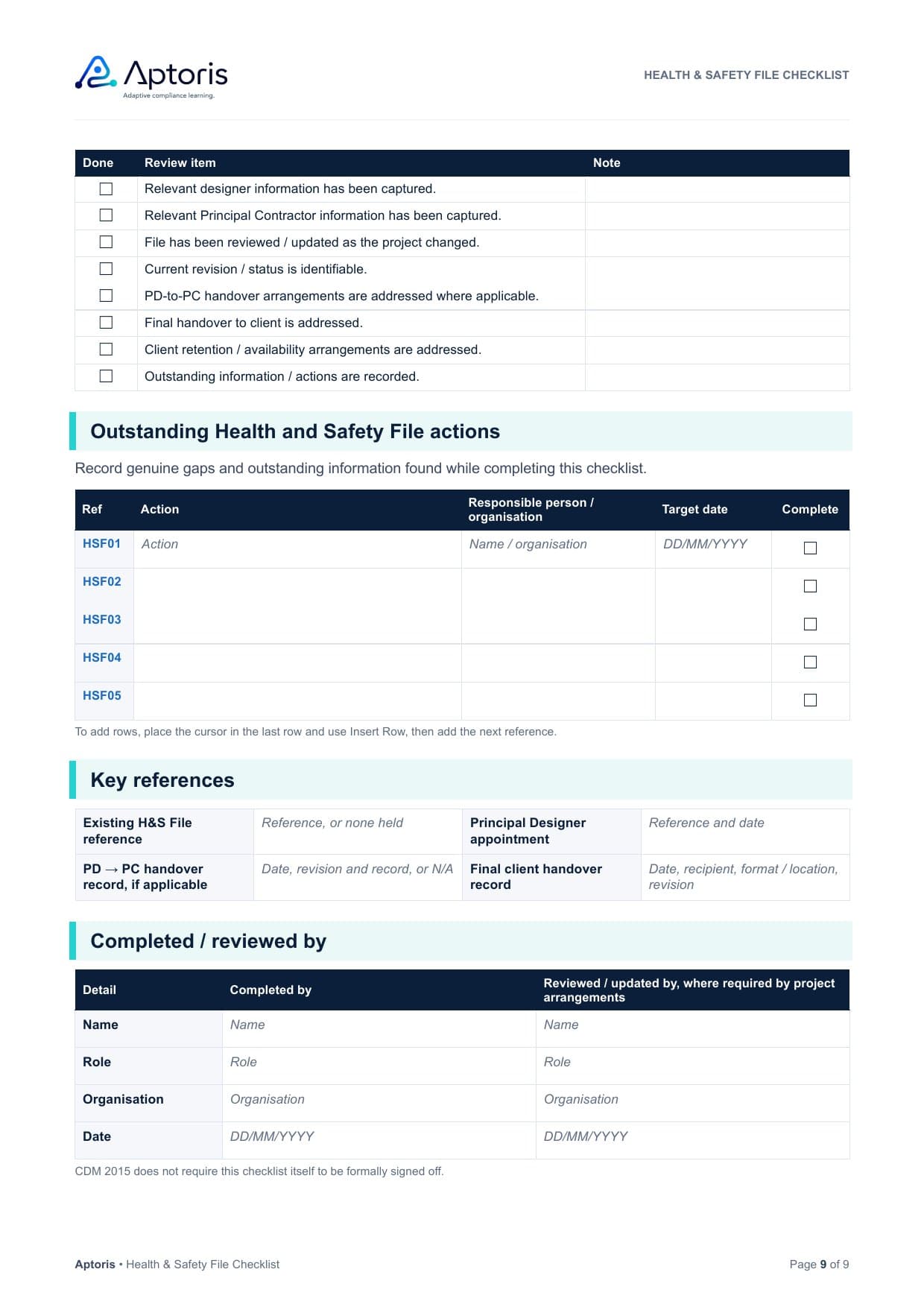
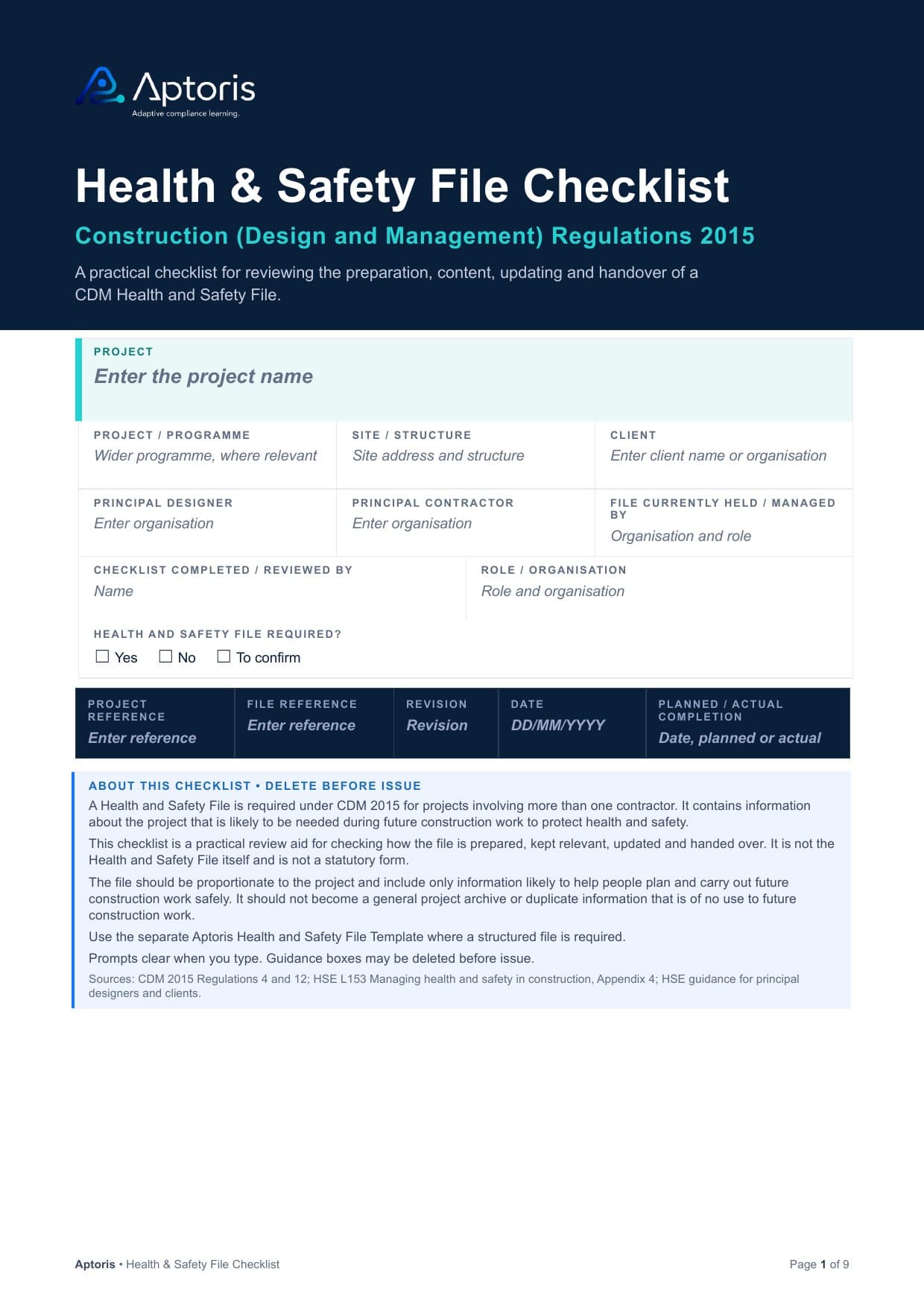
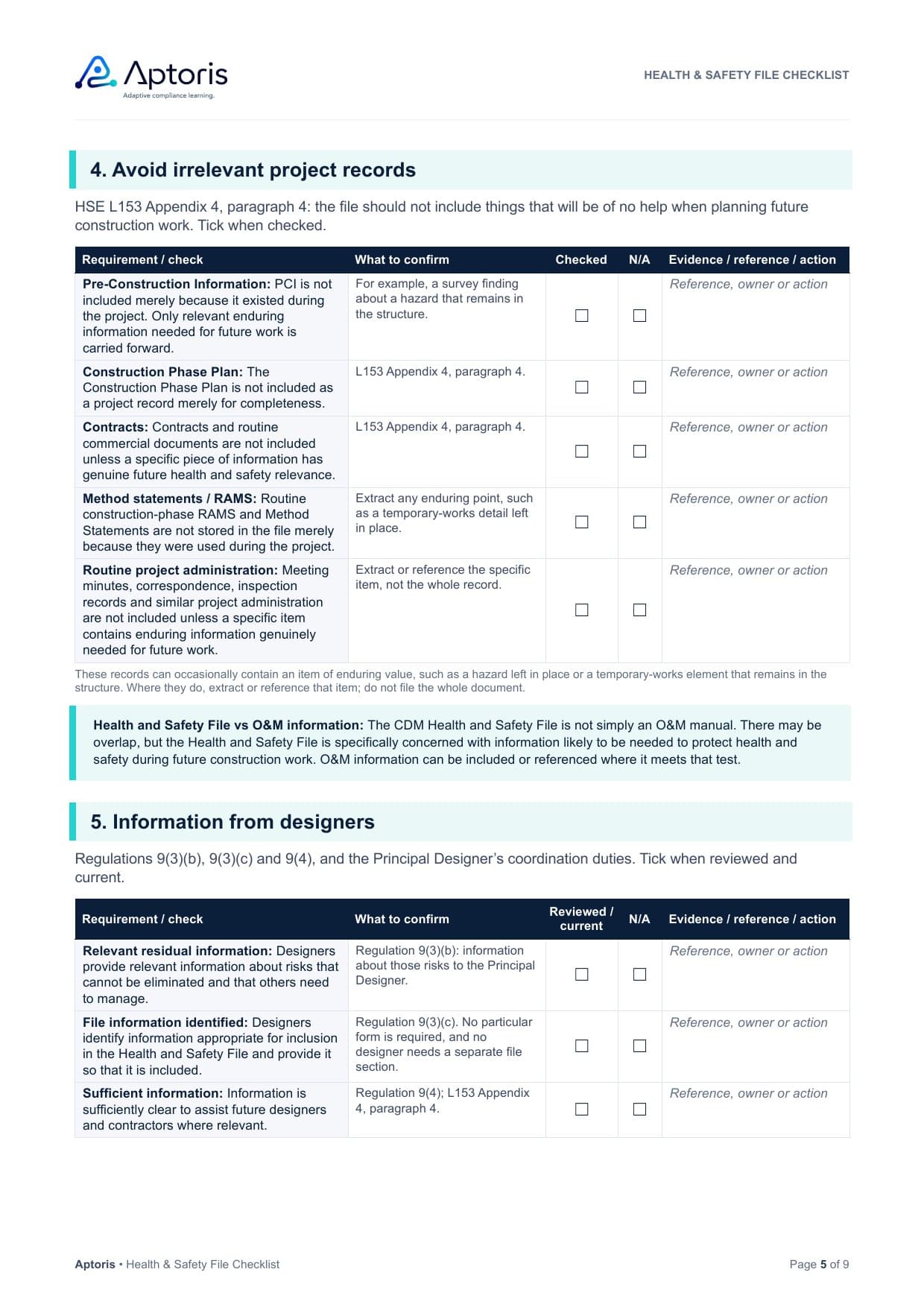
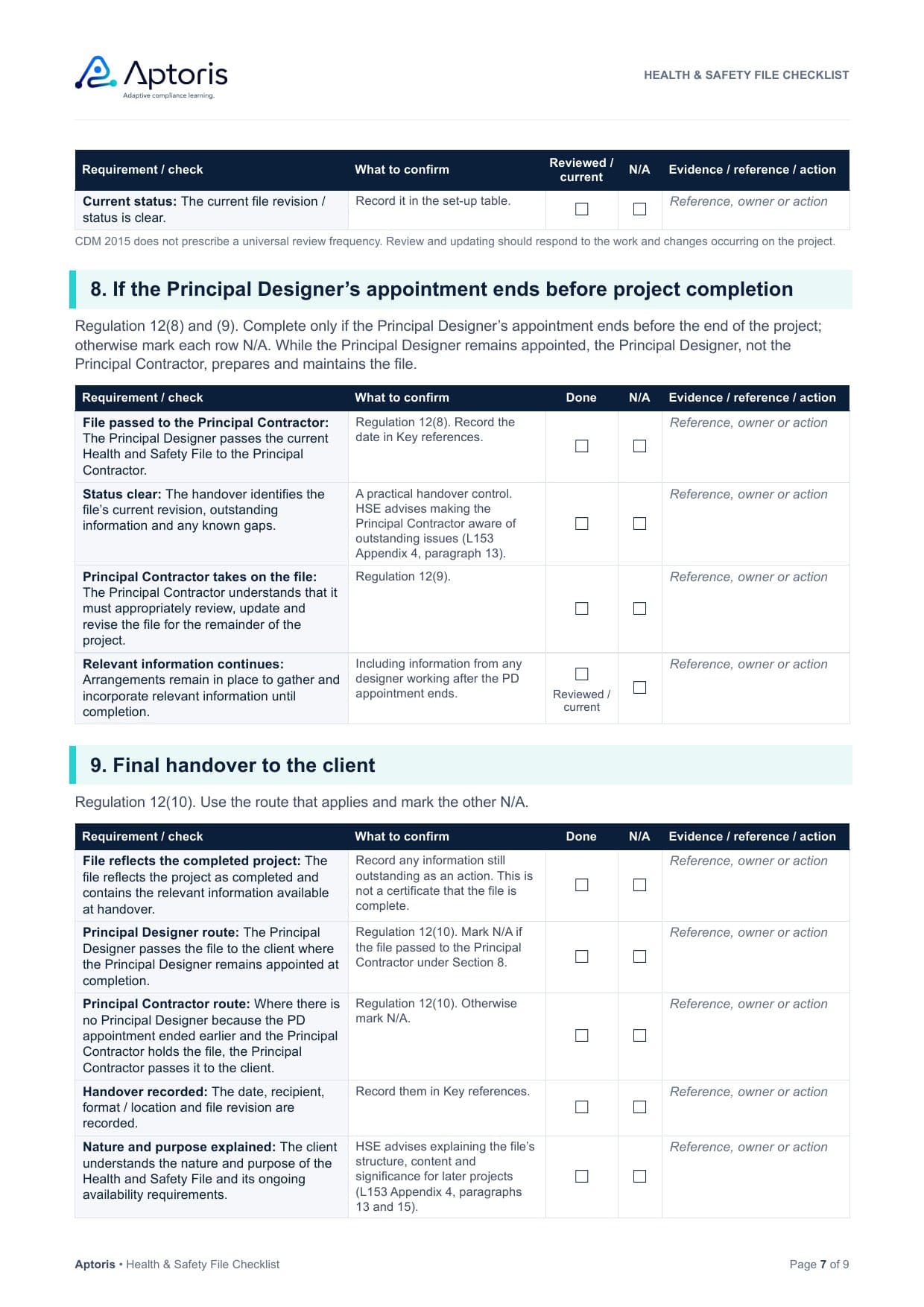
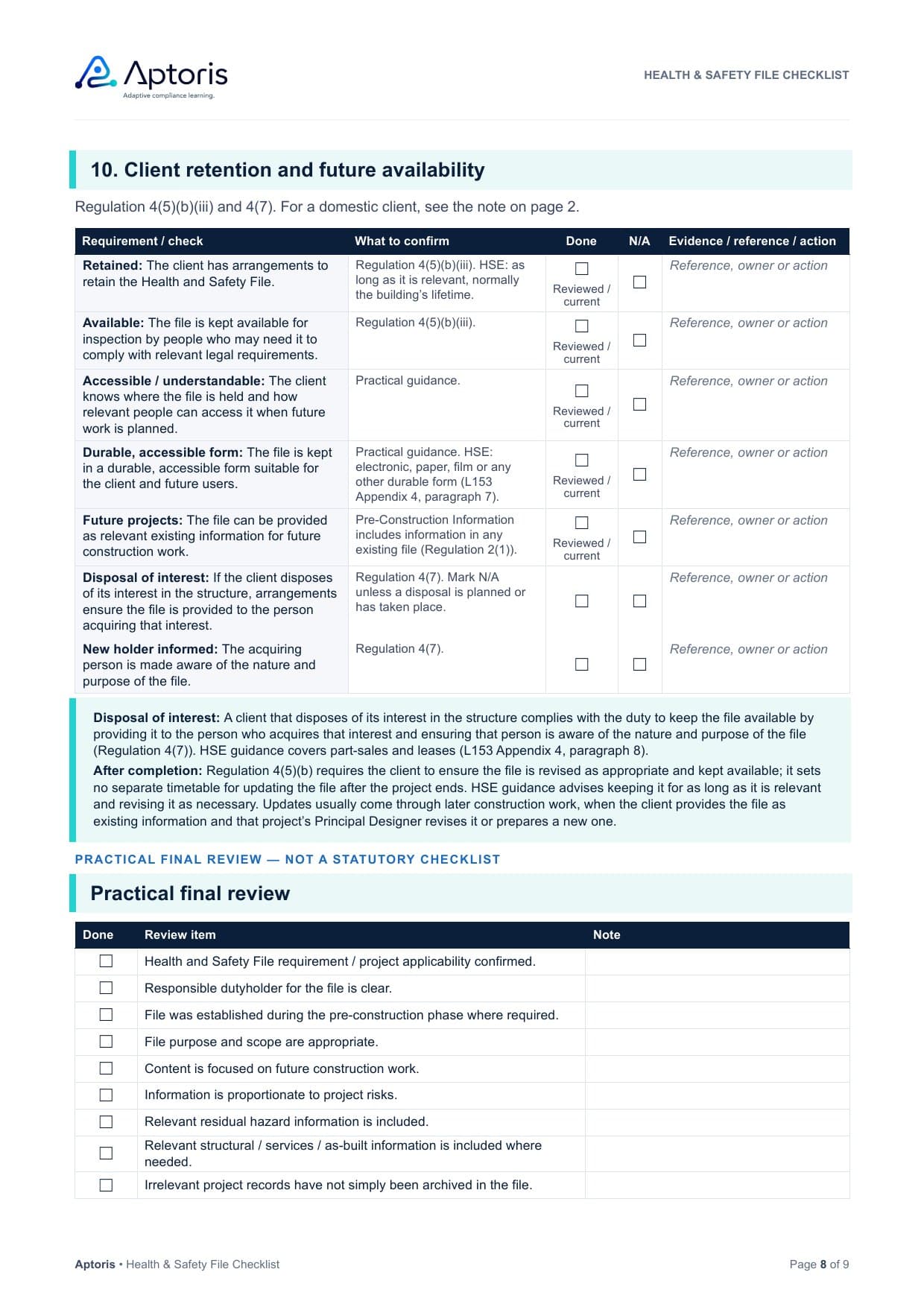
Nine pages: project and file details, file set-up, ten numbered review sections, a practical final review, outstanding actions, key references and a completed / reviewed record.
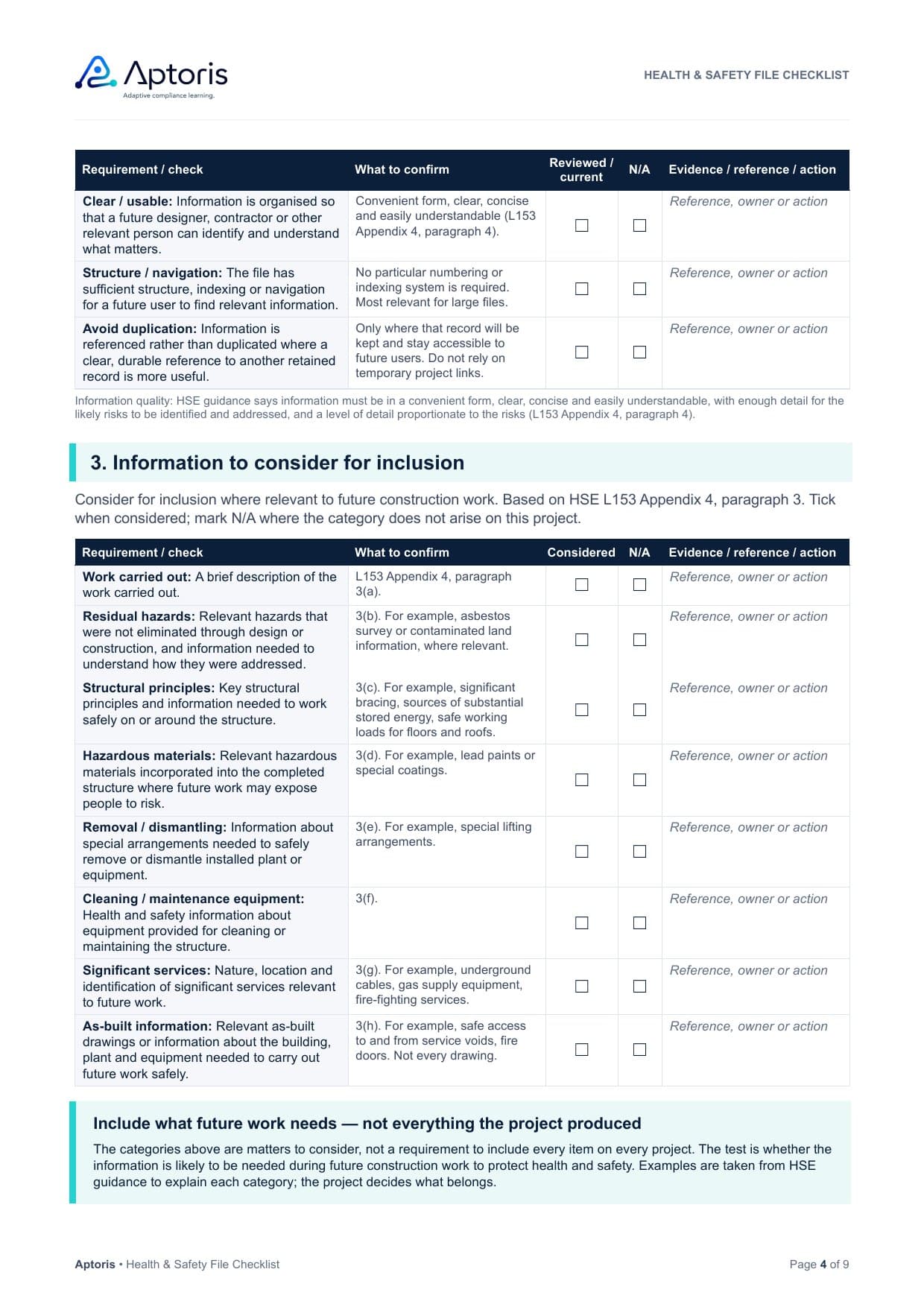
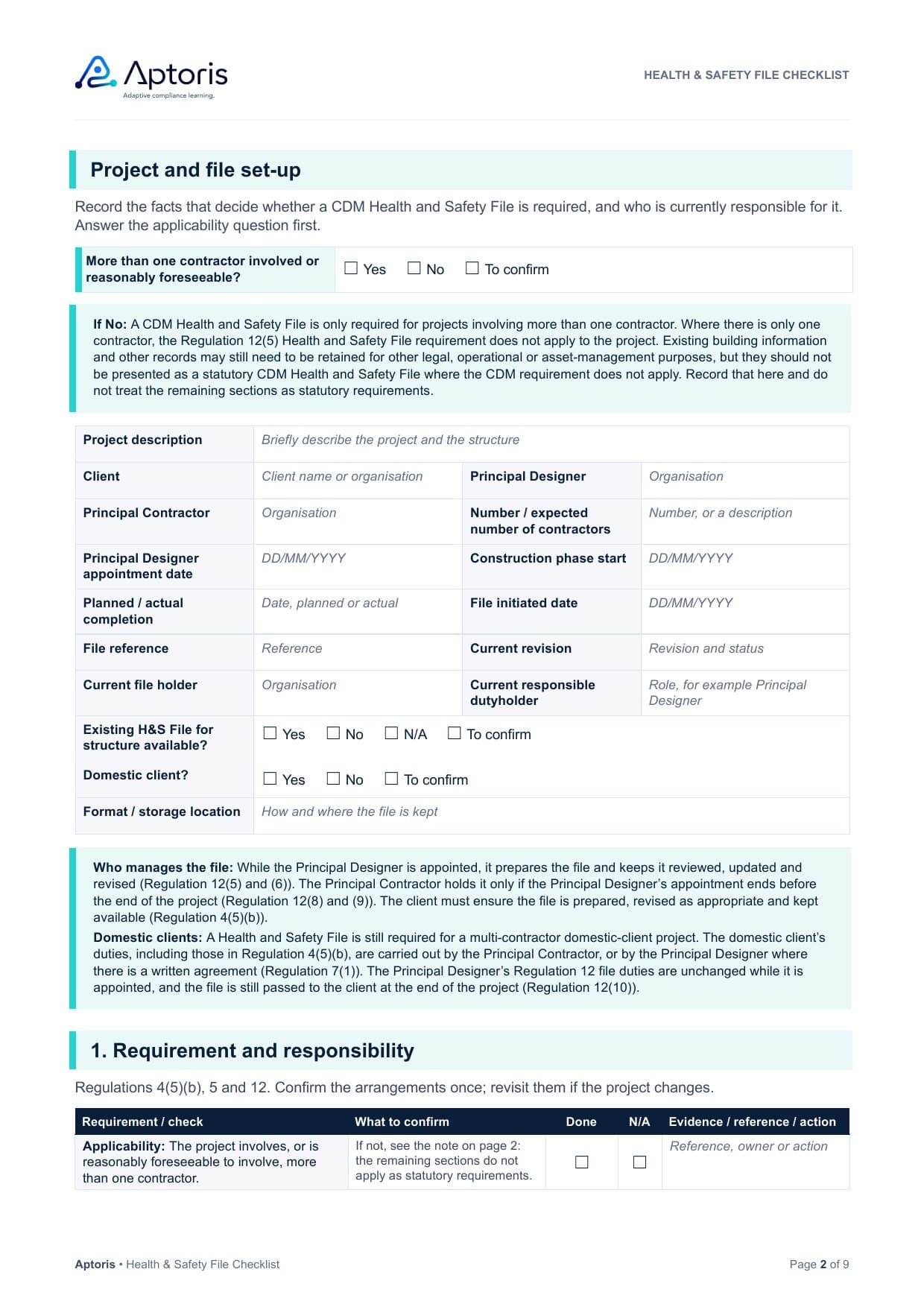
These are real pages from the Word checklist. Each check has tick boxes (Done, Reviewed / current, Considered or Checked) and N/A, with space for the evidence, reference or action behind it. The blue guidance box can be deleted before issue.
Section 3 · Information to consider for inclusion
Information to consider for inclusion
Swipe to see more pages.
Final review · Outstanding actions
Final review, actions and references
The file should contain information that is likely to be needed during future construction work to protect health and safety. Depending on the project, this may include, where relevant:
Source: HSE L153 (opens in a new tab), Appendix 4, paragraph 3, which lists these as matters to consider for inclusion. Not every category arises on every project, and not every drawing belongs in the file.
The test is whether the information is likely to be needed during future construction work to protect health and safety.
The Health and Safety File should be proportionate, clear and useful. It should not become a general project archive.
Records should not be included merely because they existed on the project. For example:
Source: HSE L153 (opens in a new tab), Appendix 4, paragraph 4.
These records can contain specific information that is genuinely useful for future construction work. Where they do, retain, extract or reference that relevant information rather than automatically filing the whole document.
No. The CDM Health and Safety File is specifically concerned with information likely to be needed to protect health and safety during future construction work.
There may be overlap with operation and maintenance information, and relevant O&M information can be included or referenced where it meets that test.
Source: CDM 2015 regulation 12(5) (opens in a new tab).
An existing file should be obtained and considered where available.
It may provide useful information for current design decisions, project planning and the updated or new file, but an older file should not automatically be assumed complete or current.
Sources: CDM 2015 regulation 2(1) (opens in a new tab) (Pre-Construction Information includes information in any existing file); HSE L153 (opens in a new tab), Appendix 4, paragraph 10.
Designers must provide information about risks they could not eliminate and ensure appropriate information is included in the file (regulation 9(3)(b)–(c) and 9(4) (opens in a new tab)). The checklist reviews whether the project captures:
No prescribed form, separate file section from every designer or Design Risk Register is required. See designer duties under CDM 2015.
During the project, the Principal Contractor must provide the Principal Designer with information in its possession that is relevant to the Health and Safety File (regulation 12(7) (opens in a new tab)). The checklist reviews practical arrangements for:
Gathering information progressively is good practice, not a separate statutory deadline. Contractors other than the Principal Contractor have no specific file duty of their own (HSE L153 (opens in a new tab), Appendix 4, paragraph 16); their information reaches the file through project arrangements.
The file is appropriately reviewed, updated and revised from time to time to take account of the work and any changes (regulation 12(6) (opens in a new tab)). The checklist prompts a review of whether:
CDM 2015 does not prescribe a universal weekly or monthly review frequency. Review and updating should respond to the work and changes occurring on the project.
If the Principal Designer’s appointment ends before project completion, the Principal Designer passes the Health and Safety File to the Principal Contractor.
The Principal Contractor then becomes responsible for appropriately reviewing, updating and revising the file for the remainder of the project.
Source: CDM 2015 regulation 12(8)–(9) (opens in a new tab). HSE advises making the Principal Contractor aware of outstanding issues (L153 (opens in a new tab), Appendix 4, paragraph 13).
At the end of the project, the Principal Designer passes the Health and Safety File to the client where the Principal Designer remains appointed.
Where the Principal Designer’s appointment ended earlier and the Principal Contractor holds the file, the Principal Contractor passes it to the client.
Source: CDM 2015 regulation 12(10) (opens in a new tab). The handover passes the file on; it is not a certificate that the file is complete or compliant.
The client must ensure the file is prepared, revised as appropriate and kept available for inspection by any person who may need it to comply with the relevant legal requirements (regulation 4(5)(b) (opens in a new tab)). In practice, the checklist reviews whether:
HSE advises keeping the file for as long as it is relevant, normally the lifetime of the building (L153 (opens in a new tab), Appendix 4, paragraph 7). CDM 2015 does not mandate a storage platform, file format or retention system.
If the client disposes of its interest in the structure, the file is provided to the person acquiring that interest and that person is made aware of the nature and purpose of the file.
Source: CDM 2015 regulation 4(7) (opens in a new tab).
Regulation 4 requires the client to ensure the file is revised as appropriate and remains available. HSE guidance also advises retaining it for as long as it is relevant.
Later construction projects are a common route through which the file is revisited, supplied as existing information and updated where necessary.
Sources: CDM 2015 regulation 4(5)(b) (opens in a new tab); HSE L153 (opens in a new tab), Appendix 4, paragraph 7.
No particular software platform is prescribed.
The important point is that the information remains durable, accessible and usable by people who may need it in future.
HSE notes the file can be kept electronically, on paper, on film or in any other durable form (L153 (opens in a new tab), Appendix 4, paragraph 7).
Confirm whether the project involves more than one contractor and identify who currently manages the file.
Check that the file contains proportionate information relevant to future construction work rather than generic project records.
Review designer and Principal Contractor information, changes, revisions and any PD-to-PC or final client handover arrangements.
Use the evidence / reference / action fields and outstanding-actions table to record missing or unclear information.
Anyone preparing, holding, receiving or reviewing a CDM Health and Safety File can use it.
Review the file while you prepare and maintain it.
Review the file you hold after a Principal Designer’s appointment ends.
Review the file at handover and your arrangements for keeping it.
Help duty holders review the file and record the gaps.
See whether designers’ file information is being captured.
Support the CDM arrangements for gathering and handing over information.
Review an existing file before a new project starts.
An adviser can help review the file and record the gaps, but using an adviser does not transfer any statutory duty holder’s responsibilities.
Yes. It is free to download, with no sign-up and no email address needed. Select Download the Word checklist and the file downloads straight away.
A Microsoft Word document (.docx) of 9 A4 pages, with no macros. It has project and file details on the first page, a set-up page, ten numbered review sections, a practical final review, an outstanding actions table, key references and a completed / reviewed record. Each prompt is a Word content control, and each check has tick boxes with space for the evidence, reference or action. The document is not locked, so it can be adapted, printed, or saved as a PDF once completed.
For projects involving more than one contractor, including where that is reasonably foreseeable. Where there is only one contractor, the regulation 12(5) (opens in a new tab) Health and Safety File requirement does not apply to the project.
The Principal Designer, during the pre-construction phase, and it keeps the file reviewed, updated and revised while it remains appointed. The Principal Contractor provides relevant information to the Principal Designer (regulation 12(5)–(7) (opens in a new tab)).
Information likely to be needed during future construction work to protect health and safety. Depending on the project, that may include a description of the work, residual hazards, key structural principles, hazardous materials, removal or dismantling arrangements, cleaning and maintenance equipment, significant services and relevant as-built information (L153 (opens in a new tab), Appendix 4). Not every category applies to every project.
No. The file should be proportionate and include what future construction work needs, not everything the project produced. Records should not be included merely because they existed; where a record contains something genuinely useful for future work, retain, extract or reference that information.
Not simply as a project record. HSE guidance says the file should not include things that will be of no help when planning future construction work, such as the Construction Phase Plan (L153 (opens in a new tab), Appendix 4, paragraph 4). If it contains a specific item of lasting relevance, extract or reference that item.
Routine construction-phase RAMS and Method Statements should not be filed merely because they were used during the project. Where one records something that remains relevant to future work, such as a temporary-works element left in place, extract or reference that information.
No. The file is specifically concerned with information likely to be needed to protect health and safety during future construction work. There may be overlap, and relevant O&M information can be included or referenced where it meets that test.
The Principal Designer, while it remains appointed. If the Principal Designer’s appointment ends before the project does, the Principal Contractor takes over reviewing, updating and revising it (regulation 12(6) and (9) (opens in a new tab)). CDM 2015 does not set a fixed review frequency.
The Principal Designer passes the file to the Principal Contractor, which then reviews, updates and revises it for the remainder of the project (regulation 12(8)–(9) (opens in a new tab)). A sensible handover identifies the current revision, outstanding information and known gaps.
The client. The Principal Designer passes it on where it remains appointed; where the Principal Designer’s appointment ended earlier and the Principal Contractor holds the file, the Principal Contractor passes it on (regulation 12(10) (opens in a new tab)). Handover is not a formal sign-off or certification of the file.
CDM 2015 sets no fixed number of years. The client must ensure the file is kept available for anyone who may need it to comply with relevant legal requirements (regulation 4(5)(b) (opens in a new tab)), and HSE guidance advises keeping it for as long as it is relevant, normally the lifetime of the building (L153 (opens in a new tab), Appendix 4, paragraph 7).
The client provides the file to the person acquiring its interest in the structure and makes sure that person is aware of the nature and purpose of the file (regulation 4(7) (opens in a new tab)).
The template and guide for the file itself, and checklists for the duty holders who prepare and receive it.
An editable Word template for preparing the file itself, structured around HSE Appendix 4.
What the file is, when it is required, who prepares it and what it should contain.
Review the Principal Designer’s duties, including preparing and maintaining the file.
Review the Principal Contractor’s duties, including information for the file.
Review the client duties, including ensuring the file is prepared and kept available.
A Word template for the information the client provides, including any existing file.
Download the editable Word checklist and record the content, updates, handover arrangements and outstanding actions that apply.
Editable .docx, 9 pages, No sign-up required