Guide
Principal Contractor duties
The Principal Contractor’s duties under CDM 2015 explained, from the Construction Phase Plan to worker consultation.

Free Word checklist
A practical, editable Word checklist for reviewing the Principal Contractor’s key duties during the construction phase under CDM 2015.
Editable .docx, 9 pages, No sign-up required
Read the Principal Contractor Duties guide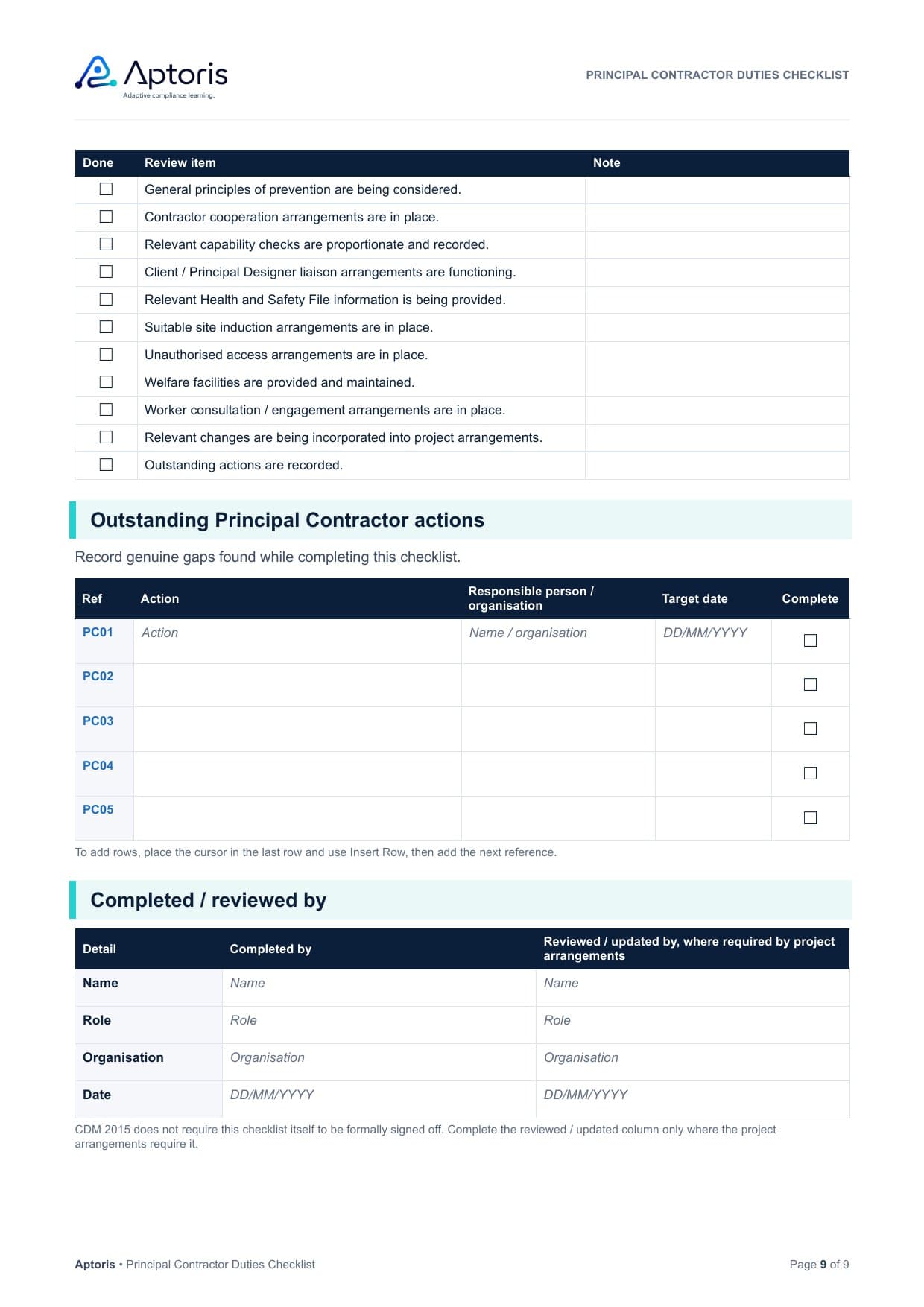
The Principal Contractor is responsible for planning, managing and monitoring the construction phase and coordinating health and safety matters so that, so far as is reasonably practicable, construction work is carried out without risks to health or safety. The key duties include:
This is a summary, not a substitute for the Regulations. Sources: CDM 2015 regulations 12 (opens in a new tab), 13 (opens in a new tab) and 14 (opens in a new tab), with the relevant parts of regulation 8 (opens in a new tab) and regulation 15 (opens in a new tab); HSE Principal contractors: roles and responsibilities (opens in a new tab); HSE L153 Managing health and safety in construction (opens in a new tab). The Principal Contractor Duties guide explains each duty in more detail.
Where more than one contractor will work on the project, or it is reasonably foreseeable that more than one contractor will work on it, the client must appoint a Principal Contractor in writing.
The appointment must be made as soon as practicable and, in any event, before the construction phase begins.
Source: CDM 2015 regulation 5 (opens in a new tab). See the Principal Contractor appointment guide.
Where only one contractor is involved, Regulation 5 does not require a Principal Contractor appointment solely because of contractor count. The contractor still has its own CDM duties, including preparing the Construction Phase Plan.
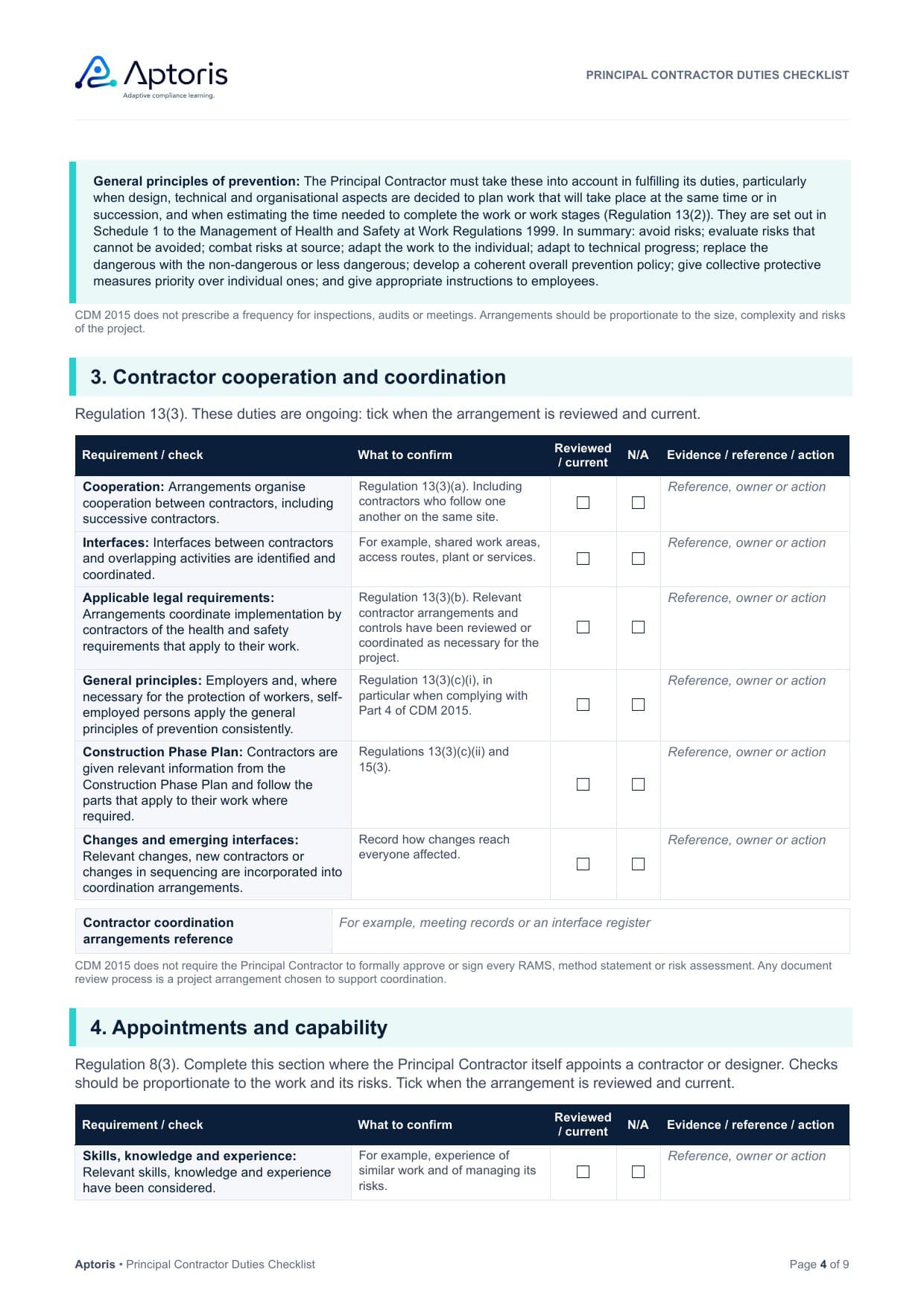
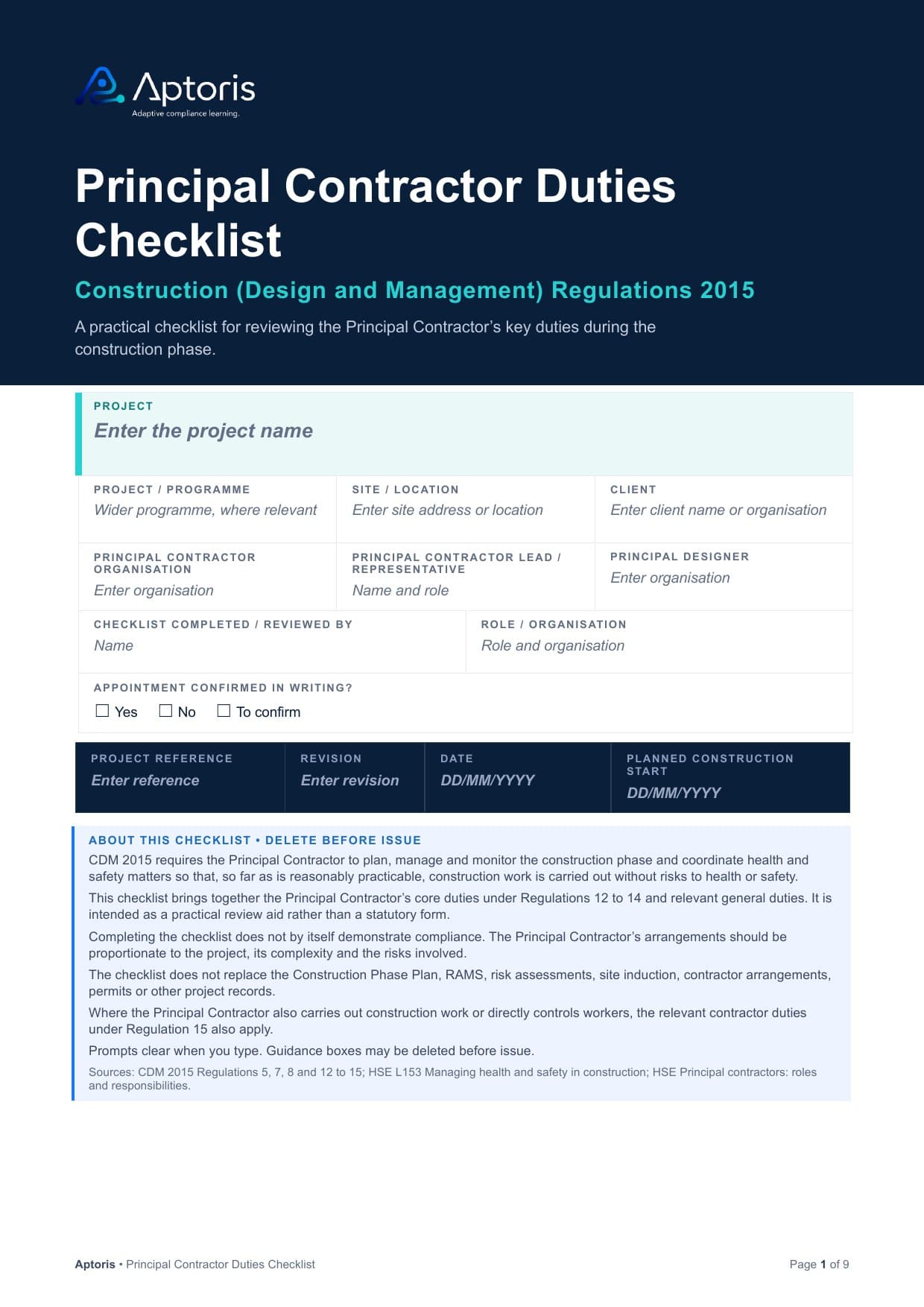
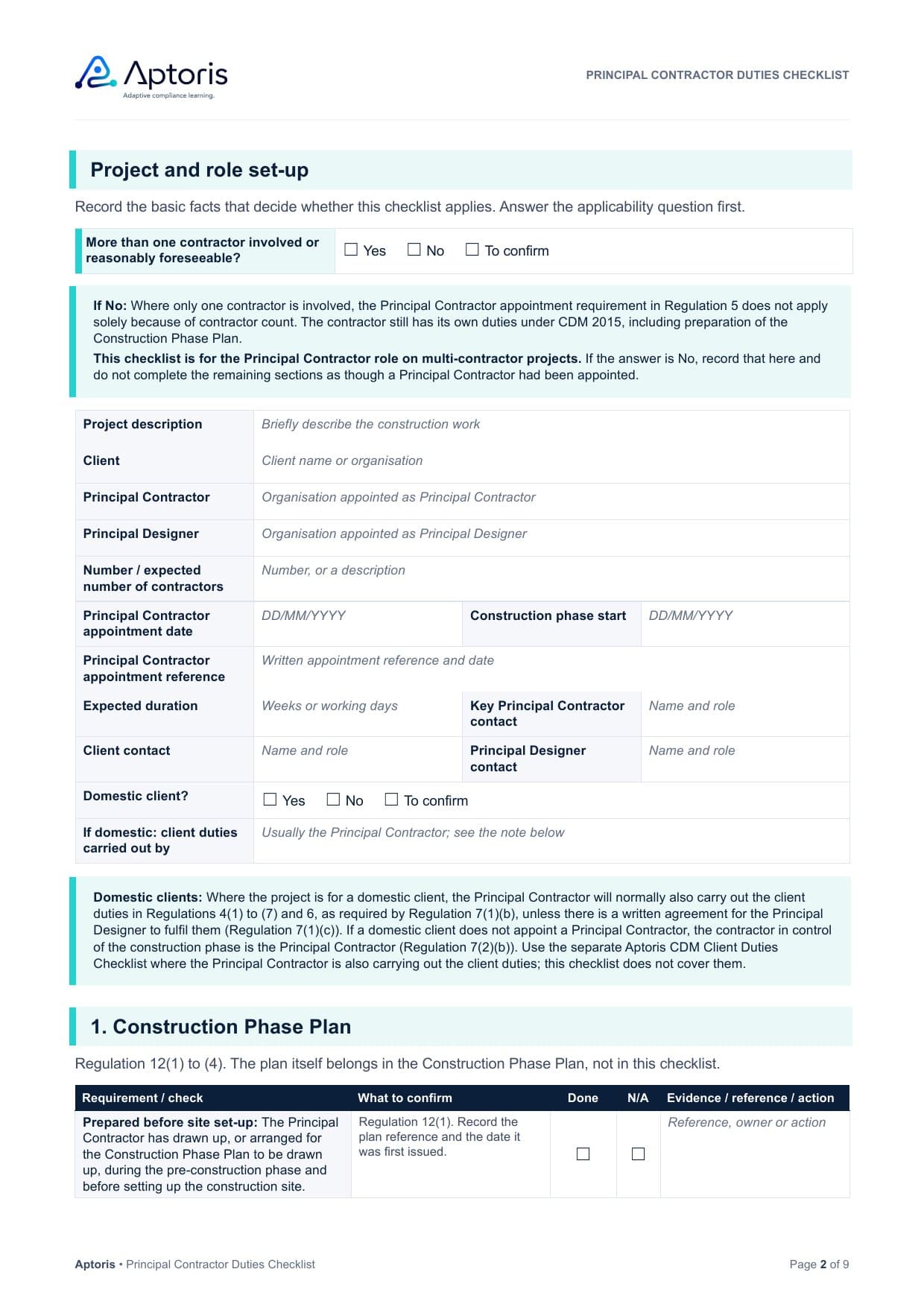
Contractor duties under CDM 2015Nine pages: project details and role set-up, eleven numbered duty sections, a practical final review, outstanding Principal Contractor actions and a completed / reviewed record.
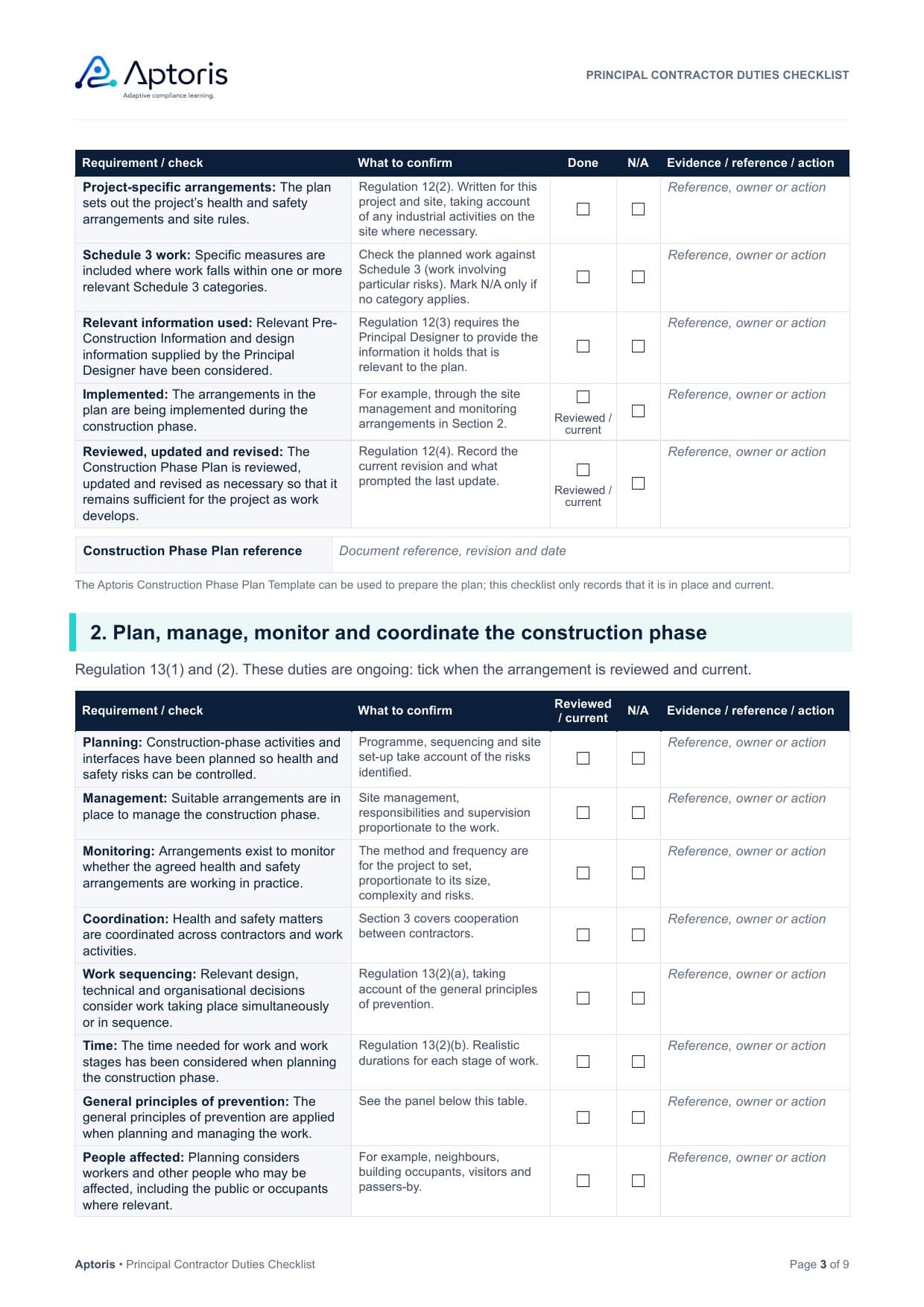
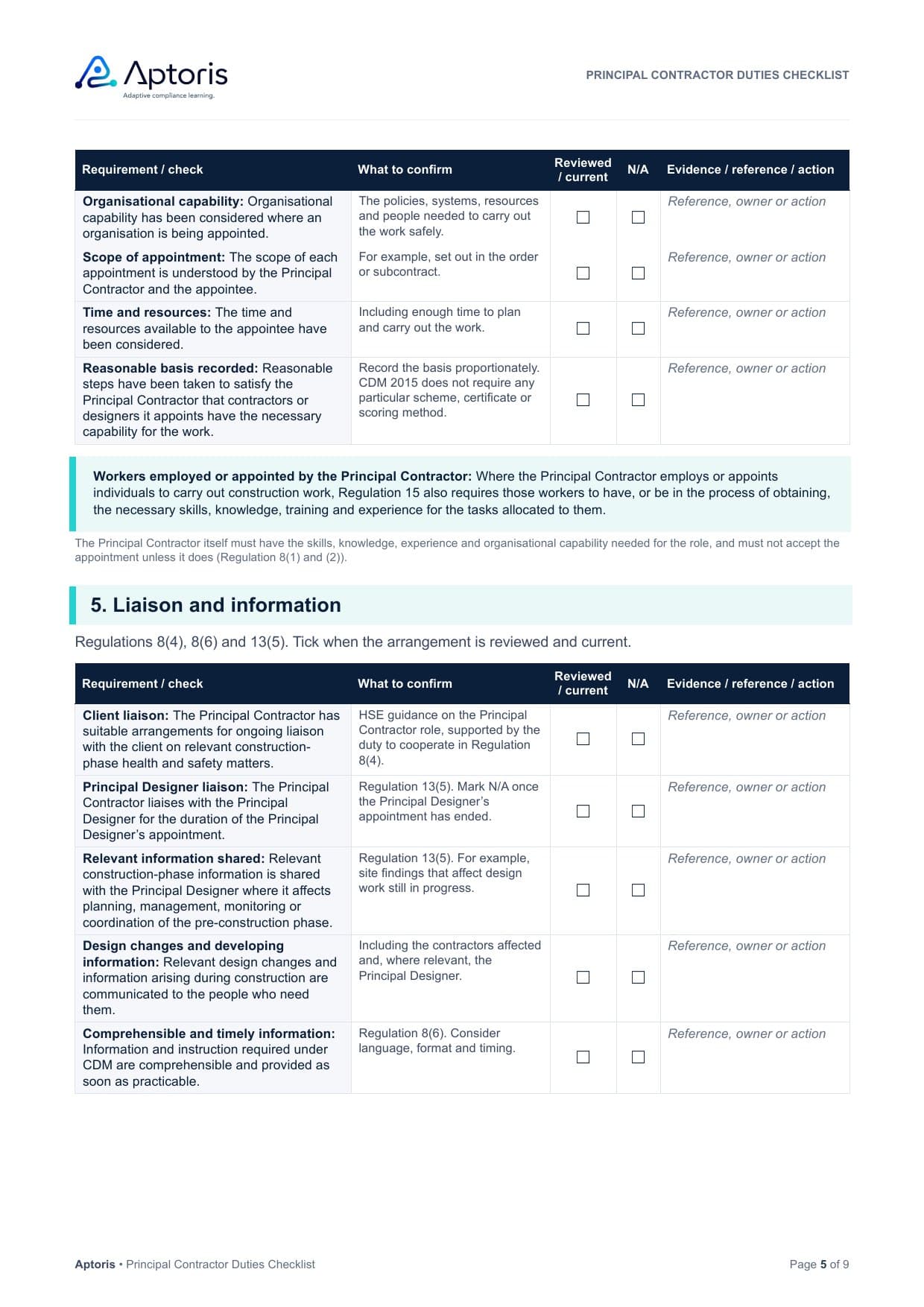
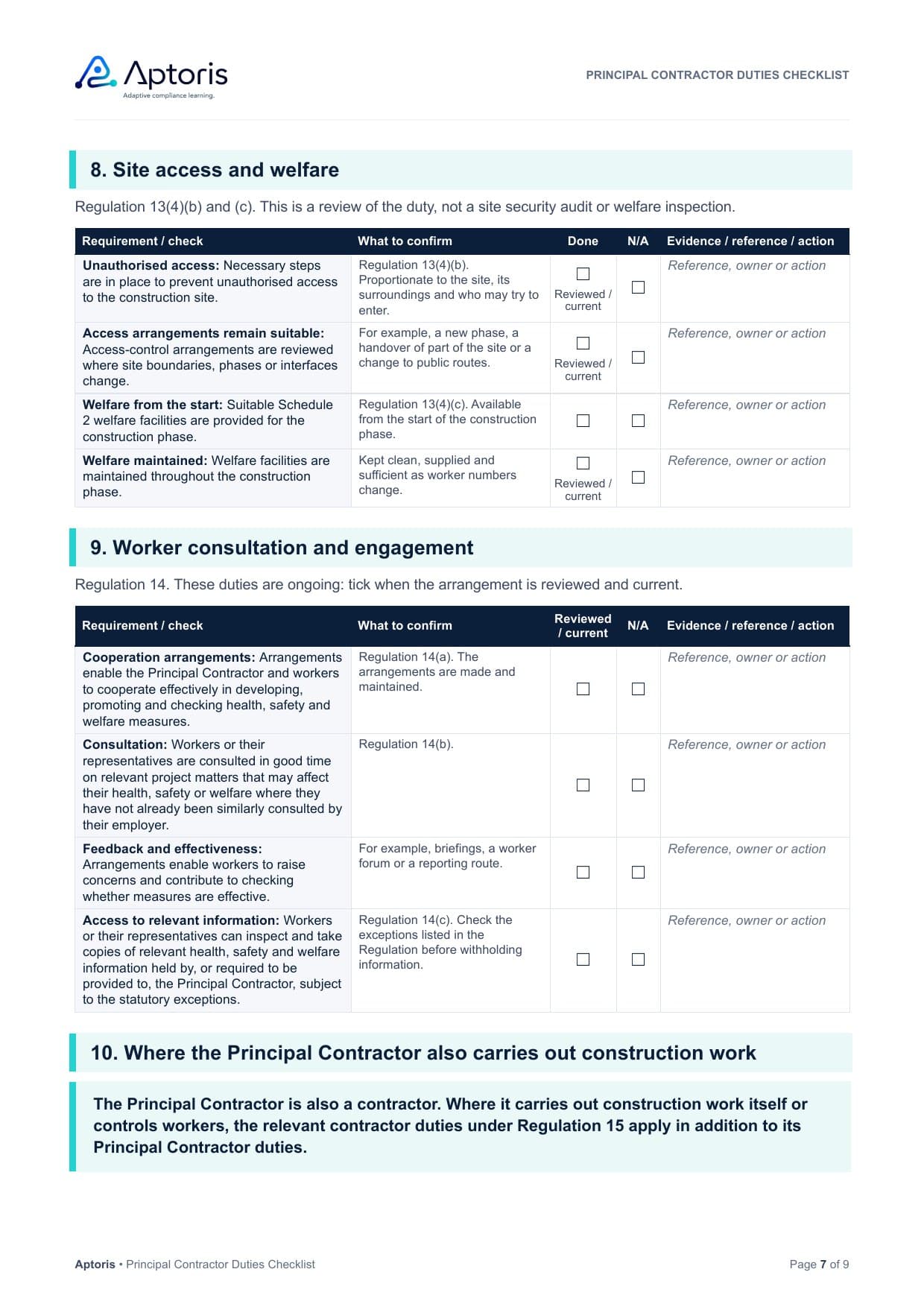
These are real pages from the Word checklist. Each check has tick boxes for Done (or Reviewed / current, for ongoing duties) and N/A, with space for the evidence, reference or action behind it. The blue guidance boxes can be deleted before issue.
Section 3 · Contractor cooperation and coordination
Contractor cooperation and coordination
Swipe to see more pages.
Final review · Outstanding Principal Contractor actions
Final review and actions
A project and role set-up page, the Principal Contractor’s duties in order, then a practical final review, outstanding actions and a completed / reviewed record.
On a project with more than one contractor, the Principal Contractor must draw up the Construction Phase Plan, or arrange for it to be drawn up:
Source: regulation 12(1)–(4) (opens in a new tab). See the Construction Phase Plan Template and Construction Phase Plan guide.
This is the core Principal Contractor duty in regulation 13(1) (opens in a new tab): planning, managing and monitoring the construction phase and coordinating health and safety matters so that construction work is carried out, so far as is reasonably practicable, without risks to health or safety.
It reviews the management arrangements; it is not a site inspection checklist.
The Principal Contractor must take the general principles of prevention into account when planning and managing the work, including decisions about sequencing and the time needed for work or work stages.
Sources: regulation 13(2) (opens in a new tab); the principles are set out in Schedule 1 to the Management of Health and Safety at Work Regulations 1999 (opens in a new tab).
The Principal Contractor must organise cooperation between contractors, including successive contractors on the same site, and coordinate their implementation of the health and safety requirements that apply to their work (regulation 13(3) (opens in a new tab)). The checklist prompts a review of:
The checklist records how cooperation and coordination are arranged; it is not a subcontractor register.
CDM 2015 does not prescribe a universal requirement for the Principal Contractor to formally approve or sign every RAMS, Method Statement or risk assessment.
The Principal Contractor must still plan, manage, monitor and coordinate the construction phase and ensure relevant contractor arrangements and controls are coordinated appropriately. A project may choose a document-review or approval process as part of its own arrangements.
Source: CDM 2015 regulation 13 (opens in a new tab). See the Method Statements and RAMS guide.
Where the Principal Contractor appoints designers or contractors, it must take reasonable steps to satisfy itself that they have what the work needs (regulation 8(3) (opens in a new tab)). The steps should be proportionate to the work and its risks.
CDM 2015 does not prescribe a particular SSIP scheme, ISO certification or scoring method.
Where the Principal Contractor employs or appoints individuals to carry out construction work, regulation 15 (opens in a new tab) also requires them to have, or be in the process of obtaining, the necessary skills, knowledge, training and experience. See competence under Regulation 8.
The Principal Contractor should:
Sources: regulation 13(5) (opens in a new tab) and regulation 8(4) and (6) (opens in a new tab); HSE Principal contractors guidance (opens in a new tab).
The Principal Designer prepares the file while appointed. The Principal Contractor:
Source: regulation 12(7)–(10) (opens in a new tab). See the Health and Safety File guide and template.
The Principal Contractor must ensure that a suitable site induction is provided. It should be:
Source: regulation 13(4)(a) (opens in a new tab).
Site Induction ChecklistTake necessary steps to prevent unauthorised access to the construction site and review arrangements as site boundaries or phases change.
Ensure suitable Schedule 2 welfare facilities are provided and maintained throughout the construction phase.
Sources: regulation 13(4)(b) and (c) (opens in a new tab); CDM 2015 Schedule 2 (opens in a new tab).
Regulation 14 (opens in a new tab) gives the Principal Contractor specific duties to work with the people doing the construction work. The checklist covers:
The exceptions to the information duty are listed in regulation 14(c) (opens in a new tab).
Where the Principal Contractor carries out construction work itself or controls workers, the relevant contractor duties under Regulation 15 apply in addition to the Principal Contractor duties.
Source: regulation 15 (opens in a new tab). See contractor duties under CDM 2015.
There is no universal fixed review frequency. The checklist prompts a review when something changes, for example:
CDM 2015 does not prescribe a universal daily, weekly or monthly monitoring frequency. Arrangements should be proportionate to the project’s size, complexity and risks.
On a multi-contractor domestic project, the Principal Contractor will normally also carry out the client duties transferred under Regulation 7 unless there is a written agreement for the Principal Designer to fulfil them.
Those transferred client duties are separate from the Principal Contractor duties covered here.
Source: CDM 2015 regulation 7 (opens in a new tab). Use the CDM Client Duties Checklist for the transferred client duties.
Confirm that the Principal Contractor has been appointed and that the project involves, or is expected to involve, more than one contractor.
Work through the CPP, management, coordination, information, induction, welfare and worker-engagement sections that apply.
Use the evidence / reference / action fields to record project documents, coordination records or gaps that need attention.
Review relevant sections when changes to contractors, design, sequencing, site arrangements or risks make the existing review outdated.
Anyone reviewing or supporting the Principal Contractor’s CDM 2015 duties on a project can use it.
Review your arrangements before work starts and as the project develops.
Check the arrangements you manage on the Principal Contractor’s behalf.
See which site arrangements are in place and which actions remain.
Keep the plan, coordination and information flows current as the project changes.
Apply a consistent review across projects and record the evidence behind it.
Help the Principal Contractor review its duties and record the basis for its arrangements.
Understand what the Principal Contractor role will involve before taking it on.
An adviser can help review the arrangements and record the evidence, but using an adviser does not transfer the Principal Contractor’s duties.
Yes. It is free to download, with no sign-up and no email address needed. Select Download the Word checklist and the file downloads straight away.
A Microsoft Word document (.docx) of 9 A4 pages, with no macros. It has project details on the first page, a project and role set-up page, eleven numbered duty sections, a practical final review, an outstanding Principal Contractor actions table and a completed / reviewed record. Each prompt is a Word content control, and each check has tick boxes for Done (or Reviewed / current) and N/A with space for the evidence, reference or action. The document is not locked, so it can be adapted, printed, or saved as a PDF once completed.
To plan, manage and monitor the construction phase and coordinate health and safety matters during it (regulation 13 (opens in a new tab)). That includes drawing up and maintaining the Construction Phase Plan, organising cooperation between contractors, ensuring a suitable site induction, preventing unauthorised access, providing welfare facilities and liaising with the Principal Designer, as well as providing Health and Safety File information (regulation 12 (opens in a new tab)) and consulting and engaging workers (regulation 14 (opens in a new tab)).
Where more than one contractor will work on the project, or it is reasonably foreseeable that more than one contractor will work on it (regulation 5 (opens in a new tab)). Where only one contractor is involved, Regulation 5 does not require a Principal Contractor appointment for that reason; the contractor still has its own duties, including preparing the Construction Phase Plan.
The client, in writing, as soon as practicable and before the construction phase begins (regulation 5 (opens in a new tab)). If a client required to appoint a Principal Contractor does not do so, the client must fulfil the Principal Contractor’s duties itself. If a domestic client does not make the appointment, the contractor in control of the construction phase is the Principal Contractor (regulation 7(2) (opens in a new tab)). The Principal Contractor Appointment Letter can be used to record the appointment.
On a project with more than one contractor, the Principal Contractor draws up the plan, or arranges for it to be drawn up, during the pre-construction phase and before setting up the construction site, then reviews, updates and revises it as necessary (regulation 12 (opens in a new tab)). On a one-contractor project, the contractor draws it up (regulation 15 (opens in a new tab)). The Construction Phase Plan Template gives a structure for it.
CDM 2015 does not prescribe a universal requirement for the Principal Contractor to formally approve or sign every RAMS, Method Statement or risk assessment. The Principal Contractor must still plan, manage, monitor and coordinate the construction phase and ensure relevant contractor arrangements and controls are coordinated appropriately. A project may choose a document-review or approval process as part of its own arrangements.
CDM 2015 does not set a universal daily, weekly or monthly frequency for the Principal Contractor’s monitoring, inspections, audits or meetings. The Principal Contractor must monitor the construction phase (regulation 13(1) (opens in a new tab)), and its arrangements should be proportionate to the project’s size, complexity and risks. Specific inspection requirements for particular work or equipment, under Part 4 of CDM 2015 or other legislation, still apply.
The Principal Contractor must ensure that a suitable site induction is provided (regulation 13(4)(a) (opens in a new tab)); it does not have to deliver every induction personally. Contractors must provide a suitable induction to workers under their control where the Principal Contractor has not already provided one. The Site Induction Checklist can be used to prepare and record a detailed induction.
To ensure that welfare facilities complying with Schedule 2 (opens in a new tab) are provided throughout the construction phase (regulation 13(4)(c) (opens in a new tab)): in practice, from the start and maintained as the project and workforce change. The client must also make arrangements that ensure welfare facilities are provided, and contractors have welfare duties for the workers under their control.
Yes, but the Principal Designer prepares the file while appointed. The Principal Contractor must provide the Principal Designer with relevant information in its possession for the file. If the Principal Designer’s appointment ends before the end of the project, the file passes to the Principal Contractor, which must then review, update and revise it; and where there is no Principal Designer at the end of the project, the Principal Contractor passes the file to the client (regulation 12(7)–(10) (opens in a new tab)).
On a domestic project with more than one contractor, the Principal Contractor will normally also carry out the client duties in regulations 4(1) to (7) and 6, unless there is a written agreement for the Principal Designer to fulfil them (regulation 7 (opens in a new tab)). Those transferred client duties are separate from the Principal Contractor duties this checklist covers: use the CDM Client Duties Checklist for them.
Yes. The Principal Contractor is also a contractor. Where it carries out construction work itself or controls workers, the relevant contractor duties under regulation 15 (opens in a new tab) apply in addition to its Principal Contractor duties. Section 10 of the checklist is a short reminder of them.
Guidance, templates and checklists for the duties the checklist reviews.
The Principal Contractor’s duties under CDM 2015 explained, from the Construction Phase Plan to worker consultation.
A one-page Word letter recording the client’s written Principal Contractor appointment under CDM 2015.
A Word template for the plan the Principal Contractor draws up before the construction site is set up.
Prepare, deliver and record a site-specific construction induction, including site rules, emergencies and attendance.
A Word template for the file the Principal Designer prepares, with the information the Principal Contractor provides.
Review the client duties, including those a Principal Contractor carries out for a domestic client.
Download the editable Word checklist and record the arrangements, evidence and outstanding actions that apply.
Editable .docx, 9 pages, No sign-up required