Guide
CDM client duties
The client’s duties under CDM 2015 explained, from project arrangements to the Health and Safety File.

Free Word checklist
A practical, editable Word checklist for reviewing the key duties of a client commissioning construction work under CDM 2015.
Editable .docx, 8 pages, No sign-up required
Read the CDM Client Duties guide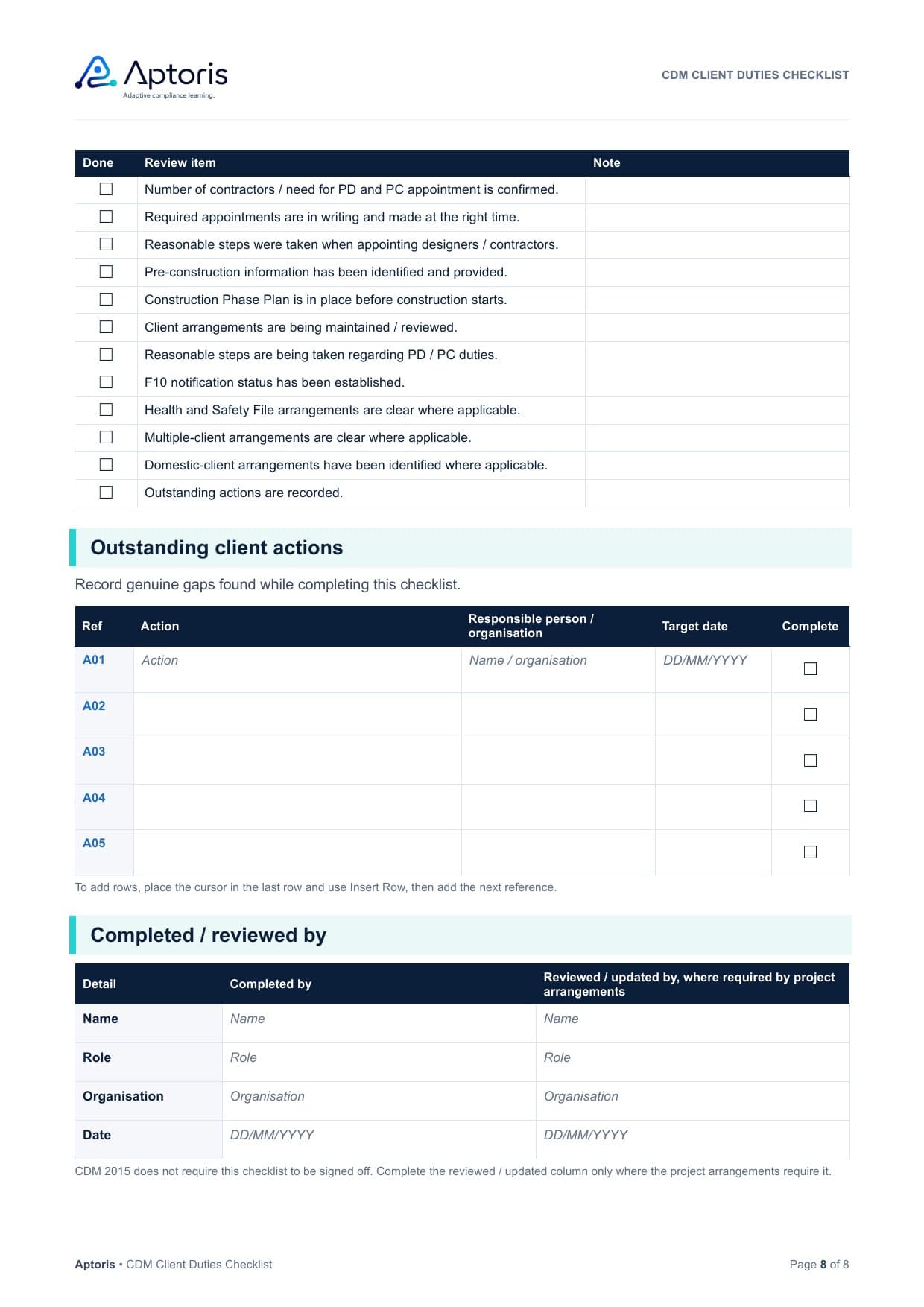
Clients have an important role under CDM 2015 because their decisions about how a project is organised, resourced and timed can affect health and safety. The key client duties include:
This is a summary, not a substitute for the Regulations. Sources: CDM 2015 regulations 4 (opens in a new tab), 5 (opens in a new tab), 6 (opens in a new tab), 7 (opens in a new tab) and 8 (opens in a new tab); HSE L153 Managing health and safety in construction (opens in a new tab); HSE guidance for commercial clients (opens in a new tab). The CDM Client Duties guide explains each duty in more detail.
The checklist is built primarily for commercial and other non-domestic clients, such as businesses, developers, landlords, public bodies and charities, who retain the client duties under CDM 2015.
Sections 1 to 7 follow those duties in order, from project arrangements to the Health and Safety File.
For a domestic client, most duties in Regulations 4(1)–(7) and 6 are normally carried out by the contractor on a one-contractor project, the Principal Contractor on a multi-contractor project, or the Principal Designer where there is a written agreement for the PD to fulfil them.
The checklist includes a dedicated domestic-client section so the transferred-duty arrangement can be recorded without treating the householder as a commercial client.
Sources: CDM 2015 regulation 7 (opens in a new tab); HSE guidance for domestic clients (opens in a new tab). See how the duties work for domestic clients.
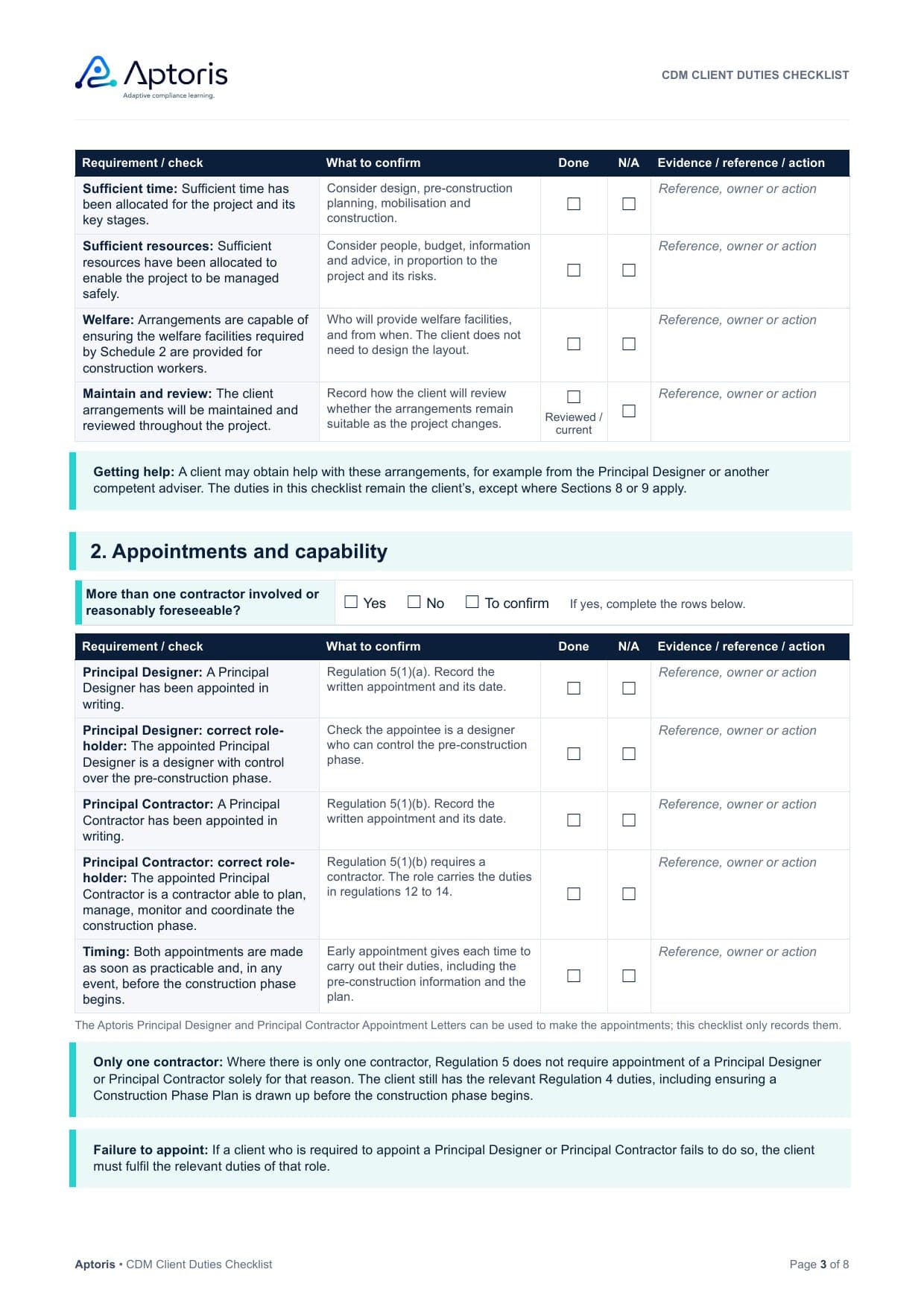
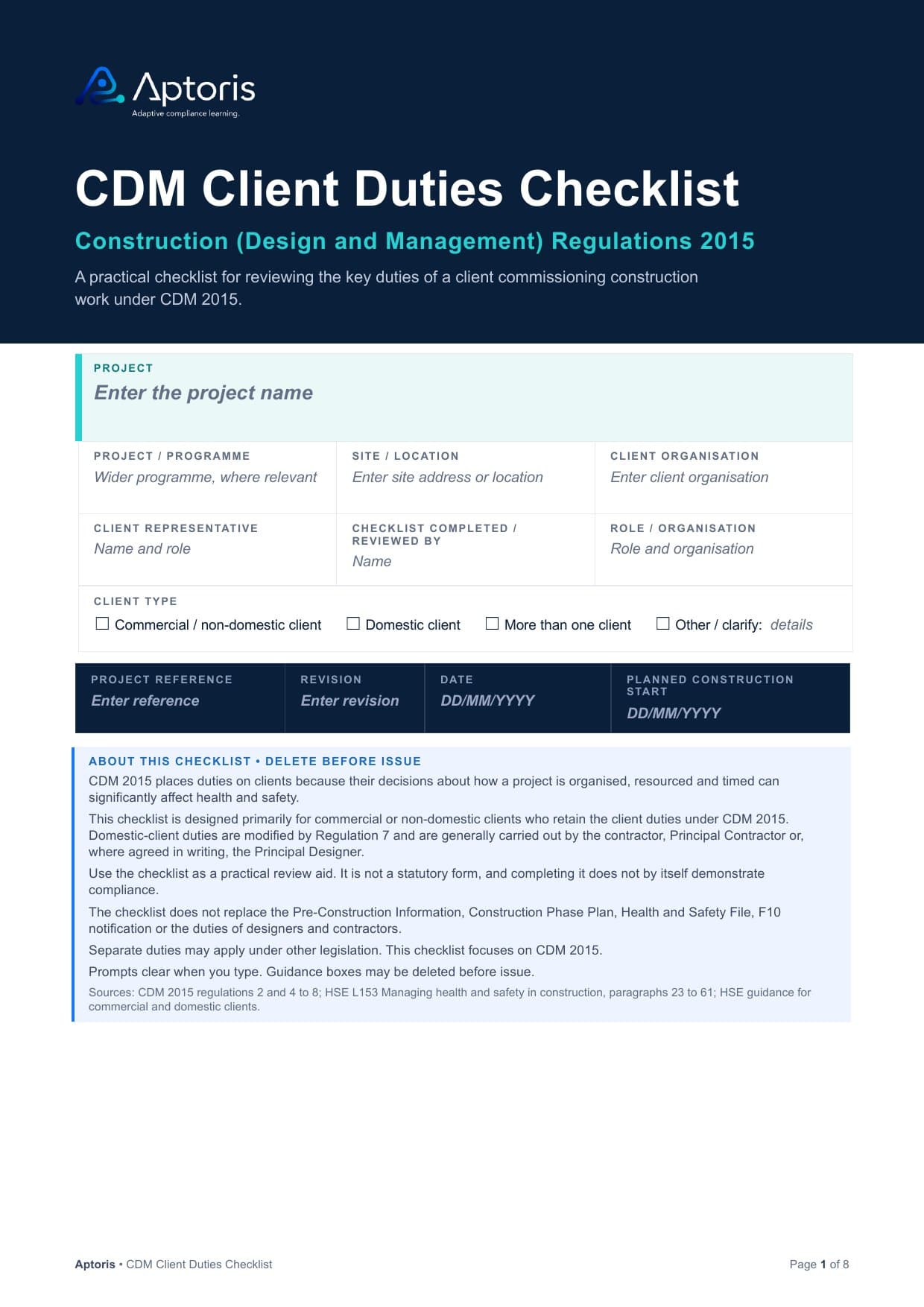
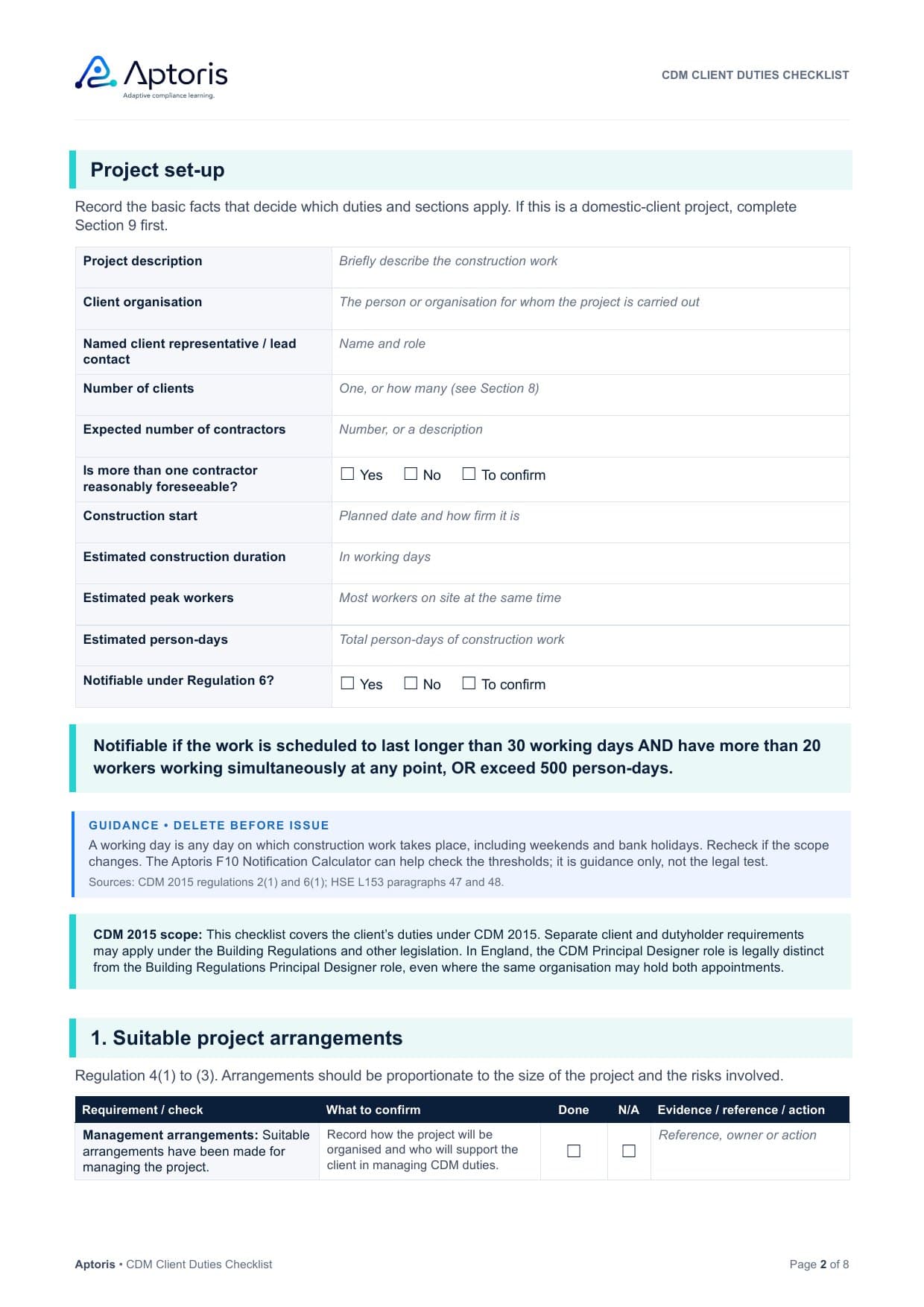
Eight pages: project details and set-up, ten numbered sections, outstanding client actions and a completed / reviewed record.
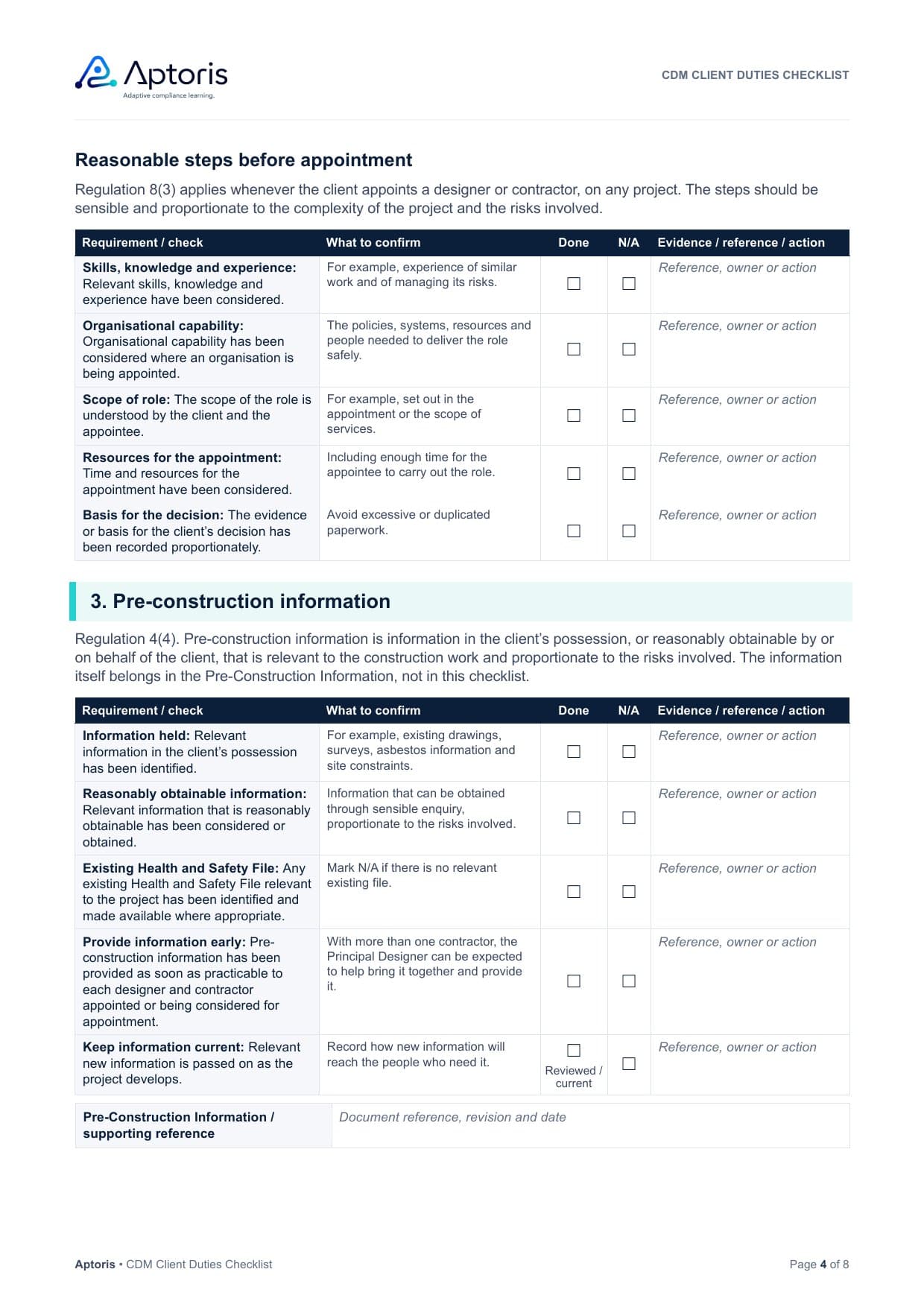
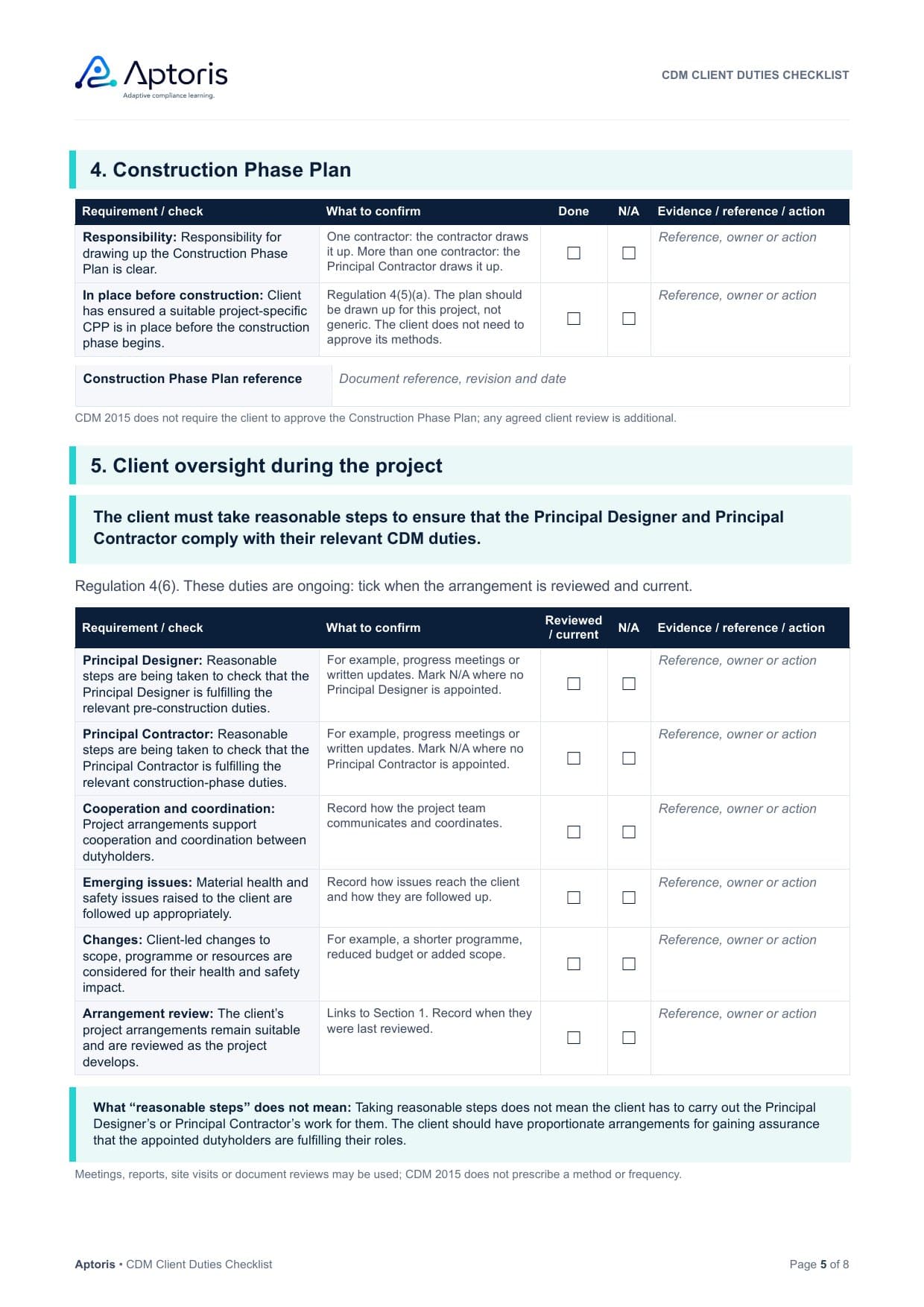
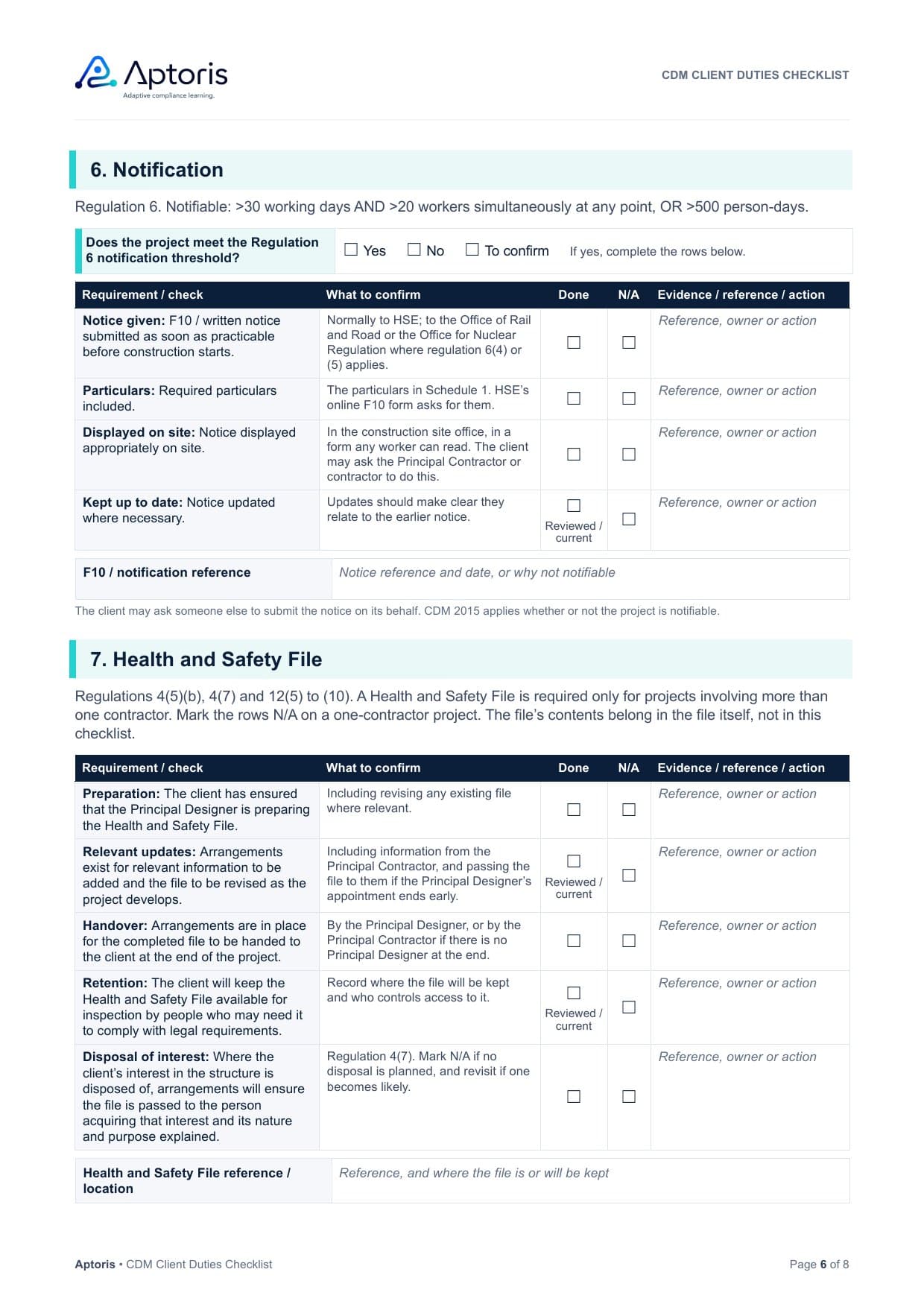
These are real pages from the Word checklist. Each check has tick boxes for Done (or Reviewed / current, for ongoing duties) and N/A, with space for the evidence, reference or action behind it. The blue guidance boxes can be deleted before issue.
Section 2 · Appointments and capability
Appointments
Swipe to see more pages.
Final review · Outstanding client actions
Final review and actions
A project set-up page, ten numbered sections, then the client’s outstanding actions and a completed / reviewed record.
Where more than one contractor will work on the project, or this is reasonably foreseeable, the client must appoint in writing a Principal Designer and Principal Contractor.
The appointments must be made as soon as practicable and, in any event, before the construction phase begins.
Must be a designer with control over the pre-construction phase.
Principal Designer Appointment LetterMust be a contractor, appointed to carry out the Principal Contractor role. The checklist records that the appointed Principal Contractor is a contractor able to plan, manage, monitor and coordinate the construction phase.
Principal Contractor Appointment LetterSource: CDM 2015 regulation 5 (opens in a new tab). How to make each appointment: Principal Designer and Principal Contractor appointment guides.
Where there is only one contractor, Regulation 5 does not require Principal Designer or Principal Contractor appointments solely because of the contractor count. The client still has the relevant Regulation 4 duties, including ensuring a Construction Phase Plan is drawn up before the construction phase begins.
Whenever a client appoints a designer or contractor, on any project, it must take reasonable steps to satisfy itself that the appointee has what the role needs (regulation 8(3) (opens in a new tab)). The steps should be sensible and proportionate to the project and its risks.
The checklist provides a practical record of the basis for the client’s decision, without excessive or duplicated paperwork.
The client must provide Pre-Construction Information as soon as practicable to designers and contractors appointed or being considered for appointment. It should include:
Source: regulation 4(4) (opens in a new tab). Our Pre-Construction Information Template gives you a structure for assembling and issuing it.
The client must ensure the plan is drawn up before the construction phase begins:
CDM 2015 requires the client to ensure a suitable project-specific plan is in place; it does not create a general requirement for the client to approve the technical methods within it. Source: regulation 4(5)(a) (opens in a new tab). See the Construction Phase Plan Template and guide.
The client must take reasonable steps to ensure the Principal Designer and Principal Contractor comply with their relevant CDM duties.
Source: CDM 2015 regulation 4(6) (opens in a new tab); HSE L153 (opens in a new tab). See what the client should check in the Client Duties guide.
A project is notifiable if construction work is scheduled to last longer than 30 working days AND have more than 20 workers working simultaneously at any point, OR exceed 500 person-days.
CDM duties apply whether or not the project is notifiable.
Source: regulation 6 (opens in a new tab). Read the F10 notification guide or check the thresholds with the F10 Notification Calculator.
For projects involving more than one contractor, the client:
Source: regulations 4(5)(b) and 4(7) (opens in a new tab). See the Health and Safety File guide and template.
Clients may agree in writing that one or more of them will be treated as the only client or clients for most relevant CDM client duties.
Even where such an agreement exists, certain duties remain with every client, including cooperation and relevant information duties.
Without such an agreement, each client remains subject to the client duties under CDM 2015.
Source: CDM 2015 regulation 4(8) (opens in a new tab) and regulation 8(4) and (6) (opens in a new tab).
Confirm the client type, number of contractors, programme and notification status.
Work through the arrangements, appointments, information, planning and ongoing oversight sections that apply.
Use the evidence / reference / action fields to point to appointments, project documents, meeting records or outstanding actions.
Review the checklist when material changes to scope, programme, resources or project arrangements make the existing review outdated.
Anyone reviewing or supporting a client’s CDM 2015 duties on a project can use it.
Review your own duties at the start of a project and as it develops.
Check appointments, information and planning on each development.
Keep sight of Health and Safety File arrangements for the structures you hold.
Apply a consistent review to refurbishment, fit-out and maintenance projects.
See which client arrangements are in place and which actions remain.
Record the evidence and outstanding actions behind the client’s arrangements.
Help the client review its duties and record the basis for its decisions.
A householder’s client duties are normally carried out by the contractor, the Principal Contractor or, under a written agreement, the Principal Designer. Section 9 records that arrangement.
Using an adviser does not automatically transfer the client's CDM duties.
Yes. It is free to download, with no sign-up and no email address needed. Select Download the Word checklist and the file downloads straight away.
A Microsoft Word document (.docx) of 8 A4 pages, with no macros. It has project details on the first page, a project set-up page, ten numbered sections, an outstanding client actions table and a completed / reviewed record. Each prompt is a Word content control, and each check has tick boxes for Done (or Reviewed / current) and N/A with space for the evidence, reference or action. The document is not locked, so it can be adapted, printed, or saved as a PDF once completed.
A commercial client must make suitable arrangements for managing the project, including sufficient time and other resources and the required welfare facilities, and maintain and review them; provide pre-construction information; ensure a Construction Phase Plan is drawn up before the construction phase begins; and, where more than one contractor is involved or reasonably foreseeable, appoint a Principal Designer and Principal Contractor in writing, ensure the Principal Designer prepares a Health and Safety File and take reasonable steps to ensure both comply with their duties (regulations 4 and 5 (opens in a new tab)). It must also take reasonable steps when appointing designers and contractors (regulation 8 (opens in a new tab)) and notify the project where regulation 6 (opens in a new tab) applies.
Where more than one contractor will work on the project, or this is reasonably foreseeable, the client must appoint in writing a designer with control over the pre-construction phase as Principal Designer and a contractor as Principal Contractor. The appointments must be made as soon as practicable and, in any event, before the construction phase begins (regulation 5 (opens in a new tab)).
The duties do not disappear. Where a client is required to appoint a Principal Designer or Principal Contractor and does not do so, the client must fulfil the relevant duties of that role itself (regulation 5(3) and (4) (opens in a new tab)). Domestic clients are treated differently: if a domestic client does not make the appointments, the designer in control of the pre-construction phase is the Principal Designer and the contractor in control of the construction phase is the Principal Contractor (regulation 7(2) (opens in a new tab)).
Where there is only one contractor, Regulation 5 does not require Principal Designer or Principal Contractor appointments solely because of the contractor count. The client still has the relevant Regulation 4 duties: suitable arrangements, sufficient time and resources, welfare, pre-construction information and ensuring the contractor draws up a Construction Phase Plan before the construction phase begins. Reasonable steps still apply when appointing the contractor and any designer, and the project may still be notifiable. A Health and Safety File is required only where there is more than one contractor.
Provide it as soon as practicable to every designer and contractor appointed, or being considered for appointment (regulation 4(4) (opens in a new tab)). It is information in the client’s possession, or reasonably obtainable by or on behalf of the client, that is relevant to the work and proportionate to the risks, such as existing drawings, surveys, asbestos information and any existing Health and Safety File. Our Pre-Construction Information Template gives a structure for it.
No. CDM 2015 requires the client to ensure the plan is drawn up before the construction phase begins: by the contractor where there is only one contractor, or by the Principal Contractor where there is more than one (regulation 4(5)(a) (opens in a new tab)). It does not create a general requirement for the client to approve the plan or the technical methods within it. A client may agree to review the plan as part of its own arrangements, but that is an additional step.
When the project is notifiable: when construction work is scheduled to last longer than 30 working days and have more than 20 workers working simultaneously at any point, or exceed 500 person-days (regulation 6 (opens in a new tab)). The client must then give notice in writing, normally to HSE using form F10, as soon as practicable before the construction phase begins; someone else may submit it on the client’s behalf. CDM duties apply whether or not a project is notifiable. The F10 Notification Calculator can help check the thresholds.
Where a Principal Designer and Principal Contractor are appointed, the client must take reasonable steps to ensure they comply with their relevant duties (regulation 4(6) (opens in a new tab)). Proportionate assurance may come from project meetings, written updates, document reviews, site visits and following up material issues. CDM 2015 does not prescribe a particular method or fixed monitoring frequency, and taking reasonable steps does not mean carrying out the Principal Designer's or Principal Contractor's work for them.
Not in the same way. A domestic client is having work done on their own home, or a family member’s home, not in connection with a business. Under regulation 7 (opens in a new tab), the client duties in regulations 4(1) to (7) and 6 are carried out by the contractor on a one-contractor project, the Principal Contractor on a multi-contractor project, or the Principal Designer where there is a written agreement for the Principal Designer to fulfil them. The checklist’s domestic-client section records that arrangement; the householder does not carry out the commercial-client checks personally.
Guidance, templates and tools for the duties the checklist reviews.
The client’s duties under CDM 2015 explained, from project arrangements to the Health and Safety File.
A one-page Word letter recording the client’s written Principal Designer appointment under CDM 2015.
A one-page Word letter recording the client’s written Principal Contractor appointment under CDM 2015.
A Word template for assembling, reviewing and issuing the client’s pre-construction information.
A Word template for the plan the contractor or Principal Contractor draws up before construction starts.
Check a project against the Regulation 6 notification thresholds.
Download the editable Word checklist and record the arrangements, evidence and outstanding actions that apply.
Editable .docx, 8 pages, No sign-up required