Template
Pre-Construction Information Template
An editable Word template for preparing a structured PCI document.

Free Word checklist
A practical, editable Word checklist for reviewing whether Pre-Construction Information is relevant, proportionate, provided when needed and kept current under CDM 2015.
Editable .docx, 10 pages, No sign-up required
Pre-Construction Information is information already held by the client, or reasonably obtainable by or on the client’s behalf, that is relevant to the construction work, appropriately detailed and proportionate to the risks involved.
The client must provide PCI as soon as practicable to every designer and contractor appointed, or being considered for appointment, to the project.
On multi-contractor projects, the Principal Designer assists the client and, so far as it is within the Principal Designer’s control, provides PCI promptly and in a convenient form.
Information provided under CDM 2015 must be comprehensible and provided as soon as practicable.
This is a summary, not a substitute for the Regulations. Sources: CDM 2015 regulation 2(1) (opens in a new tab), regulation 4(4) (opens in a new tab), regulation 8(6) (opens in a new tab) and regulation 11(6) (opens in a new tab); HSE L153 Managing health and safety in construction (opens in a new tab), Appendix 2. The Pre-Construction Information guide explains the requirements in more detail.
Yes.
The client’s Regulation 4(4) duty to provide Pre-Construction Information applies on single-contractor projects as well as multi-contractor projects.
Where there is only one contractor, there is no Principal Designer appointment requirement. The client should liaise with the contractor and any designer to provide the information they need.
Sources: CDM 2015 regulation 4(4) (opens in a new tab) and regulation 5(1) (opens in a new tab); HSE L153 (opens in a new tab), Appendix 2, paragraph 7: on single-contractor projects, it is the client’s responsibility alone.
The client has the main duty to provide PCI under Regulation 4(4).
The Principal Designer assists the client and, so far as it is within the Principal Designer’s control, provides PCI promptly and in a convenient form to designers and contractors appointed or being considered for appointment.
The client’s own duty continues.
The client retains the Regulation 4(4) duty and should liaise with the contractor and any designer.
Sources: CDM 2015 regulation 4(4) (opens in a new tab) and regulation 11(6) (opens in a new tab); HSE L153 (opens in a new tab), Appendix 2, paragraphs 7 and 11. See CDM client duties and Principal Designer duties.
Regulation 7 transfers the domestic client’s duties in Regulation 4(1)–(7), including the PCI duty, to another duty holder. The householder does not administer PCI personally, although the duty holder will need information the householder holds.
The contractor carries out the domestic client’s Regulation 4 duties.
The Principal Contractor normally carries out those client duties.
The Principal Designer may agree in writing to fulfil them instead.
Where a Principal Designer is appointed, its own Regulation 11(6) duties to assist with and provide PCI still apply.
Source: CDM 2015 regulation 7(1) (opens in a new tab). See does CDM apply to domestic projects?
Clients may agree in writing that one or more of them is treated as the only client for most CDM client duties.
Each client still retains the Regulation 4(4) and Regulation 8(6) information duties to the extent they relate to information in that client’s possession.
Source: CDM 2015 regulation 4(8) (opens in a new tab).
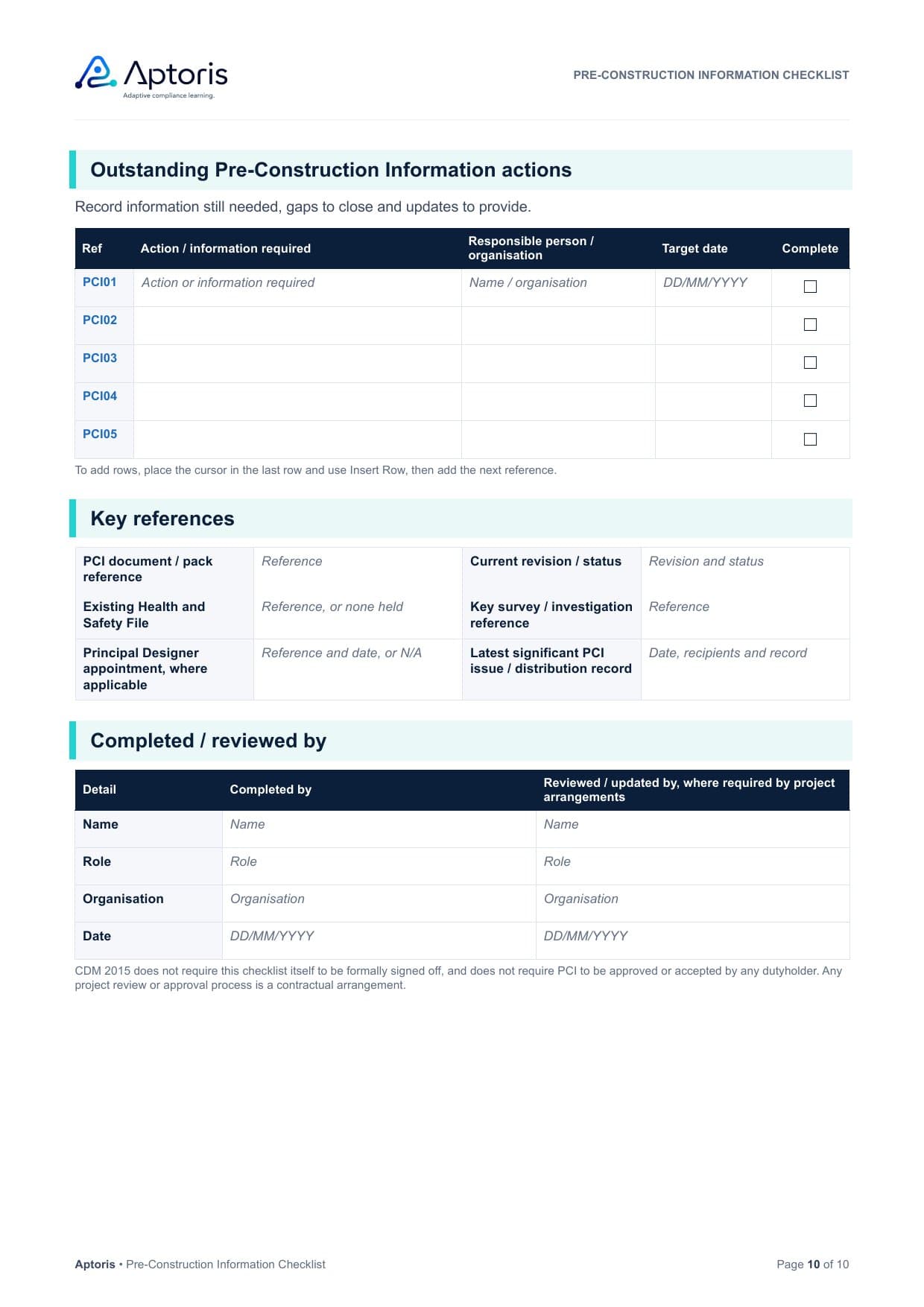
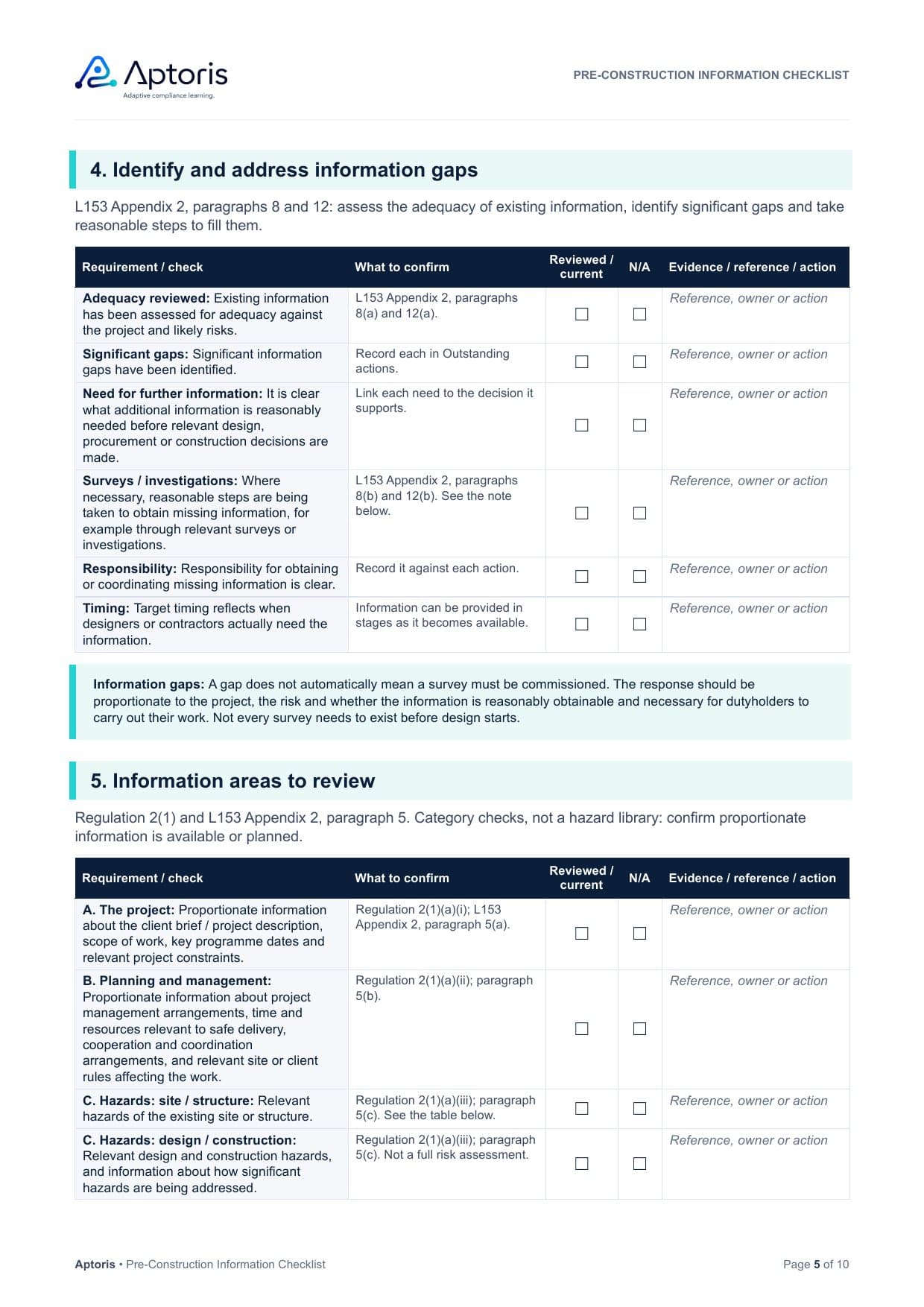
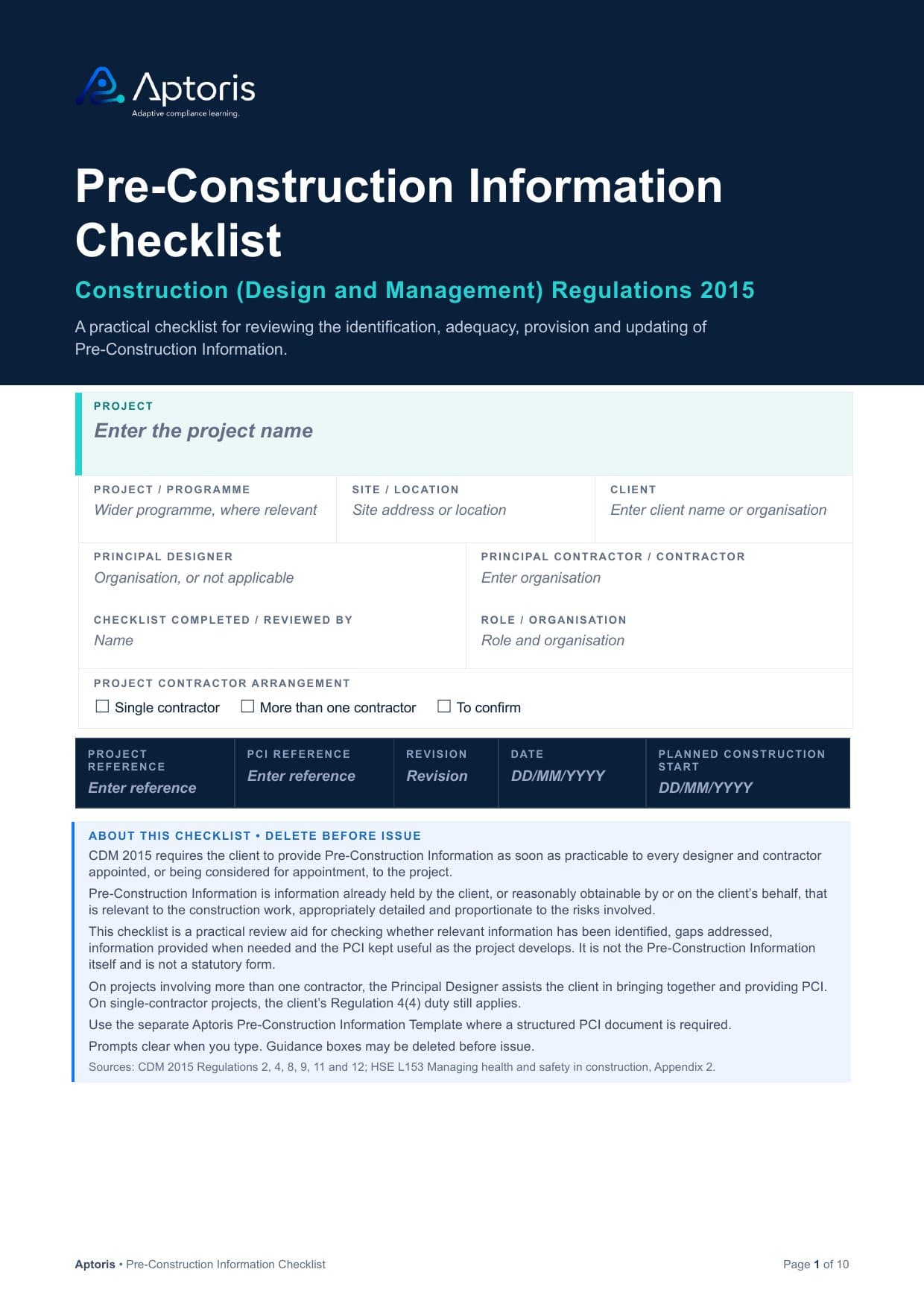
Ten pages: project details, PCI set-up and responsibility notes, ten numbered review sections, a practical final review, outstanding actions, key references and a completed / reviewed record.
These are real pages from the Word checklist. Each check has tick boxes (Done, Reviewed / current or Checked) and N/A, with space for the evidence, reference or action behind it. The blue guidance box can be deleted before issue.
Sections 4 and 5 · Gaps and information areas
Information gaps and areas to review
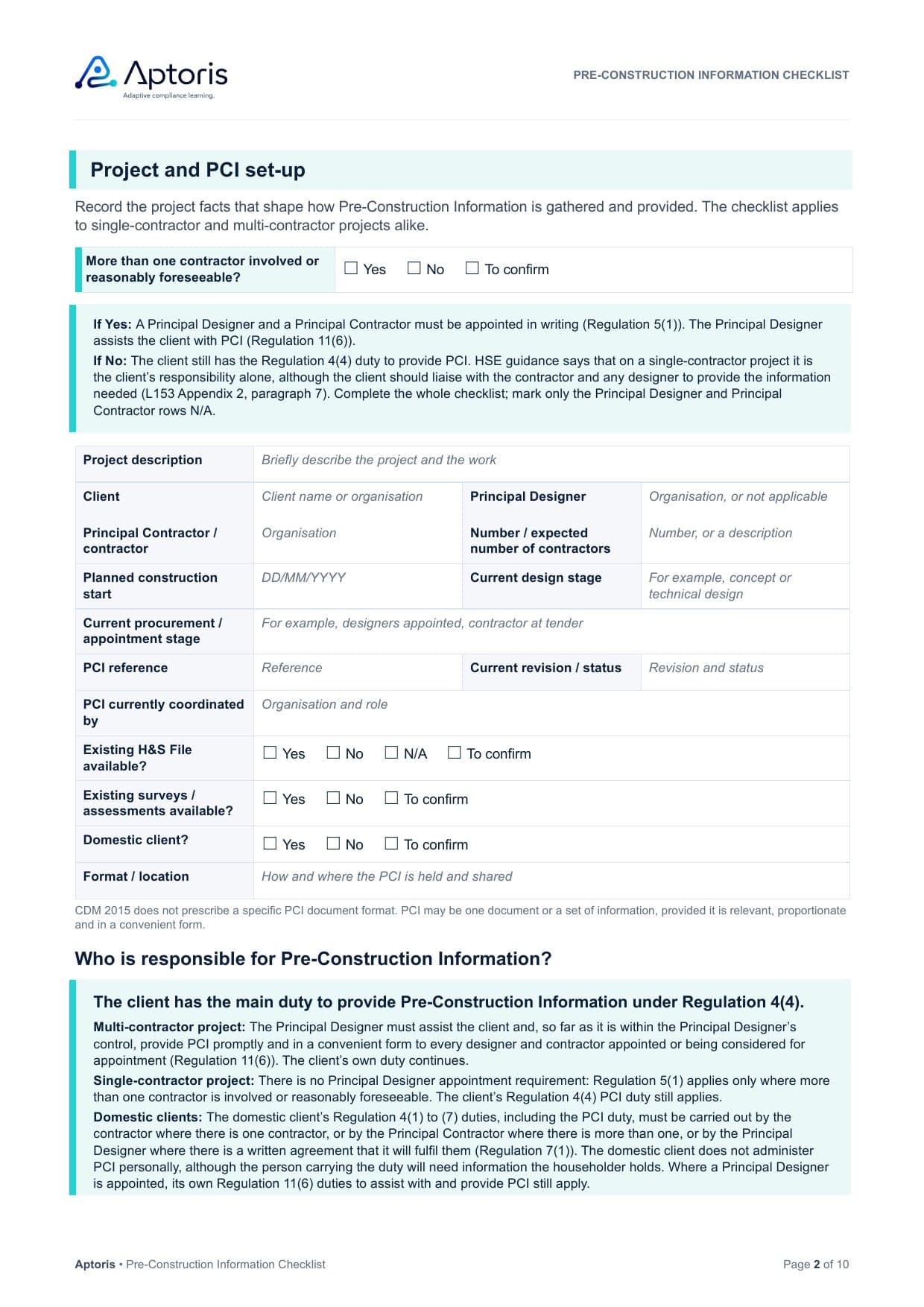
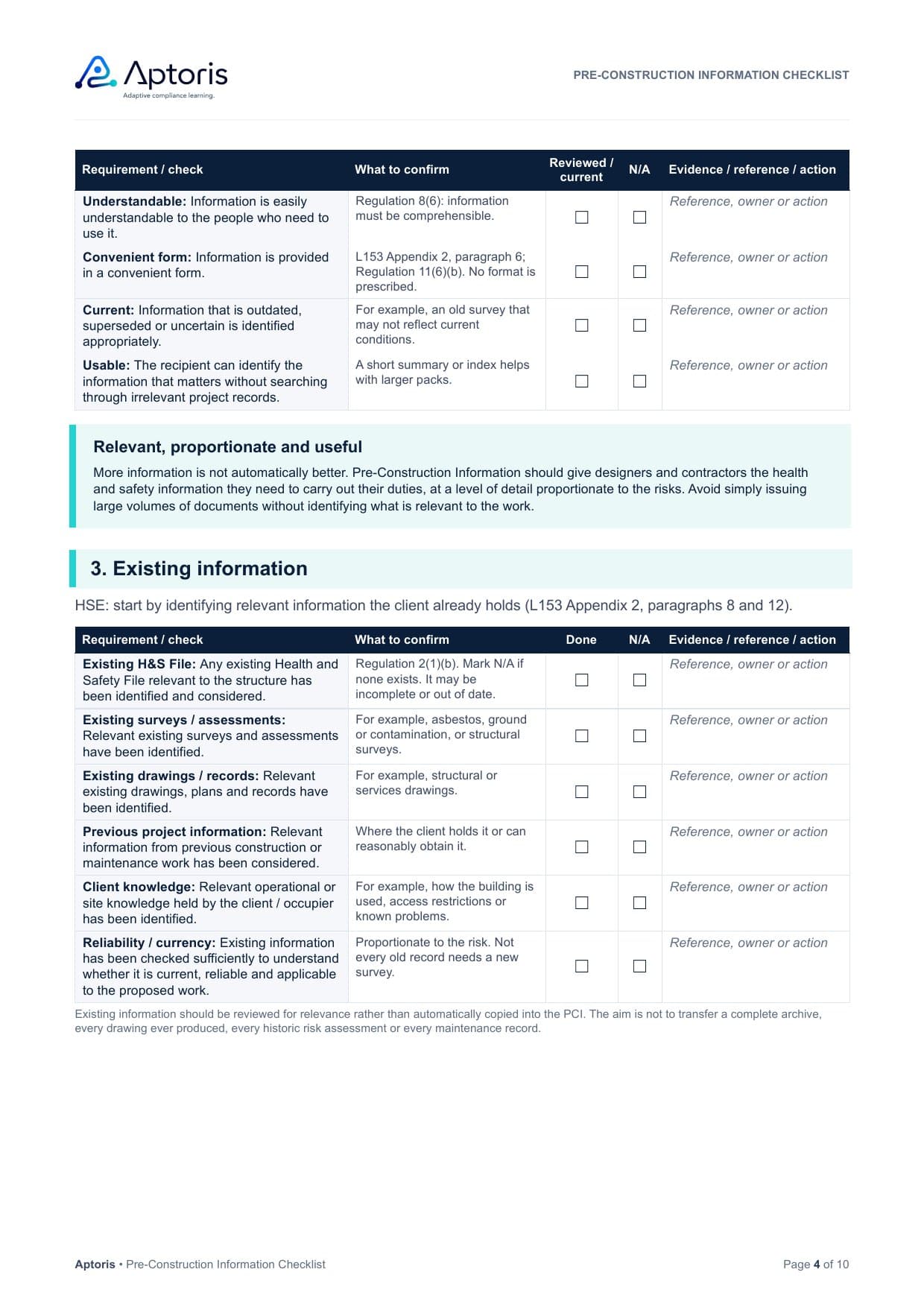
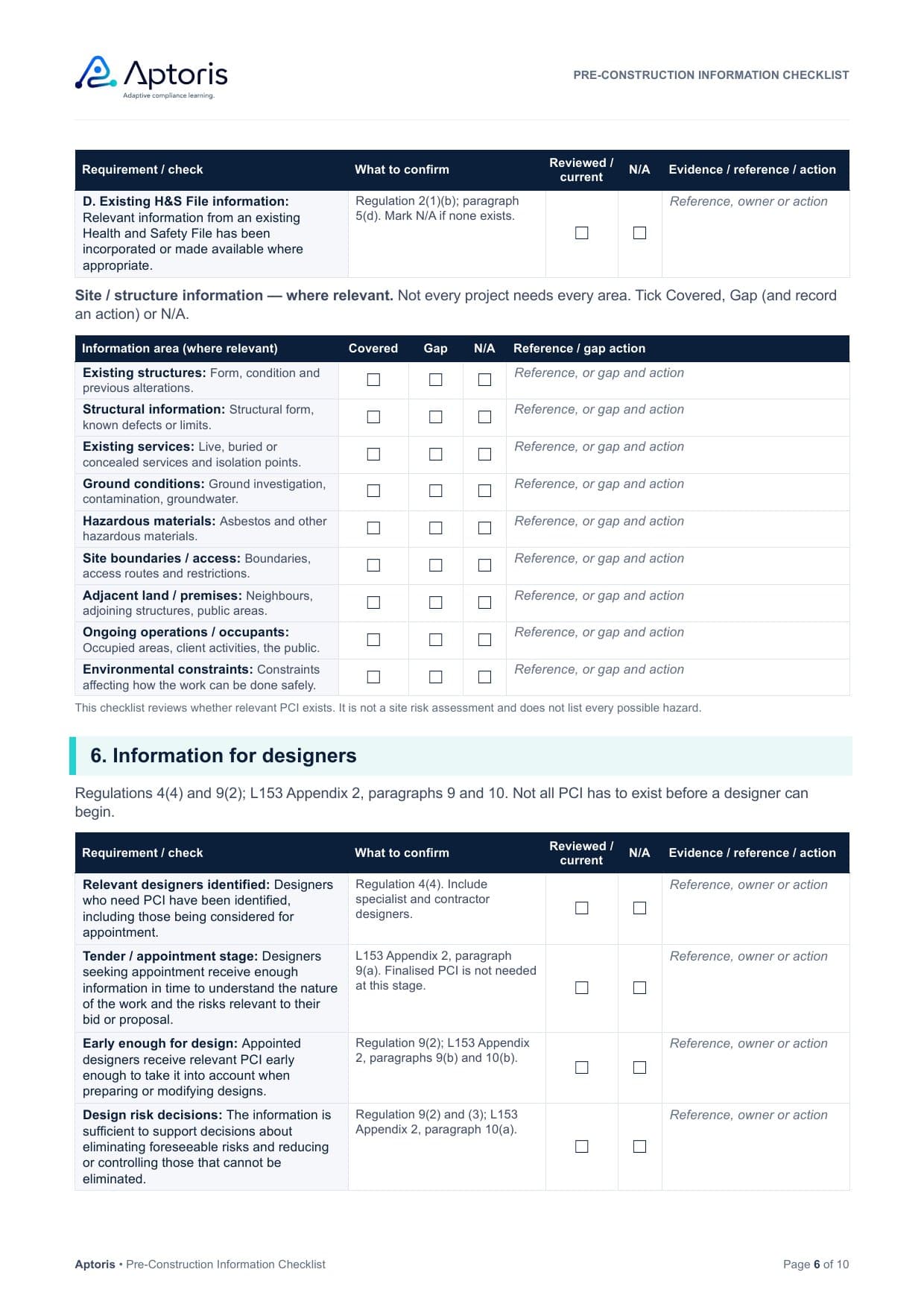
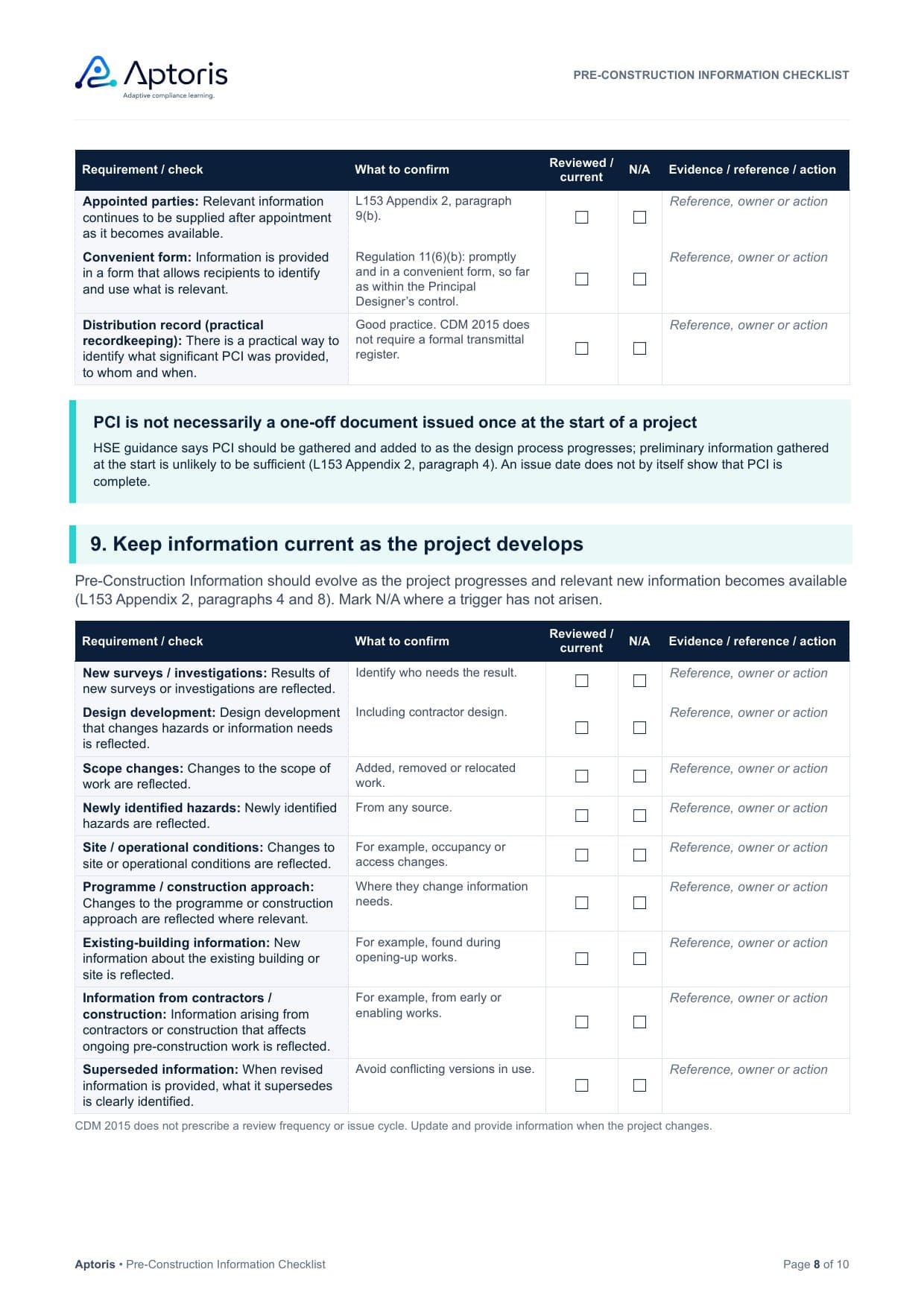
Swipe to see more pages.
Outstanding actions · Key references
Actions, references and record
More information is not automatically better.
PCI should give designers and contractors the health and safety information they need to carry out their duties, at a level of detail proportionate to the risks.
Sources: CDM 2015 regulation 2(1) (opens in a new tab) and regulation 8(6) (opens in a new tab); HSE L153 (opens in a new tab), Appendix 2, paragraphs 3 and 6. No scoring: each item is reviewed and ticked.
HSE guidance says gathering PCI should begin by identifying relevant information the client already holds. Depending on the project, this may include:
Source: HSE L153 (opens in a new tab), Appendix 2, paragraphs 8 and 12.
Existing information should be reviewed for relevance rather than automatically copied into the PCI.
Older information may be incomplete, out of date or not applicable to the proposed work. Check it in proportion to the risk; not every historic record needs a new survey.
The checklist helps the client, and the Principal Designer where appointed, to:
Source: HSE L153 (opens in a new tab), Appendix 2, paragraphs 8 and 12: the client, in liaison with the Principal Designer where there is one, takes reasonable steps to obtain the information needed, for example by commissioning relevant surveys.
A gap does not automatically mean a survey must be commissioned.
The response should be proportionate to the project, the risk and whether the information is reasonably obtainable and necessary for dutyholders to carry out their work.
Depending on the project, PCI should include proportionate information in four categories, where relevant:
Sources: CDM 2015 regulation 2(1) (opens in a new tab); HSE L153 (opens in a new tab), Appendix 2, paragraph 5.
The checklist’s compact site and structure table marks each area Covered, Gap or N/A, where relevant:
Not every project needs every category. This is not a site risk assessment or exhaustive hazard list.
Designers must take account of PCI when preparing or modifying designs (regulation 9(2) (opens in a new tab)). The checklist reviews whether:
Not all PCI has to exist before a designer can begin. HSE recognises it may not be possible to provide the information all at once; it should then be provided as soon as it becomes available (L153 (opens in a new tab), Appendix 2, paragraph 9(b)).
PCI goes to every contractor appointed or being considered for appointment (regulation 4(4) (opens in a new tab)). The checklist reviews whether:
PCI is not the Construction Phase Plan. On multi-contractor projects, the Principal Designer passes relevant PCI to the Principal Contractor for the plan (regulation 12(3)(a) (opens in a new tab)); HSE L153 (opens in a new tab), Appendix 2, paragraph 9.
CDM 2015 does not create a standalone duty for contractors or the Principal Contractor to prepare or approve Pre-Construction Information.
They need relevant PCI to discharge their own duties and must cooperate and liaise appropriately with the other duty holders.
Source: HSE L153 (opens in a new tab), Appendix 2, paragraphs 14 and 15: the Principal Contractor liaises with the Principal Designer and shares relevant information; on multi-contractor projects, contractors cooperate to ensure the PCI is right.
PCI is provided as soon as practicable (regulation 4(4) (opens in a new tab)), and the client, with the Principal Designer where there is one, takes account of when each recipient needs it. The checklist reviews whether information reaches:
CDM 2015 does not require a formal PCI transmittal register.
Pre-Construction Information is not necessarily a document issued once at the start of the project.
HSE guidance recognises that information should be gathered and added to as design and planning progress. A single issue date does not demonstrate that PCI is complete.
Source: HSE L153 (opens in a new tab), Appendix 2, paragraphs 4 and 8.
The checklist prompts a review when something changes, including:
CDM 2015 does not prescribe a universal review frequency or issue cycle.
Designers use relevant PCI when applying the general principles of prevention and managing foreseeable design risks.
PCI provides a basis for preparing the Construction Phase Plan but is not the plan itself.
Some PCI may also be relevant to the Health and Safety File, but the two have different purposes.
A Design Risk Register can record design-risk decisions but does not replace PCI and is not itself a prescribed CDM requirement.
Sources: CDM 2015 regulation 9(2) (opens in a new tab); HSE L153 (opens in a new tab), Appendix 2, paragraph 2.
No.
CDM 2015 does not prescribe a specific PCI document format. The information may be brought together in one document or provided through an organised set of information, provided it is relevant, proportionate and usable.
Use the Pre-Construction Information TemplateThe template is an optional structured format, not a requirement.
CDM 2015 does not create a universal requirement for PCI to be formally approved or accepted by the client, Principal Designer, Principal Contractor or another duty holder.
Projects may use review or approval processes for contractual or management reasons.
The checklist’s completed / reviewed record is not a sign-off. Source: CDM 2015 regulation 4(4) (opens in a new tab) and regulation 11(6) (opens in a new tab).
Identify who carries the client PCI duty and whether the project is single- or multi-contractor.
Check relevance, proportionality, existing information, gaps and the project-specific content needed.
Review whether designers and contractors receive the information they need at the stage when they need it.
Record new information, superseded information and outstanding actions as the project develops.
Anyone gathering, providing or reviewing Pre-Construction Information can use it.
Review the information you hold, can obtain and provide.
Review the PCI you help the client bring together and provide.
Help duty holders review the PCI and record the gaps.
Support the client in gathering and issuing information.
Check designers receive the information they need in time.
Liaise with the client on the information you need.
Check the PCI you need for planning and the Construction Phase Plan.
Review PCI before appointing or starting work.
They can help gather and review the information, but using an adviser or coordinator does not transfer statutory duties.
Yes. It is free to download, with no sign-up and no email address needed. Select Download the Word checklist and the file downloads straight away.
A Microsoft Word document (.docx) of 10 A4 pages, with no macros. It has project details on the first page, a set-up page with responsibility notes, ten numbered review sections, a practical final review, an outstanding actions table, key references and a completed / reviewed record. Each prompt is a Word content control, and each check has tick boxes with space for the evidence, reference or action. The document is not locked, so it can be adapted, printed, or saved as a PDF once completed.
Information already held by the client, or reasonably obtainable by or on the client’s behalf, that is relevant to the construction work, appropriately detailed and proportionate to the risks. It covers the project, its planning and management, health and safety hazards and how they will be addressed, and relevant information in any existing Health and Safety File (regulation 2(1) (opens in a new tab)).
The client has the main duty (regulation 4(4) (opens in a new tab)). On multi-contractor projects, the Principal Designer assists the client and, so far as within its control, provides PCI promptly and in a convenient form (regulation 11(6) (opens in a new tab)); the client’s own duty continues. For a domestic client, the duty is carried out by the contractor, the Principal Contractor or, by written agreement, the Principal Designer (regulation 7(1) (opens in a new tab)).
Yes. The client’s Regulation 4(4) duty applies on single-contractor projects too. There is no Principal Designer appointment requirement where there is only one contractor, so the client should liaise with the contractor and any designer to provide the information they need (L153 (opens in a new tab), Appendix 2, paragraph 7).
Proportionate information about the project, the planning and management of the project, relevant health and safety hazards and how significant hazards are being addressed, and relevant information from any existing Health and Safety File. What is relevant depends on the project; not every project needs every category.
No. Designers should receive relevant information early enough to take it into account, but HSE recognises it may not be possible to provide it all at once; it should then be provided as soon as it becomes available (L153 (opens in a new tab), Appendix 2, paragraph 9(b)).
No. CDM 2015 does not prescribe a specific format. The information can be one document or an organised set of information, provided it is relevant, proportionate and usable.
CDM 2015 does not create a universal requirement for PCI to be formally approved or accepted by the client, Principal Designer, Principal Contractor or another duty holder. Projects may use review or approval processes for contractual or management reasons.
Assess whether the gap is significant and what additional information is reasonably needed, then take reasonable steps to obtain it where necessary, for example through a relevant survey or investigation (L153 (opens in a new tab), Appendix 2, paragraph 8). A gap does not automatically mean a survey must be commissioned: the response should be proportionate. Record who is obtaining it and when it is needed.
Designers seeking appointment need enough information to understand the work. Appointed designers need relevant PCI early enough to take it into account when preparing or modifying designs, with updates as they become available (regulation 9(2) (opens in a new tab); L153 (opens in a new tab), Appendix 2, paragraphs 9 and 10).
Contractors being considered for appointment need sufficient information in time to understand the nature of the work. Appointed contractors need the information to plan, manage and monitor their work (L153 (opens in a new tab), Appendix 2, paragraph 9).
No. PCI provides a basis for preparing the Construction Phase Plan, which sets out the health and safety arrangements for the construction phase. On multi-contractor projects, the Principal Designer passes relevant PCI to the Principal Contractor for the plan (regulation 12(3) (opens in a new tab)).
Yes. PCI should be gathered and added to as the design and planning progress; preliminary information gathered at the start is unlikely to be sufficient (L153 (opens in a new tab), Appendix 2, paragraph 4). CDM 2015 does not set a fixed review frequency, so update and provide information when the project changes.
The domestic client’s Regulation 4 duties, including the PCI duty, are carried out by the contractor where there is one contractor, or by the Principal Contractor where there is more than one, or by the Principal Designer where there is a written agreement that it will fulfil them (regulation 7(1) (opens in a new tab)). The householder does not administer PCI personally.
The template and guide for the information itself, and checklists and templates for the duty holders and documents it connects to.
An editable Word template for preparing a structured PCI document.
What PCI is, who provides it, when it is needed and what it should contain.
Review the client duties, including providing Pre-Construction Information.
Review the Principal Designer’s duties, including assisting the client with PCI.
An editable Word template for the plan that relevant PCI helps to inform.
Review the file that holds information for future construction work.
Download the editable Word checklist and record the gaps, recipients, timing and outstanding actions that apply to your project.
Editable .docx, 10 pages, No sign-up required