Template
Construction Phase Plan Template
An editable Word template for preparing a project-specific Construction Phase Plan.

Free Word checklist
A practical, editable Word checklist for reviewing whether a Construction Phase Plan is project-specific, proportionate, communicated and kept up to date under CDM 2015.
Editable .docx, 12 pages, No sign-up required
A Construction Phase Plan is required for every construction project to which CDM 2015 applies.
Required under Regulations 4, 12 and 15, for the client, the Principal Contractor and the contractor on a single-contractor project.
A separate Regulation 6 requirement to notify HSE of projects above the thresholds. It does not decide whether a plan is needed.
Sources: CDM 2015 regulation 4(5)(a) (opens in a new tab), regulation 6 (opens in a new tab), regulation 12(1) (opens in a new tab) and regulation 15(5) (opens in a new tab). The Construction Phase Plan guide explains when a plan is required.
The Principal Contractor must draw up the plan, or make arrangements for it to be drawn up, during the pre-construction phase and before setting up the construction site.
Regulation 12(1)
The contractor must draw up the plan, or make arrangements for it to be drawn up, as soon as is practicable before setting up the construction site.
Regulation 15(5)
The client must ensure that a Construction Phase Plan has been drawn up before the construction phase begins.
Regulation 4(5)(a)
On a multi-contractor project, the Principal Designer assists the Principal Contractor by providing relevant information. The Principal Designer does not prepare or approve the CPP.
Sources: CDM 2015 regulation 4(5)(a) (opens in a new tab), regulation 12(1) and (3) (opens in a new tab) and regulation 15(5) (opens in a new tab).
CDM 2015 sets three separate timing provisions, one for each duty holder.
Before the construction phase begins.
Regulation 4(5)(a)
During the pre-construction phase and before setting up the construction site.
Regulation 12(1)
As soon as is practicable before setting up the construction site.
Regulation 15(5)
Sources: CDM 2015 regulation 4(5)(a) (opens in a new tab), regulation 12(1) (opens in a new tab) and regulation 15(5) (opens in a new tab).
CDM 2015 does not prescribe a formal client approval certificate or CPP sign-off.
The client must ensure the CPP is drawn up before the construction phase begins. On a multi-contractor project, the client must also take reasonable steps to ensure the Principal Contractor complies with Regulations 12 to 14.
HSE guidance says the client must ensure that the plan adequately addresses the arrangements for managing the risks and that the Principal Contractor — or contractor on a single-contractor project — regularly reviews and revises it so it remains fit for purpose.
A project may still use internal or contractual review / approval arrangements.
Sources: CDM 2015 regulation 4(5)(a) and 4(6) (opens in a new tab); HSE L153 (opens in a new tab), Appendix 3, paragraph 8. The checklist’s completed / reviewed record is not a sign-off.
Regulation 7 transfers the domestic client’s duties to another duty holder:
The contractor carries out the relevant client duties.
The Principal Contractor carries them out.
The Principal Designer may agree in writing to fulfil them.
This does not remove the contractor’s or Principal Contractor’s own CPP responsibilities under Regulations 15 or 12. The householder is not expected to approve the plan.
Source: CDM 2015 regulation 7(1) (opens in a new tab). See does CDM apply to domestic projects?
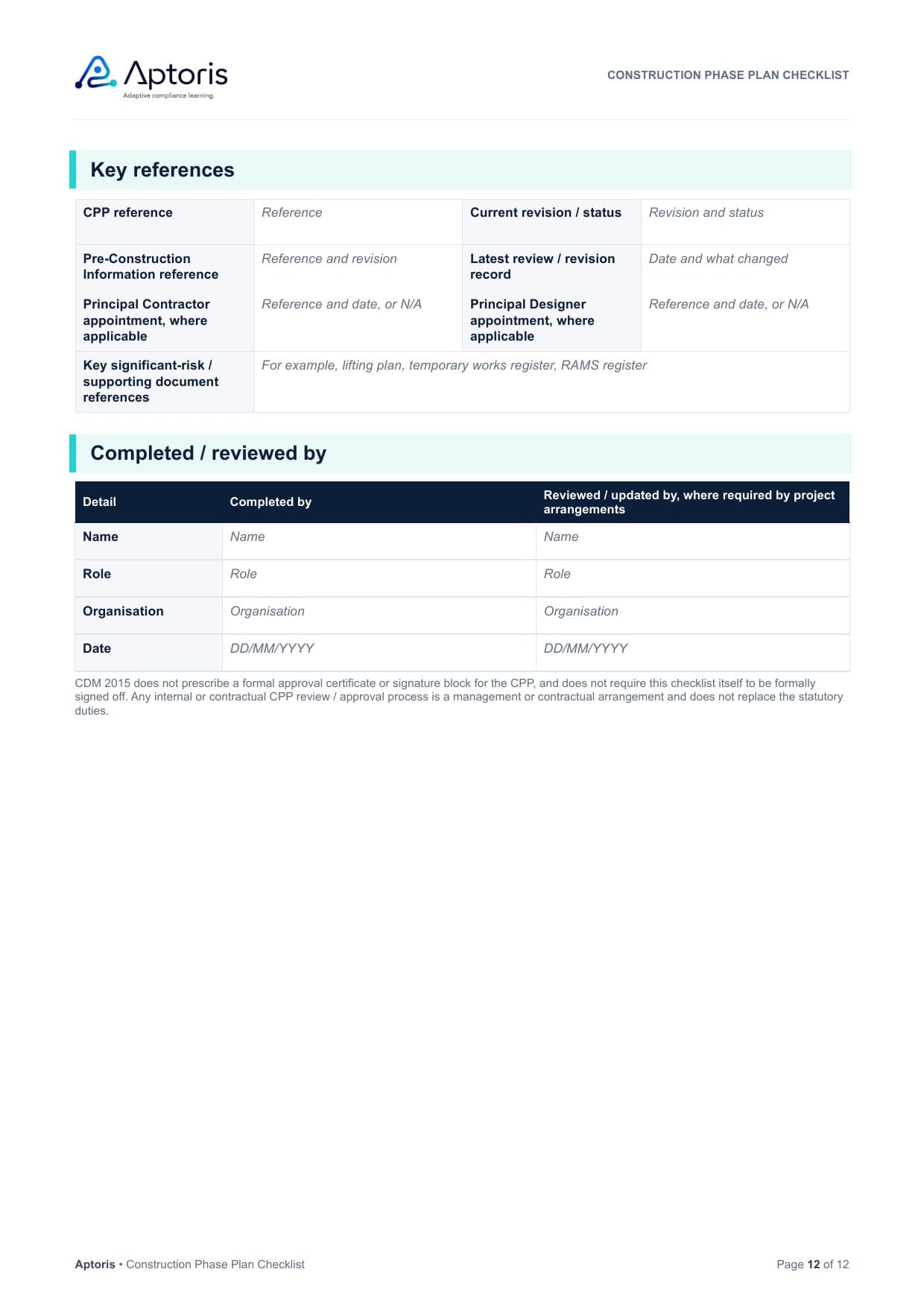
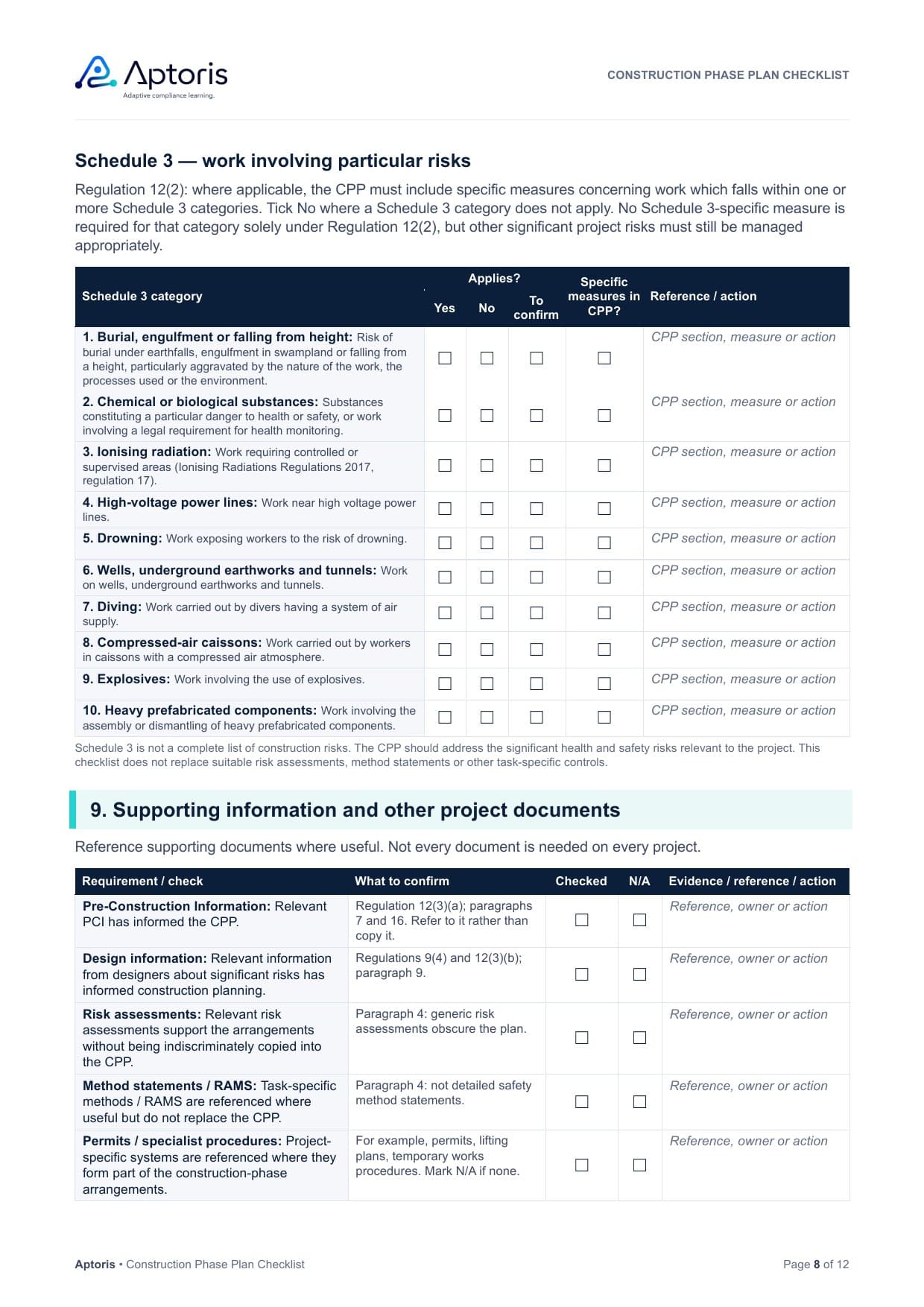
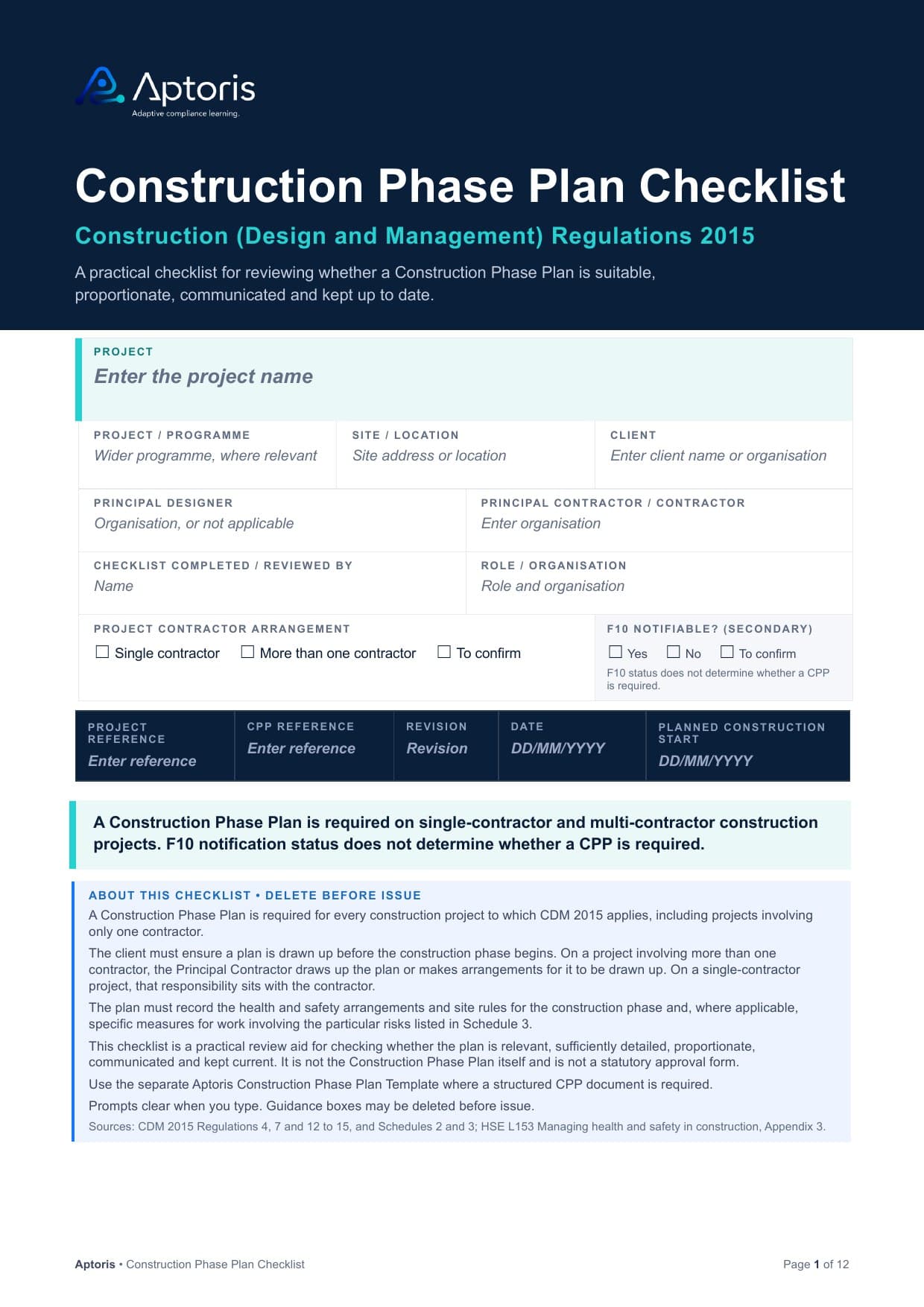
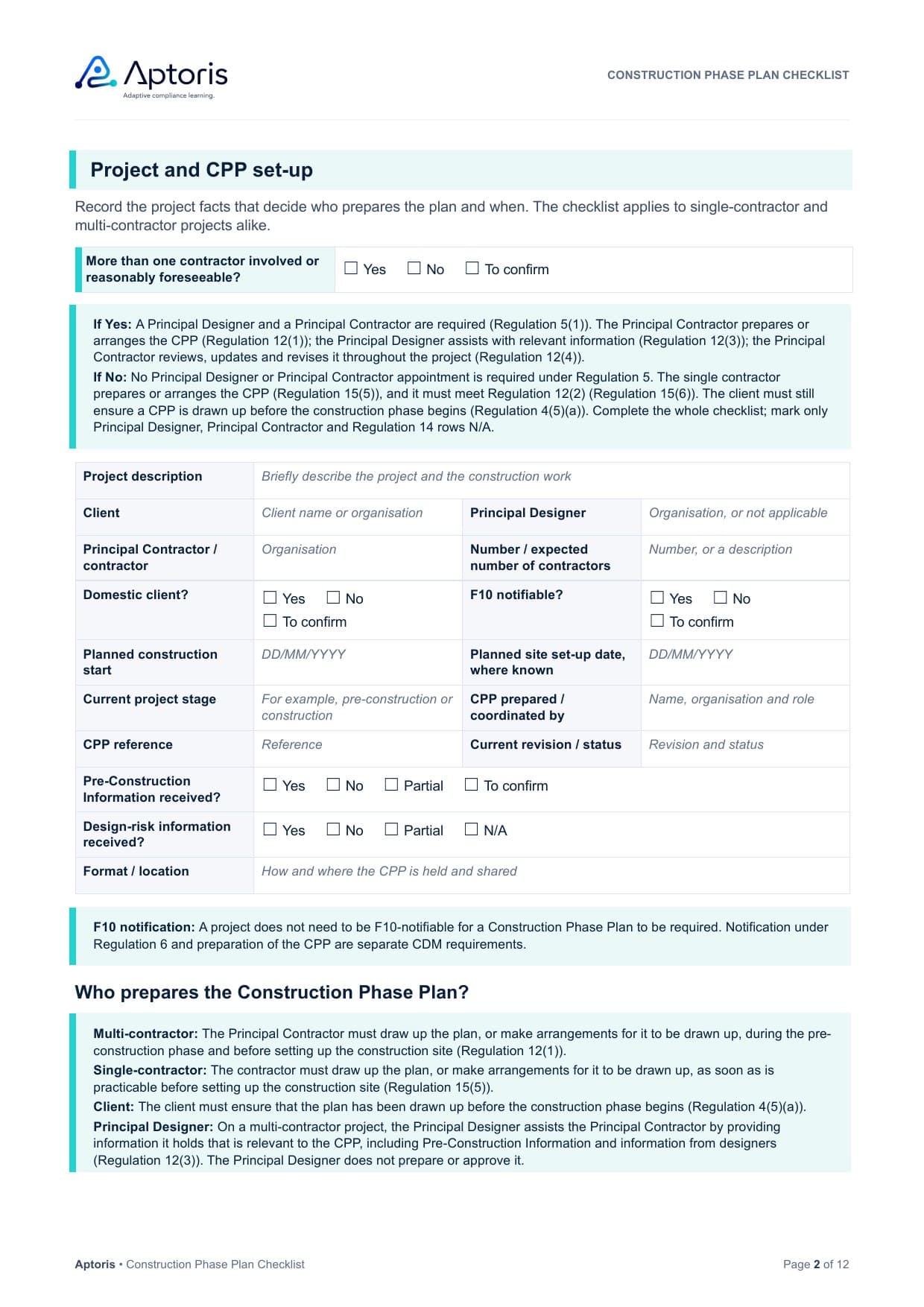
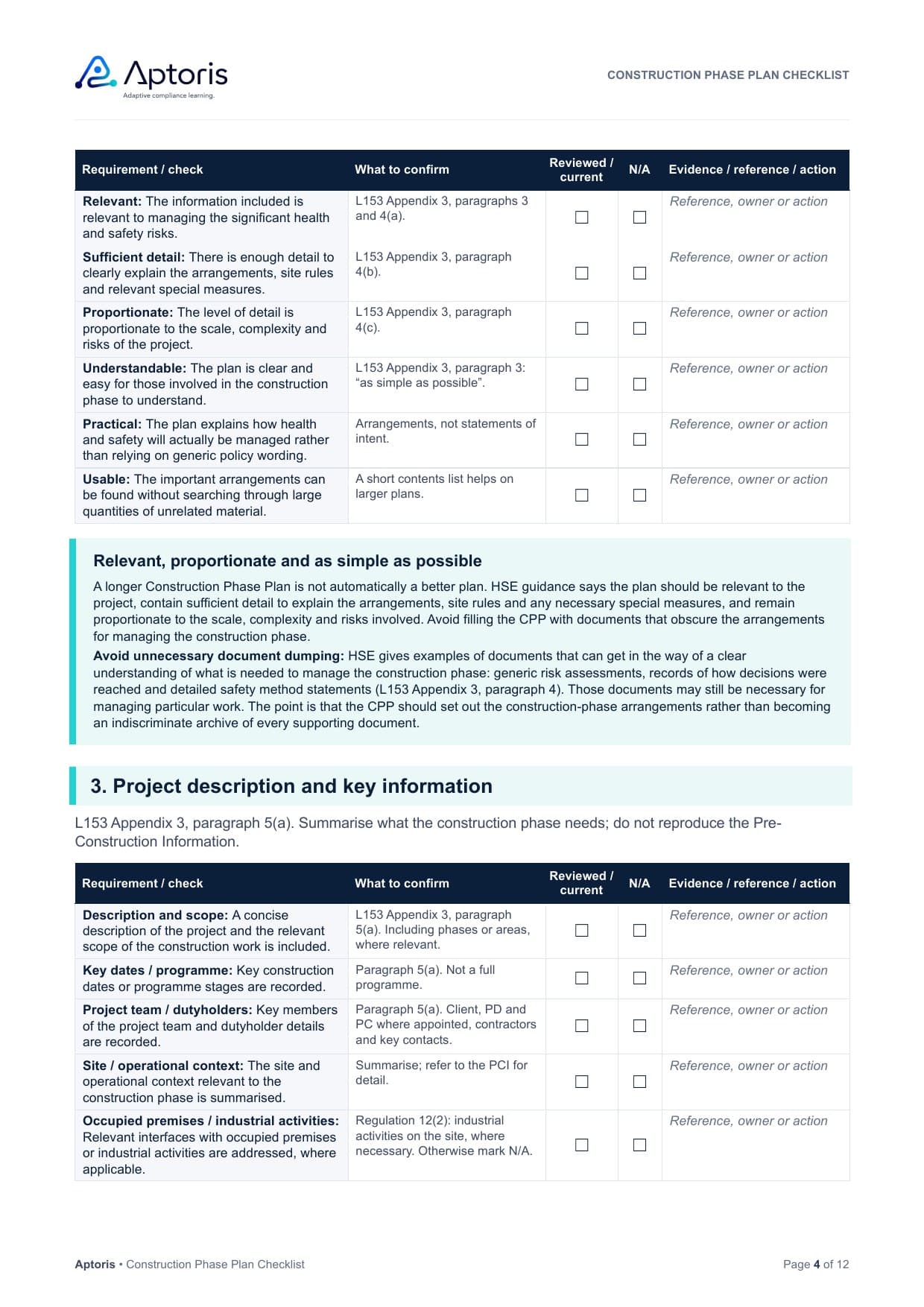
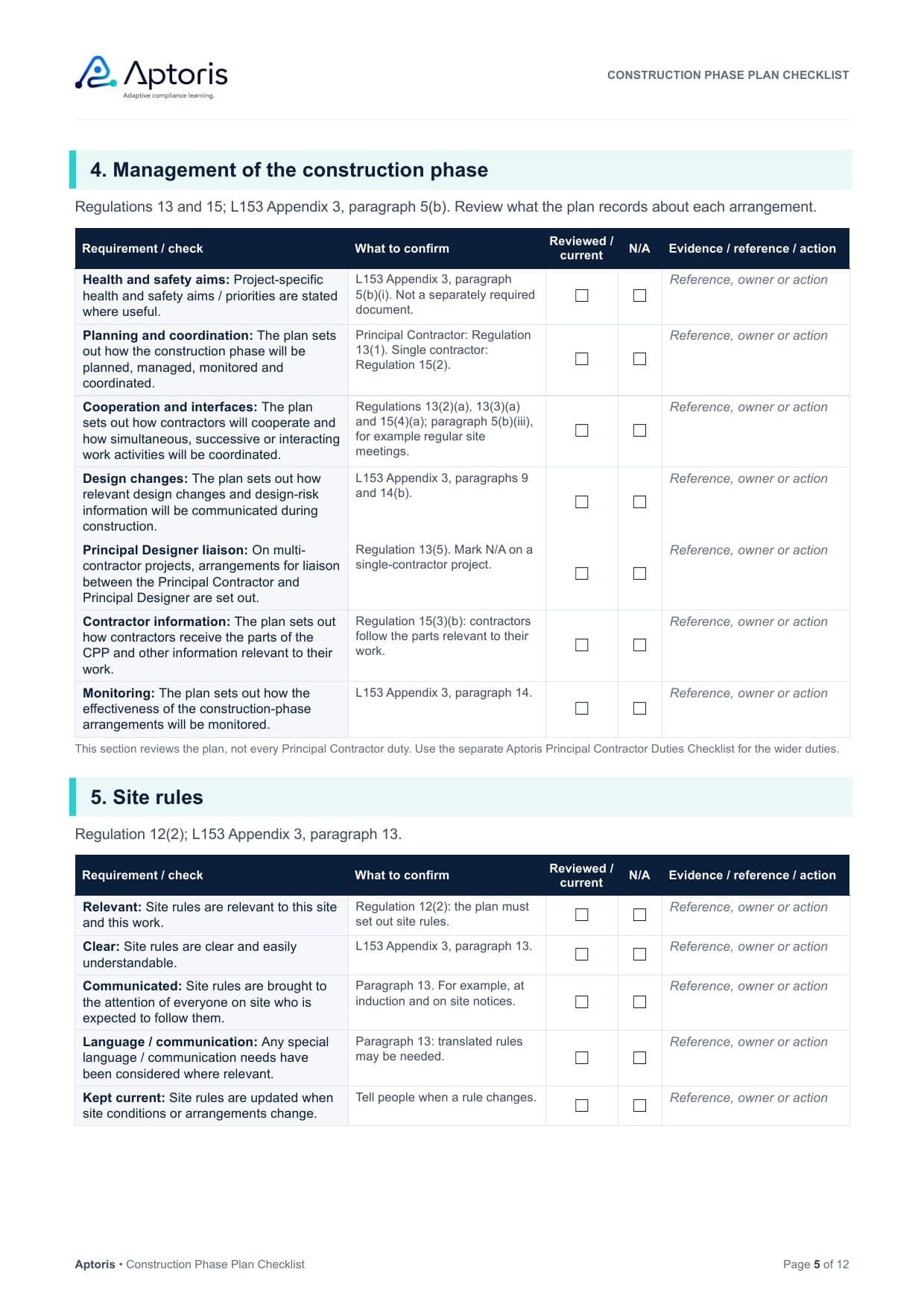
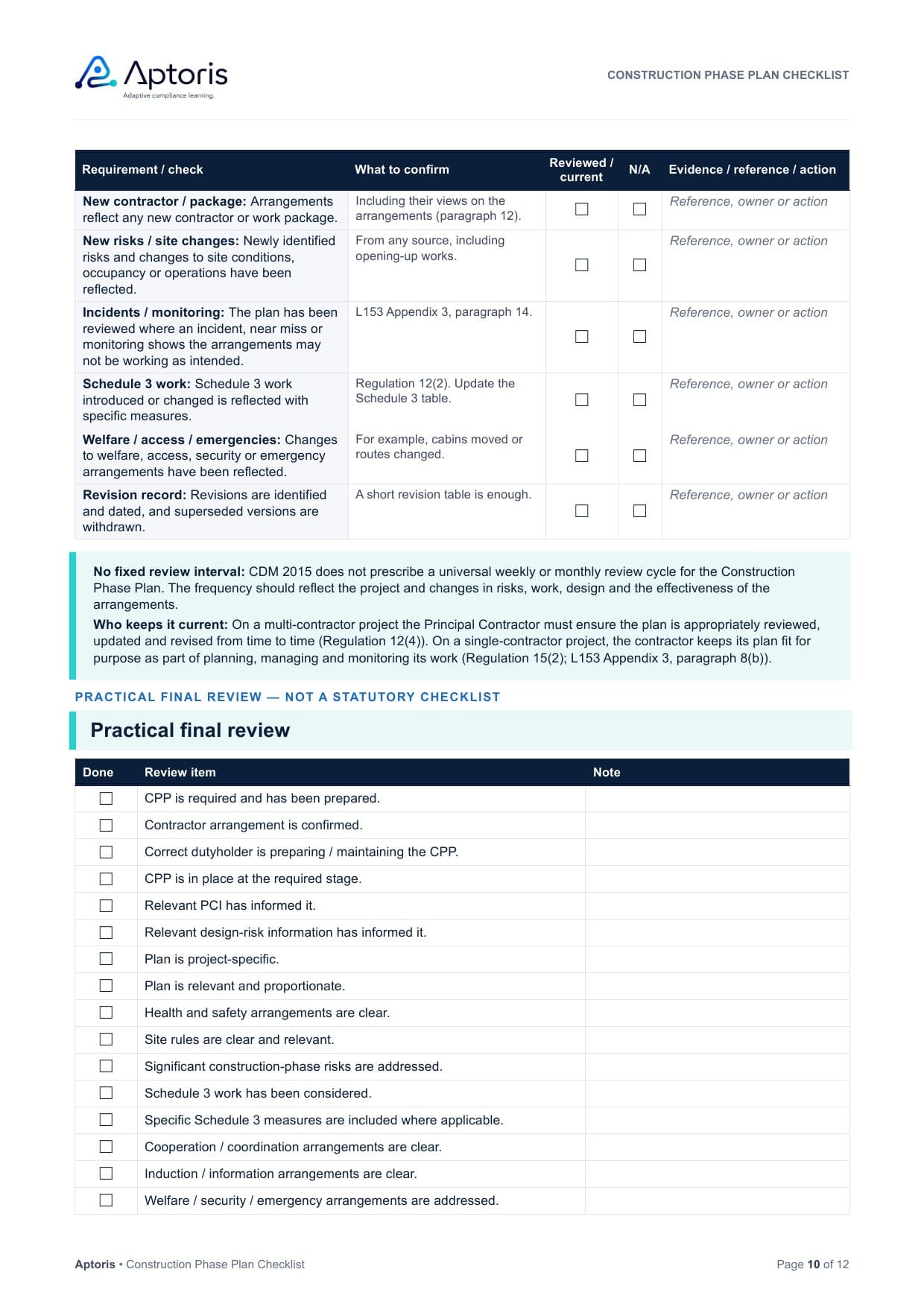
Twelve pages: project details, CPP set-up, eleven numbered review sections with a Schedule 3 table, a practical final review, outstanding actions, key references and a completed / reviewed record.
These are real pages from the Word checklist. Each check has tick boxes (Done, Reviewed / current or Checked) and N/A, with space for the evidence, reference or action behind it. The blue guidance box can be deleted before issue.
Schedule 3 · Particular risks
Schedule 3 particular risks
Swipe to see more pages.
Key references · Completed record
Key references and record
HSE guidance says the plan is the basis for communicating the construction-phase arrangements to everyone involved, so it should be easy to understand. The checklist reviews whether the plan is:
Source: HSE L153 (opens in a new tab), Appendix 3, paragraphs 3 and 4. No scoring: each item is reviewed and ticked.
A longer Construction Phase Plan is not automatically a better plan.
HSE guidance says the plan should:
HSE guidance specifically warns against including material that gets in the way of a clear understanding of what is needed to manage the construction phase. Its examples are:
Source: HSE L153 (opens in a new tab), Appendix 3, paragraph 4.
Risk assessments, method statements and RAMS may still be necessary for particular work. They can support the CPP without being indiscriminately copied into it.
Proportionate to the project, the checklist reviews what the plan records in four areas:
Sources: CDM 2015 regulation 12(2) (opens in a new tab); HSE L153 (opens in a new tab), Appendix 3, paragraph 5. Not a hazard library: what is relevant depends on the project.
Regulation 12(2) requires the CPP to set out the site rules. Depending on the site, examples may include:
These are examples, not mandatory rules for every site.
Rules should be clear, brought to everyone’s attention and kept current; where relevant, consider communication and language needs, for example translated site rules. Sources: CDM 2015 regulation 12(2) (opens in a new tab); HSE L153 (opens in a new tab), Appendix 3, paragraph 13.
The checklist reviews whether the plan sets out how workers receive:
On a multi-contractor project, it also reviews worker cooperation, consultation and access to relevant information under Regulation 14, a Principal Contractor duty.
Sources: CDM 2015 regulation 13(4) (opens in a new tab), regulation 14 (opens in a new tab) and regulation 15(8) and (9) (opens in a new tab).
The checklist reviews whether the plan reflects appropriate arrangements for:
It is not an emergency plan template or a site-security guide. Sources: CDM 2015 regulation 13(4) (opens in a new tab), regulation 15(9) to (11) (opens in a new tab) and Schedule 2 (opens in a new tab).
The CPP should record the management arrangements for the significant health and safety risks associated with the construction phase.
This does not mean inserting a generic hazard library or full risk assessment into the plan.
The checklist reviews:
Source: HSE L153 (opens in a new tab), Appendix 3, paragraphs 3 and 5.
Where applicable, Regulation 12(2) requires the CPP to include specific measures concerning work falling within one or more Schedule 3 categories:
If a Schedule 3 category does not apply, no Schedule 3-specific measure is required for that category solely under Regulation 12(2). Other significant project risks must still be managed appropriately.
Schedule 3 is not a complete list of construction risks.
Sources: CDM 2015 regulation 12(2) (opens in a new tab) and Schedule 3 (opens in a new tab). Summarised; see the Schedule for the full wording.
No.
The Construction Phase Plan explains how health and safety will be managed across the construction phase.
Risk assessments and method statements address particular hazards, tasks or methods of work.
They can support each other, but one does not replace the other.
Source: HSE L153 (opens in a new tab), Appendix 3, paragraph 4.
Relevant Pre-Construction Information should inform preparation of the Construction Phase Plan.
On a multi-contractor project, the Principal Designer assists the Principal Contractor by providing relevant information it holds.
PCI is not the Construction Phase Plan.
Sources: CDM 2015 regulation 12(3) (opens in a new tab); HSE L153 (opens in a new tab), Appendix 3, paragraphs 7 and 12.
The checklist reviews whether:
Sources: CDM 2015 regulation 13(3) (opens in a new tab) and regulation 15(3) (opens in a new tab); HSE L153 (opens in a new tab), Appendix 3, paragraphs 13 and 14.
Completing this checklist is not evidence by itself that site conditions or controls are compliant in practice.
On a multi-contractor project, the Principal Contractor must ensure the CPP is appropriately reviewed, updated and revised from time to time.
On a single-contractor project, the contractor should keep the plan fit for purpose as part of planning, managing and monitoring its work.
Sources: CDM 2015 regulation 12(4) (opens in a new tab) and regulation 15(2) (opens in a new tab); HSE L153 (opens in a new tab), Appendix 3, paragraphs 8(b) and 14.
The checklist prompts a review when something changes, including:
CDM 2015 does not prescribe a universal review cycle for the Construction Phase Plan.
Review frequency should reflect the project and changes in risks, work, design and the effectiveness of the arrangements.
Identify whether the project is single- or multi-contractor and confirm the responsible contractor / Principal Contractor.
Check that the CPP is project-specific, proportionate and clearly records the construction-phase arrangements and site rules.
Review significant risks, Schedule 3 where applicable, supporting information and how the arrangements are communicated.
Record changes, outstanding actions and revisions as the project develops.
Anyone preparing, reviewing or relying on a Construction Phase Plan can use it.
Check a plan is drawn up before the construction phase begins.
Review the plan you draw up, maintain and revise.
Review the plan for your own work.
Check the information you provide has informed the plan.
Help duty holders review the plan and record actions.
Support the plan’s preparation and updates.
Check the plan reflects how the site actually runs.
Review arrangements, site rules and significant risks.
Record a consistent, evidence-based review.
They can help review the plan, but using an adviser or reviewer does not transfer statutory duties.
Yes. It is free to download, with no sign-up and no email address needed. Select Download the Word checklist and the file downloads straight away.
A Microsoft Word document (.docx) of 12 A4 pages, with no macros. It has project details on the first page, a set-up page, eleven numbered review sections including a Schedule 3 table, a practical final review, an outstanding actions table, key references and a completed / reviewed record. Each prompt is a Word content control, and each check has tick boxes with space for the evidence, reference or action. The document is not locked, so it can be adapted, printed, or saved as a PDF once completed.
Yes. A Construction Phase Plan is required for every construction project to which CDM 2015 applies, including single-contractor and multi-contractor projects, whatever its size (regulation 4(5)(a) (opens in a new tab), regulation 12(1) (opens in a new tab) and regulation 15(5) (opens in a new tab)). It should be proportionate to the project.
Yes. On a single-contractor project, the contractor must draw up the plan, or arrange for it to be drawn up, as soon as is practicable before setting up the construction site (regulation 15(5) (opens in a new tab)). No Principal Designer or Principal Contractor appointment is needed where there is only one contractor.
No. F10 notification is a separate Regulation 6 requirement (regulation 6 (opens in a new tab)), and notification status does not determine whether a Construction Phase Plan is required. The F10 Notification Calculator checks the notification thresholds.
On a multi-contractor project, the Principal Contractor draws up the plan or arranges for it to be drawn up (regulation 12(1) (opens in a new tab)). On a single-contractor project, the contractor does (regulation 15(5) (opens in a new tab)). The client must ensure a plan has been drawn up before the construction phase begins (regulation 4(5)(a) (opens in a new tab)). The Principal Designer assists the Principal Contractor by providing relevant information (regulation 12(3) (opens in a new tab)) but does not prepare or approve the plan.
CDM 2015 sets three separate provisions. The client must ensure it is drawn up before the construction phase begins. The Principal Contractor draws it up during the pre-construction phase and before setting up the construction site. A single contractor draws it up as soon as is practicable before setting up the construction site.
CDM 2015 does not prescribe a formal client approval certificate or CPP sign-off. The client must ensure the plan is drawn up before the construction phase begins and, on a multi-contractor project, take reasonable steps to ensure the Principal Contractor complies with Regulations 12 to 14 (regulation 4(6) (opens in a new tab)). HSE guidance says the client should ensure the plan adequately addresses the arrangements for managing the risks and is regularly reviewed and revised (L153 (opens in a new tab), Appendix 3, paragraph 8). Projects may still use internal or contractual review arrangements.
The health and safety arrangements for the construction phase, the site rules (taking account, where necessary, of industrial activities on the site) and, where applicable, specific measures for work in any Schedule 3 category (regulation 12(2) (opens in a new tab)). HSE guidance lists the project description, management arrangements and arrangements for controlling significant site risks (L153 (opens in a new tab), Appendix 3, paragraph 5). What is relevant depends on the project.
The level of detail should match the scale, complexity and risks of the project, while still being relevant and detailed enough to explain the arrangements, site rules and any special measures (L153 (opens in a new tab), Appendix 3, paragraph 4). A longer plan is not automatically a better plan, and a short, straightforward job may only need brief entries.
Not indiscriminately. HSE guidance says the plan should not include documents that get in the way of a clear understanding of the arrangements, such as generic risk assessments, records of how decisions were reached or detailed safety method statements (L153 (opens in a new tab), Appendix 3, paragraph 4). Risk assessments, method statements and RAMS may still be necessary for particular work; they can be referenced where useful and support the plan without being copied into it.
A list of ten categories of work involving particular risks, such as work near high-voltage power lines, work with explosives or work exposing workers to a risk of drowning (Schedule 3 (opens in a new tab)). Where applicable, the plan must include specific measures for that work (regulation 12(2) (opens in a new tab)). Where a category does not apply, no Schedule 3-specific measure is needed for it solely under Regulation 12(2), but other significant risks must still be managed. Schedule 3 is not a complete list of construction risks.
No. The Construction Phase Plan explains how health and safety will be managed across the construction phase. Risk assessments and method statements address particular hazards, tasks or methods of work. They can support each other, but one does not replace the other. See the RAMS Template and the Method Statement Template.
CDM 2015 does not prescribe a fixed weekly, monthly or other review interval. The plan is a working document and should be reviewed regularly enough to address significant changes in the risks, the work, the design or the effectiveness of the controls (L153 (opens in a new tab), Appendix 3, paragraph 14).
On a multi-contractor project, the Principal Contractor must ensure the plan is appropriately reviewed, updated and revised from time to time (regulation 12(4) (opens in a new tab)). On a single-contractor project, the contractor keeps the plan fit for purpose as part of planning, managing and monitoring its work (regulation 15(2) (opens in a new tab); L153 (opens in a new tab), Appendix 3, paragraph 8(b)).
The template for preparing the plan, checklists for the duty holders and information it connects to, and templates for task-specific documents.
An editable Word template for preparing a project-specific Construction Phase Plan.
Review the Principal Contractor’s duties, including the CPP, coordination and welfare.
Review the client duties, including ensuring a CPP is drawn up in time.
An editable Word template for task-specific risk assessments and method statements.
An editable Word template for setting out how a particular task will be done safely.
Download the editable Word checklist and record the arrangements, risks, updates and outstanding actions that apply to your project.
Editable .docx, 12 pages, No sign-up required